Economic Pulse Net | Sources: World Bank World Development Indicators, Government Sources | 2026
🇲🇭 Western Sahara: The Economy of the Unresolved
Key Takeaways
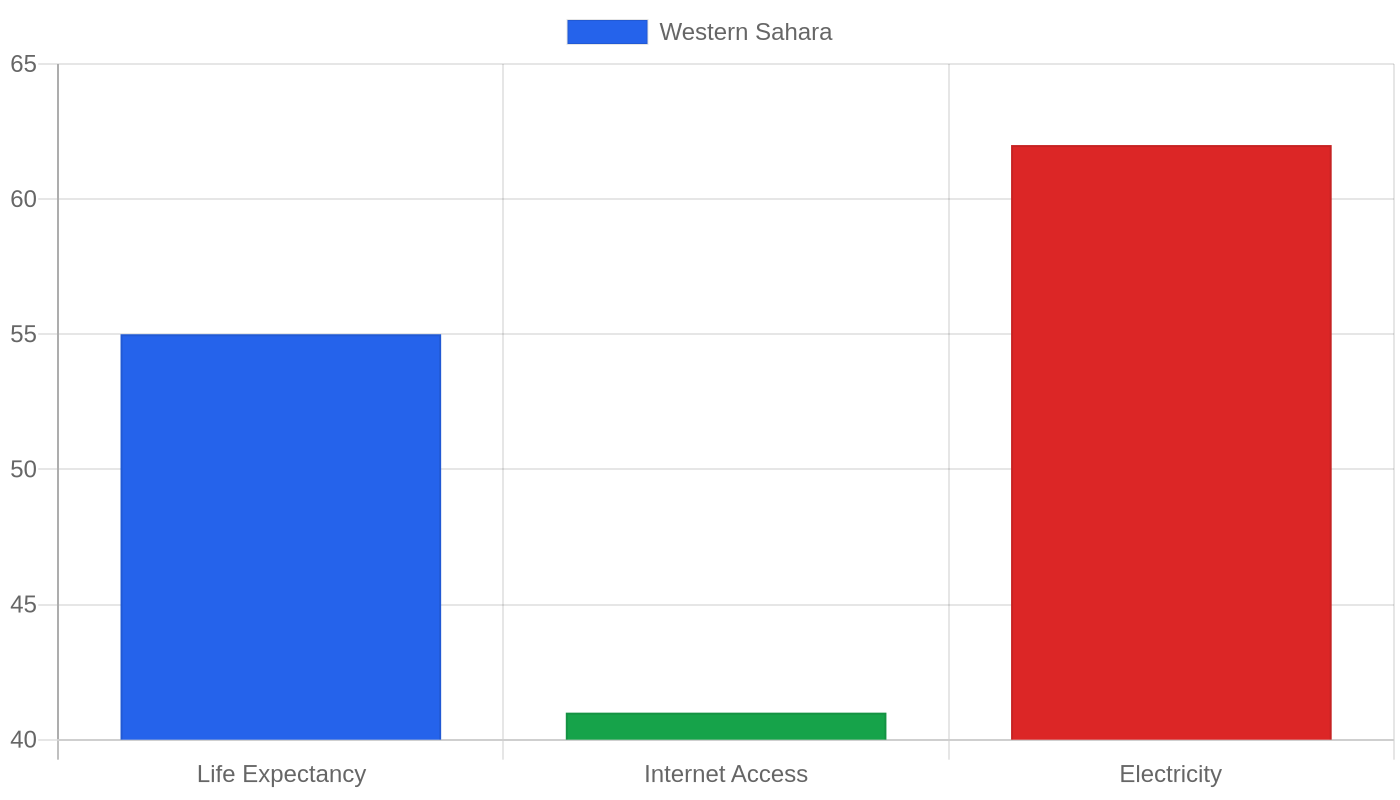
- Statistical Blackout: Western Sahara presents a unique challenge for global economists, as core macroeconomic indicators such as GDP, inflation, and unemployment are currently unavailable from major international data providers like the World Bank.
- Sovereignty Over Statistics: The primary driver of economic opacity is not necessarily a lack of economic activity, but a profound political impasse. The territory’s status remains contested between Morocco and the Polisario Front, preventing the consolidation of unified, internationally recognized economic data.
- UN Designation: The United Nations classifies Western Sahara as a “non-self-governing territory,” a legal designation that underscores the ongoing diplomatic struggle and complicates standard international economic integration.
- Investment Uncertainty: With no clear data on cost of living, safety indices, or major corporate presence, the business climate remains shrouded in ambiguity, deterring most foreign direct investment and limiting market transparency.
- A Narrative of Stasis: In the absence of quantitative growth metrics, the economic story of Western Sahara is defined by its static political landscape, where legal uncertainty takes precedence over commercial development.
The Data Void: Why Numbers Matter Less Than Status
In the realm of global economic analysis, the absence of data is often as telling as the presence of it.
For Western Sahara, the World Bank reports “N/A” for nearly every critical metric, including GDP growth, inflation rates, unemployment figures, and total GDP in USD terms.
This statistical silence is not merely an administrative oversight; it is a direct reflection of the territory’s complex geopolitical position.
Typically, economists rely on these baseline numbers to gauge the health of a nation’s economy, assessing whether a country is expanding, contracting, or stabilizing.
However, without a sovereign entity fully recognized by the international community to compile and verify these statistics, standard economic models break down.
The lack of data on GDP per capita (PPP) or GNI per capita means that comparisons with neighboring regions or global averages are impossible to make with any degree of accuracy.
This void forces analysts to look beyond traditional economic indicators and focus instead on the structural barriers that prevent the formation of a cohesive economic identity.
The numbers are missing because the framework to generate them is politically fractured, leaving investors and observers in a state of permanent uncertainty regarding the true scale and vitality of the local economy.
Living in the Gray Zone: Cost of Living and Daily Reality
Understanding the cost of living in Western Sahara is an exercise in speculation due to the complete lack of available data on housing costs, rent versus buy dynamics, or daily expenses.
In most emerging markets, journalists can point to specific indices to tell readers how much a loaf of bread or a monthly mortgage might cost, but here, the World Bank and other major statistical bodies provide no figures.
This absence of data makes it impossible to compare local living costs to regional averages or to provide a concrete picture of what daily life entails for residents.
Without reliable information on housing markets, potential expatriates or migrants have no benchmark to assess affordability or lifestyle quality.
The inability to quantify these basic economic realities highlights a broader disconnect between the territory and the globalized information economy.
While other countries publish detailed reports on consumer price indices and rental yields, Western Sahara remains an economic black box, where the true cost of living is obscured by the same political clouds that obscure its borders.
Business in the Fog: Investment and Corporate Presence
The business climate in Western Sahara is effectively non-existent on the international radar, as there are no listed top companies, major industries, or recognizable corporate players to anchor an investment thesis.
In a typical country research feature, one would discuss sectors to watch, such as technology, mining, or agriculture, and identify the key firms driving growth.
However, for this territory, the data fields for main industries and top companies are entirely empty.
This lack of corporate visibility suggests that the formal private sector is either extremely small, heavily informal, or so entangled in the sovereignty dispute that it fails to register on international business databases.
Foreign investors, who rely on clear regulatory frameworks and identifiable market leaders to mitigate risk, are likely to view the territory as too opaque to enter.
The absence of a defined business environment means that opportunities for foreign direct investment are virtually nil, as there is no established track record of commercial success or legal protection for foreign capital.
Consequently, the economic narrative is not one of missed opportunities, but of fundamental inaccessibility to the global business community.
Safety, Politics, and the Human Cost of Uncertainty
The political landscape of Western Sahara is defined by a deep-seated conflict over sovereignty, which directly impacts the safety and quality of life for its inhabitants.
The United Nations considers the territory to be a “non-self-governing territory,” a status that reflects the ongoing dispute between Morocco and the Polisario Front.
This unresolved legal status creates a volatile environment where political tensions can quickly spill over into social instability.
Crime and safety indices are listed as “N/A,” indicating that there is no reliable, independent data to measure the level of criminal activity or public safety.
In regions with similar political complexities, such a lack of data often correlates with a lack of effective law enforcement or reporting mechanisms.
The political impasse means that resources are often directed toward maintaining the status quo rather than improving public services or security infrastructure.
For residents, this means living in a state of perpetual uncertainty, where the rules of the game can change with every diplomatic shift, making long-term planning for safety and well-being exceedingly difficult.
The Current State of Affairs: A Stalemate in Motion
Current affairs in Western Sahara are dominated by the static nature of the political dispute, with no recent reforms, elections, or policy shifts breaking the deadlock.
The latest available data from the World Bank and other sources remains consistent in its absence, signaling that the situation has not changed in any measurable economic or political way.
There are no live indicators to suggest a surge in inflation, a change in governance, or a new business development that would alter the economic trajectory.
The territory remains locked in a diplomatic stalemate, where the United Nations continues to monitor the situation without a resolution in sight.
This lack of dynamic change means that the “news” is the absence of news; the economy is not growing, shrinking, or transforming, it is simply suspended.
For observers, the most significant current affair is the persistence of the status quo, where the legal and political boundaries remain as contested as they have been for decades.
The focus remains entirely on the sovereignty debate, with economic considerations taking a back seat to the fundamental question of who controls the territory.
The Bottom Line
Western Sahara remains a fascinating but inaccessible case study for economic journalists and investors alike.
The territory is a prime example of how political sovereignty directly dictates economic visibility, with the unresolved status between Morocco and the Polisario Front creating a barrier that no amount of economic potential can overcome.
For global analysts, the key takeaway is that until the political impasse is resolved, Western Sahara will remain a statistical ghost, invisible to the standard metrics that drive global economic decision-making.
It is a region to watch for diplomatic breakthroughs rather than market opportunities, where the true currency is political recognition, not GDP growth.
Sources & Methodology
This article is authored by Economic Pulse Net for informational and research purposes.
Economic Pulse Net sources its data from multilateral institutions, national statistics bureaus, and proprietary databases.
All data is believed to be current as of the date of publication. Published: September 03, 2026 |
Category: Research — Western Sahara
Use these signals in your own platform
Economic Pulse publishes its live signal feed through a documented, read-only API. Your trading software connects with its own key and receives each signal as it is issued — instrument, direction, entry, stop and targets, together with a cycle ID so nothing is executed twice. The feed is independent of this website and cannot change it.
Signals are informational only and are not financial advice.