Economic Pulse Net | Sources: World Bank World Development Indicators, Government Sources | 2026
Key Takeaways
– Mozambique’s economy is anchored by major state-owned enterprises across transportation, energy, and finance, with the Ports and Railways company and Electricidade de Moçambique serving as critical infrastructure pillars.
– The political system operates under a constitutional framework where the president serves as both head of state and government, with a prime minister appointed to coordinate cabinet functions.
– The country’s economic narrative is shaped by its strategic position as a regional logistics hub, with Beira Railroad Corporation and Mozambique Ports and Railways connecting landlocked neighbors to global markets.
– Consumer services and aviation sectors show notable domestic private sector activity, with multiple airlines operating in a competitive market.
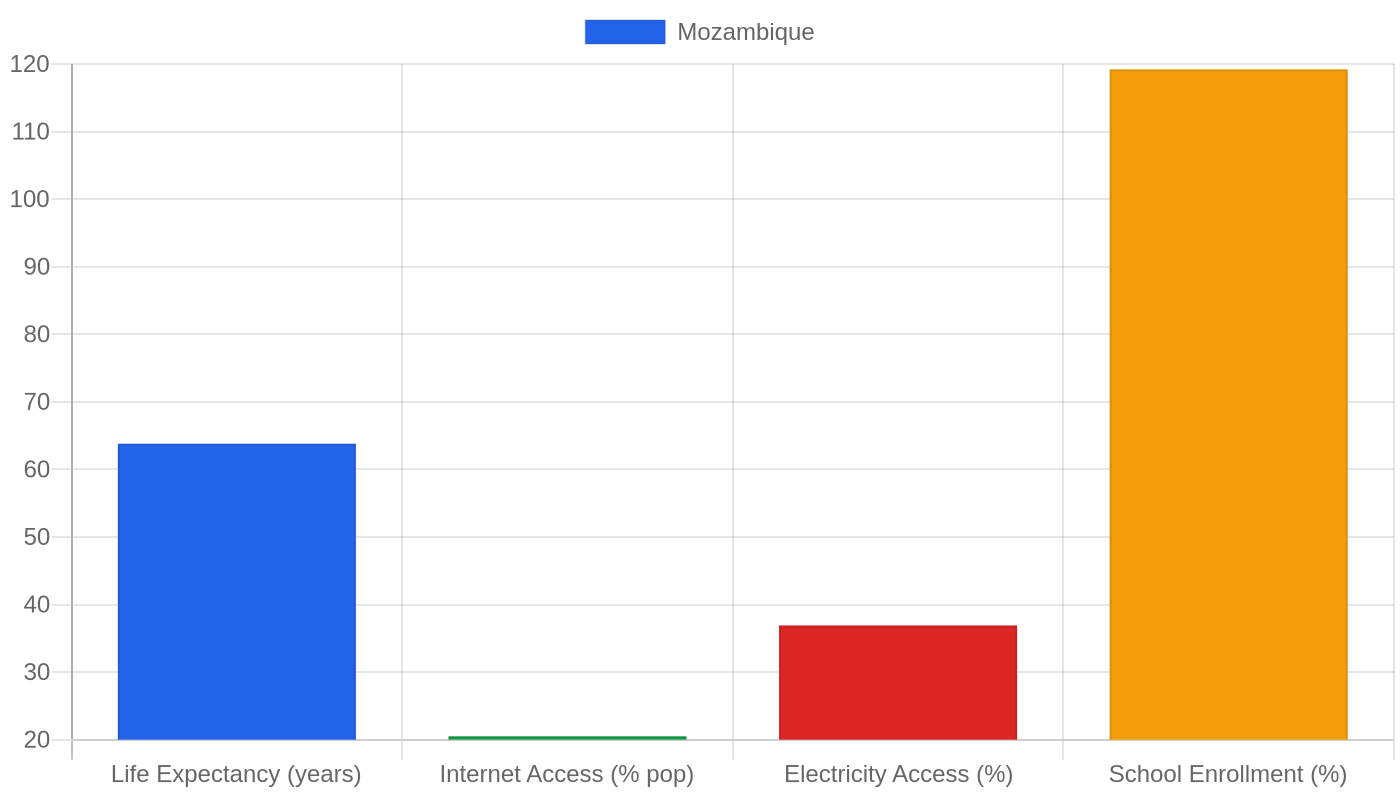
– The absence of recent World Bank economic indicators suggests a transition period in data reporting, making qualitative analysis of institutional structures particularly important.
The Structural Backbone: State Enterprise and Economic Foundation
The World Bank’s latest data release shows no current figures for Mozambique’s GDP growth, inflation, or unemployment — a silence that speaks volumes about the challenges of economic measurement in a nation still formalizing its statistical infrastructure. What we can observe, however, is the institutional architecture that has carried the economy through periods of both turbulence and transformation.
The financial sector is anchored by the Bank of Mozambique, the central monetary authority, alongside the Banco Nacional de Investimento, which functions as the country’s development finance institution. These entities form the monetary policy transmission mechanism that determines credit conditions for businesses and households alike.
The industrial landscape is dominated by logistics and energy infrastructure. Mozambique Ports and Railways operates as a vertically integrated transport monopoly, managing rail networks and port facilities that serve not only domestic needs but also provide critical transit corridors for neighboring landlocked nations. The Beira Railroad Corporation complements this by operating one of the region’s most strategically important rail links, connecting the port city of Beira to the interior.
Electricidade de Moçambique manages the national power grid, a utility whose expansion plans are closely watched by investors in the energy-intensive extractive industries. The postal service, Correios de Moçambique, rounds out the state-owned industrial portfolio, providing essential communications infrastructure across a vast territory with challenging geography.
What makes this structure noteworthy is the concentration of economic activity within state-owned enterprises. This creates a dual economy: a formal sector dominated by government-linked entities with stable employment and predictable operations, alongside an informal sector that absorbs the majority of the workforce but remains largely invisible in official statistics.
The aviation sector shows the most private-sector dynamism, with Air Corridor, Kaya Airlines, LAM Mozambique Airlines, and Moçambique Expresso all competing for domestic and regional routes. LAM, as the flag carrier, occupies the premium position, but the presence of multiple operators suggests a functioning competitive market in air travel, which is essential given the country’s road infrastructure limitations.
The Cost of Living Reality: Infrastructure, Import Dependence, and Daily Survival
Without current consumer price index data from the World Bank, understanding the cost of living in Mozambique requires examining the structural factors that determine household expenses. The country’s reliance on imported manufactured goods, combined with significant distances between production centers and consumption hubs, creates inherent price pressures.
Transportation costs are magnified by the country’s geography — a long coastline with several major port cities, but an interior where road connectivity remains underdeveloped. This means that goods reaching inland markets carry substantial logistics premiums that are ultimately borne by consumers.
Housing costs in urban centers like Maputo, Beira, and Nampula reflect a classic developing-economy pattern: formal housing stock is limited and expensive, while the majority of urban residents live in self-built neighborhoods where land tenure security varies.
The rental market in central Maputo commands premium rates comparable to regional business hubs, driven by demand from international organizations, extractive industry professionals, and the expanding middle class employed by financial institutions and state enterprises. The state-owned banking sector’s presence suggests that mortgage finance exists but remains concentrated among formal-sector employees with documented income.
Daily expenses for ordinary Mozambicans are shaped by the price of basic food staples — maize, rice, cassava, and beans — which are subject to both domestic production variability and international commodity price movements. The energy utility’s pricing structure affects everything from cooking fuel to transportation costs, creating a cascading effect on the price level.
For the majority of the population engaged in subsistence agriculture and informal trade, the cash economy operates on thin margins where any price shock can push households into distress. The absence of reliable inflation data makes it difficult to quantify these pressures precisely, but the structural conditions point toward an economy where food and transportation costs dominate household budgets and where vulnerability to external price shocks remains high.
Investment Climate: Where State Power Meets Private Ambition
The investment landscape in Mozambique is defined by the tension between state-controlled strategic sectors and opportunities for private capital. The presence of Banco Nacional de Investimento signals a government commitment to development financing, but also indicates that major projects require state involvement or guarantees to reach financial close.
For foreign investors, the transportation and logistics sector offers the most established entry points, given the region’s dependence on Mozambican ports and rail corridors. The Beira corridor, in particular, represents a critical trade artery with significant capacity expansion potential.
The financial sector presents a more nuanced picture. The Bank of Mozambique’s regulatory oversight provides a stable monetary environment, but the dominance of state-linked institutions may crowd out private banking innovation. The aviation sector’s multiple carriers suggest that the government has permitted competition in consumer services, which could serve as a model for other sectors.
However, the overall business environment remains characterized by bureaucratic processes, infrastructure gaps, and the need for local partnerships to navigate regulatory requirements.
Sectors to watch include energy distribution, where Electricidade de Moçambique’s grid expansion creates opportunities for renewable energy developers and off-grid solutions providers. The logistics sector offers opportunities in port modernization, rail rehabilitation, and cold-chain development for agricultural exports.
Consumer services, particularly in financial technology and mobile payments, represent a growth frontier where the country’s high mobile phone penetration could leapfrog traditional banking infrastructure. The key constraint remains the availability of reliable, current economic data — investors must operate with a longer time horizon and accept greater uncertainty than in markets with more transparent statistical reporting.
Safety, Politics, and the Quality of Life Calculus
The political landscape in Mozambique operates under a constitutional framework that concentrates significant authority in the presidency. The president serves simultaneously as head of state, head of government, and commander-in-chief of the armed forces, embodying national unity in a single office. This structure provides executive clarity but raises questions about checks and balances, particularly given the absence of current crime and safety indices from the World Bank data.
The president is directly elected for a five-year term through a run-off voting system, which ensures that the eventual winner commands majority support. The prime minister, appointed by the president, convenes and chairs the council of ministers, advises the president, and coordinates government functions — a role that suggests significant administrative authority but ultimately subordinate to presidential direction.
The quality of life in Mozambique is shaped by the country’s dual identity as both a regional economic hub and a nation with substantial development challenges. The concentration of economic activity in coastal cities creates an urban-rural divide in access to services, employment opportunities, and infrastructure. The presence of multiple domestic airlines suggests that internal connectivity is valued, but also that road and rail networks remain insufficient for seamless national integration.
The state-owned enterprises provide stable employment for a segment of the workforce, creating a formal-sector middle class whose consumption patterns anchor urban commerce.
The political system’s stability is tested by the country’s history and the ongoing need to balance competing regional interests. The constitutional design, with its strong presidency, aims to provide decisive leadership, but the effectiveness of this model depends on the quality of governance and the inclusiveness of economic growth.
The absence of current crime and safety data makes it difficult to assess security trends, but the presence of significant state security infrastructure and the country’s strategic importance to regional trade suggest that stability remains a priority for both domestic authorities and international partners.
The Current Moment: Data Gaps, Regional Pressures, and the Watchlist Economy
Right now, Mozambique finds itself in an unusual position for a country of its strategic importance: the World Bank’s latest snapshot shows no current figures for GDP growth, inflation, unemployment, or population. This data vacuum creates challenges for policymakers, investors, and international partners who rely on timely indicators to make decisions.
The silence in the statistics does not mean economic inactivity — rather, it suggests a period of statistical recalibration, where national institutions are working to update their measurement frameworks to better capture the realities of a rapidly evolving economy.
The current affairs landscape is dominated by the operational performance of the state-owned enterprises that anchor the economy. The Mozambique Ports and Railways company continues to manage the trade corridors that generate crucial transit revenues, while Electricidade de Moçambique faces the dual challenge of expanding access and maintaining financial sustainability.
The aviation sector shows signs of competitive dynamism, with multiple carriers adjusting routes and services to capture domestic and regional demand. The financial sector, guided by the Bank of Mozambique’s monetary policy, must navigate the tension between supporting growth and maintaining price stability in an environment where external shocks — from global commodity prices to regional weather patterns — can quickly transmit to domestic markets.
The political calendar remains a focus for observers, given the constitutional framework that requires regular presidential elections with run-off provisions. The prime minister’s role in coordinating cabinet functions suggests an active policy agenda, even as the absence of fresh economic data makes it difficult to assess the impact of government initiatives.
For the international community, Mozambique represents a country where infrastructure investment, regional trade integration, and political stability intersect — a combination that keeps it on the watchlist for development partners and emerging market investors alike.
The Bottom Line
Mozambique is a country of structural significance that currently operates in a statistical shadow — its economic narrative must be read through institutional analysis rather than real-time indicators. The state-owned enterprise ecosystem provides both stability and constraint, creating opportunities for investors who understand how to work within this framework.
For regional trade partners, development financiers, and infrastructure investors, Mozambique’s ports, railways, and energy grid represent strategic assets with long-term value. The country deserves attention not for its current data points, but for its position as the logistics backbone of a region whose economic integration is still unfolding. Watch Mozambique for the long game — the fundamentals are in the infrastructure, not the headlines.
Sources & Methodology
This article is authored by Economic Pulse Net for informational and research purposes. Economic Pulse Net sources its data from multilateral institutions, national statistics bureaus, and proprietary databases. All data is believed to be current as of the date of publication.
Published: August 01, 2026 | Category: Research — Mozambique
Use these signals in your own platform
Economic Pulse publishes its live signal feed through a documented, read-only API. Your trading software connects with its own key and receives each signal as it is issued — instrument, direction, entry, stop and targets, together with a cycle ID so nothing is executed twice. The feed is independent of this website and cannot change it.
Signals are informational only and are not financial advice.