Economic Pulse Net | Sources: World Bank World Development Indicators, Government Sources | 2026
Key Takeaways
– Mozambique’s economy is anchored by massive state-owned enterprises in transport, energy, and banking, yet the country remains heavily dependent on a narrow set of industries.
– The political system is defined by a powerful executive presidency, with the president serving as head of state, head of government, and commander-in-chief — a concentration of power that shapes every aspect of economic life.
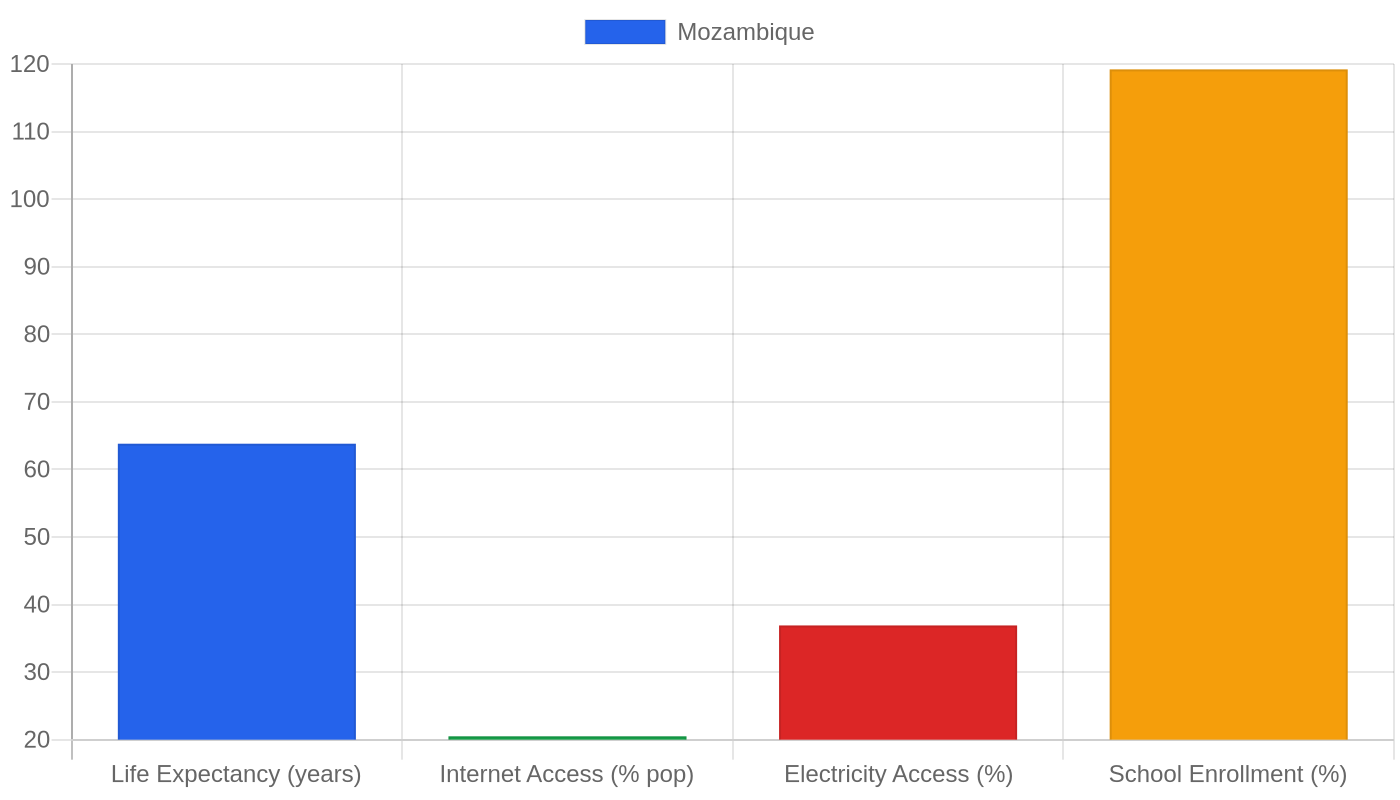
– The country’s economic indicators are currently opaque, with the World Bank reporting no recent figures for GDP growth, inflation, or unemployment, making independent assessment challenging.
– State-owned companies dominate the corporate landscape, from the national airline to the railway and port authorities, meaning public sector performance is inextricably linked to economic outcomes.
– The safety and crime situation remains unclear due to a lack of reliable index data, but the political structure suggests a centralized governance model with significant implications for investors and citizens alike.
The Economic Engine — State Power and Structural Vulnerability
The World Bank’s latest data paints an incomplete picture of Mozambique’s economic standing, with no figures currently available for GDP growth, inflation, or unemployment. This absence of reliable statistics is itself telling — it signals a country where data infrastructure may be lagging behind economic activity, making it difficult for policymakers, investors, and citizens to gauge the true health of the nation’s finances.
What we do know is that Mozambique’s economic backbone is composed almost entirely of state-controlled enterprises. The financial sector is anchored by the Bank of Mozambique, the central bank, alongside the Banco Nacional de Investimento, which serves as the country’s development bank. These institutions are not mere players in the economy — they are its architects and gatekeepers, directing credit, managing monetary policy, and shaping the investment landscape.
The industrial sector tells a similar story. Mozambique Ports and Railways, along with the Beira Railroad Corporation, controls the country’s critical transport infrastructure. These are not just companies; they are the arteries through which trade flows, connecting landlocked neighbors to the Indian Ocean and facilitating the movement of goods that underpin regional commerce.
The utilities sector is dominated by Electricidade de Moçambique, the state power company, which holds a virtual monopoly over electricity generation and distribution.
This concentration of economic power in state hands has profound implications. On one hand, it allows for coordinated national development strategies. On the other, it creates vulnerability — when state enterprises struggle, the entire economy feels the ripple effects.
The dominance of state-owned enterprises also raises questions about private sector development, foreign investment attractiveness, and the ease of doing business in a landscape where the government is simultaneously regulator, competitor, and customer.
The Cost of Living — Navigating an Opaque Landscape
Without current World Bank data on consumer prices or household incomes, assessing the true cost of living in Mozambique requires reading between the lines of what we know about the country’s economic structure. The dominance of state-owned enterprises in utilities and transport suggests that the government has significant control over the prices of essential services — electricity, rail freight, and port fees — which in turn influence the cost of goods throughout the economy.
The presence of multiple domestic airlines, including LAM Mozambique Airlines, Kaya Airlines, Air Corridor, and Moçambique Expresso, points to a developing domestic travel market, though air travel in most African nations remains a premium service accessible primarily to business travelers and the affluent. This suggests a bifurcated economy where a formal sector with salaried employment exists alongside a vast informal economy that operates largely outside official statistics.
For the average Mozambican, daily expenses are likely shaped by the efficiency — or inefficiency — of the state-owned enterprises that dominate the economy. When Electricidade de Moçambique faces operational challenges, the cost of power affects everything from food preservation to small business operations. When the ports and railways function well, goods move more cheaply; when they falter, the costs ripple outward.
The lack of transparent housing data makes it difficult to compare rental and purchase costs to regional averages, but the structure of the economy suggests that access to affordable housing is likely tied to employment in the formal sector, particularly within the state-owned enterprises that dominate the corporate landscape.
Investment and Business Climate — The State as Gatekeeper
For investors eyeing Mozambique, the corporate landscape presents both opportunity and obstacle. The top companies in the country are overwhelmingly state-owned, from the Banco Nacional de Investimento to Mozambique Ports and Railways. This means that any serious investment strategy must account for the government’s central role in economic life.
The financial sector offers a starting point for understanding the investment climate. The Bank of Mozambique sets monetary policy and regulates the banking system, while the Banco Nacional de Investimento functions as a development bank, likely directing capital toward priority sectors identified by the government.
For foreign investors, this means that access to financing may be channeled through state institutions, making relationships with government officials and alignment with national development priorities essential.
The transport and logistics sector presents perhaps the most significant opportunity. Mozambique’s ports and railways are not just domestic infrastructure — they serve as critical corridors for neighboring landlocked countries. The Beira Railroad Corporation and Mozambique Ports and Railways are positioned to capitalize on regional trade flows, and investment in these enterprises could yield substantial returns if managed effectively.
However, the state’s controlling interest in these companies means that private investors must navigate complex public-private partnership arrangements.
The utilities sector, dominated by Electricidade de Moçambique, offers another avenue for investment, particularly given the global push toward renewable energy and the country’s significant natural resource potential. Yet, the monopoly status of the state power company means that private sector participation would likely require government partnership or regulatory approval, adding layers of complexity to any investment decision.
Safety, Politics, and Quality of Life — The Centralized State
The political landscape in Mozambique is defined by a powerful executive presidency. According to the country’s constitution, the president functions as head of state, head of government, and commander-in-chief of the armed forces, serving as a symbol of national unity. This concentration of authority means that political stability and policy direction are largely determined by the character and priorities of the individual holding the presidency.
The president is directly elected for a five-year term through a run-off voting system, providing a mechanism for democratic accountability. However, the prime minister, appointed by the president, serves at the pleasure of the executive rather than being independently elected. This structure creates a political environment where power is centralized at the top, and the cabinet’s effectiveness depends on the president’s leadership style and willingness to delegate.
The safety situation in Mozambique remains difficult to assess due to the absence of reliable crime and safety index data. Similarly, quality of life indicators such as happiness rankings and social well-being metrics are not currently available.
What can be inferred from the economic structure is that access to quality services — electricity, transportation, banking — is likely tied to formal sector employment, and the state’s dominance in these areas means that government performance directly impacts daily life.
The political system’s design, with its powerful presidency, offers the potential for decisive action and coordinated policy implementation. However, it also carries risks — the absence of robust checks and balances can lead to policy volatility if leadership changes, and the concentration of economic power in state enterprises means that political decisions have outsized economic consequences.
What’s Happening Now — A Nation in Transition
Mozambique finds itself at a critical juncture, though the full picture of current developments remains clouded by the absence of recent economic data. The World Bank’s lack of updated figures on GDP growth, inflation, and unemployment suggests that the country may be experiencing challenges in data collection and reporting — a situation that itself demands attention from policymakers and investors who rely on accurate information to make decisions.
The dominance of state-owned enterprises in the corporate landscape indicates that the government remains deeply involved in economic management, with the Bank of Mozambique steering monetary policy and the Banco Nacional de Investimento directing development capital. The transport sector, anchored by Mozambique Ports and Railways and the Beira Railroad Corporation, continues to play a crucial role in regional trade, positioning the country as a potential logistics hub for southern Africa.
The aviation sector shows signs of activity, with four airlines operating in the domestic market — LAM Mozambique Airlines, Kaya Airlines, Air Corridor, and Moçambique Expresso. This suggests some level of commercial dynamism, though the sustainability of multiple carriers in a developing market remains uncertain. The presence of Correios de Moçambique, the national postal service, alongside these transport and communications enterprises, indicates that the state maintains a broad footprint across the economy.
For observers watching Mozambique, the key questions center on whether the government will pursue economic liberalization and private sector development, or whether the state’s dominant role will persist. The answers to these questions will determine the country’s trajectory — whether it emerges as a dynamic regional player or remains constrained by the limitations of state-led development.
What is clear is that Mozambique’s future will be shaped by the decisions made in the corridors of power, where the president’s authority over both government and, indirectly, the economy, remains the defining feature of the nation’s political and economic landscape.
The Bottom Line
Mozambique is a country of significant potential and substantial uncertainty, where the state’s heavy hand in economic affairs creates both opportunities and obstacles. Investors and businesses should watch this nation closely, particularly those interested in transport infrastructure, energy, and financial services — sectors where the state-owned enterprises that dominate the landscape are positioned for growth.
The concentration of political power in the presidency means that policy direction can shift quickly, making it essential for stakeholders to maintain close attention to political developments. For those willing to navigate the complexities of a state-led economy, Mozambique offers the prospect of being at the forefront of regional trade and development — but the path forward requires patience, local knowledge, and a clear-eyed assessment of the risks and rewards.
Sources & Methodology
This article is authored by Economic Pulse Net for informational and research purposes. Economic Pulse Net sources its data from multilateral institutions, national statistics bureaus, and proprietary databases. All data is believed to be current as of the date of publication.
Published: August 01, 2026 | Category: Research — Mozambique
Use these signals in your own platform
Economic Pulse publishes its live signal feed through a documented, read-only API. Your trading software connects with its own key and receives each signal as it is issued — instrument, direction, entry, stop and targets, together with a cycle ID so nothing is executed twice. The feed is independent of this website and cannot change it.
Signals are informational only and are not financial advice.