Economic Pulse Net | Sources: World Bank World Development Indicators, Government Sources | 2026
For a country sitting on some of the world’s largest bauxite reserves, Guinea presents a paradox that has long confounded economists and investors alike. The West African nation is a geological treasure chest: its red laterite soils hold nearly a quarter of the planet’s known bauxite, the essential ore for aluminium. Yet, for the vast majority of its 13 million citizens, life remains a daily struggle against poverty, poor infrastructure, and political instability.
Since the 2021 military coup that ousted President Alpha Condé, Guinea has existed in a state of suspended animation — a *de jure* republic that functions as a *de facto* military autocracy. The economic data, where available, tells a story of potential unrealised and progress interrupted.
This is a nation standing at a crossroads, where immense mineral wealth collides with fragile governance, and where the decisions made in the next twelve months will determine whether Guinea becomes a West African success story or another cautionary tale of resource curse.
Key Takeaways
– Mineral Dominance: Guinea’s economy is overwhelmingly driven by bauxite and alumina extraction, with major players like Compagnie des Bauxites de Guinée, Halco Mining, and Alumina Company of Guinea dominating the corporate landscape. This single-sector reliance makes the economy acutely vulnerable to global commodity price swings.
– Post-Coup Uncertainty: The 2021 military takeover has created a dual reality — political stability on the surface, but deep uncertainty beneath.
The suspension of the National Assembly and the consolidation of power by military authorities has chilled foreign direct investment outside the mining sector.
– Infrastructure Gap: Despite its mineral wealth, Guinea suffers from chronic underinvestment in power, transport, and housing. The cost of living, particularly in Conakry, is disproportionately high relative to average incomes, creating a stark divide between the mining enclaves and the general population.
– Aviation as Bellwether: The presence of multiple airlines — Air Guinee Express, Air Guinee International, Eagle Air, and Guinee Air Service — among the top companies signals both the difficulty of overland travel and the emergence of a small but significant business class dependent on regional connectivity.
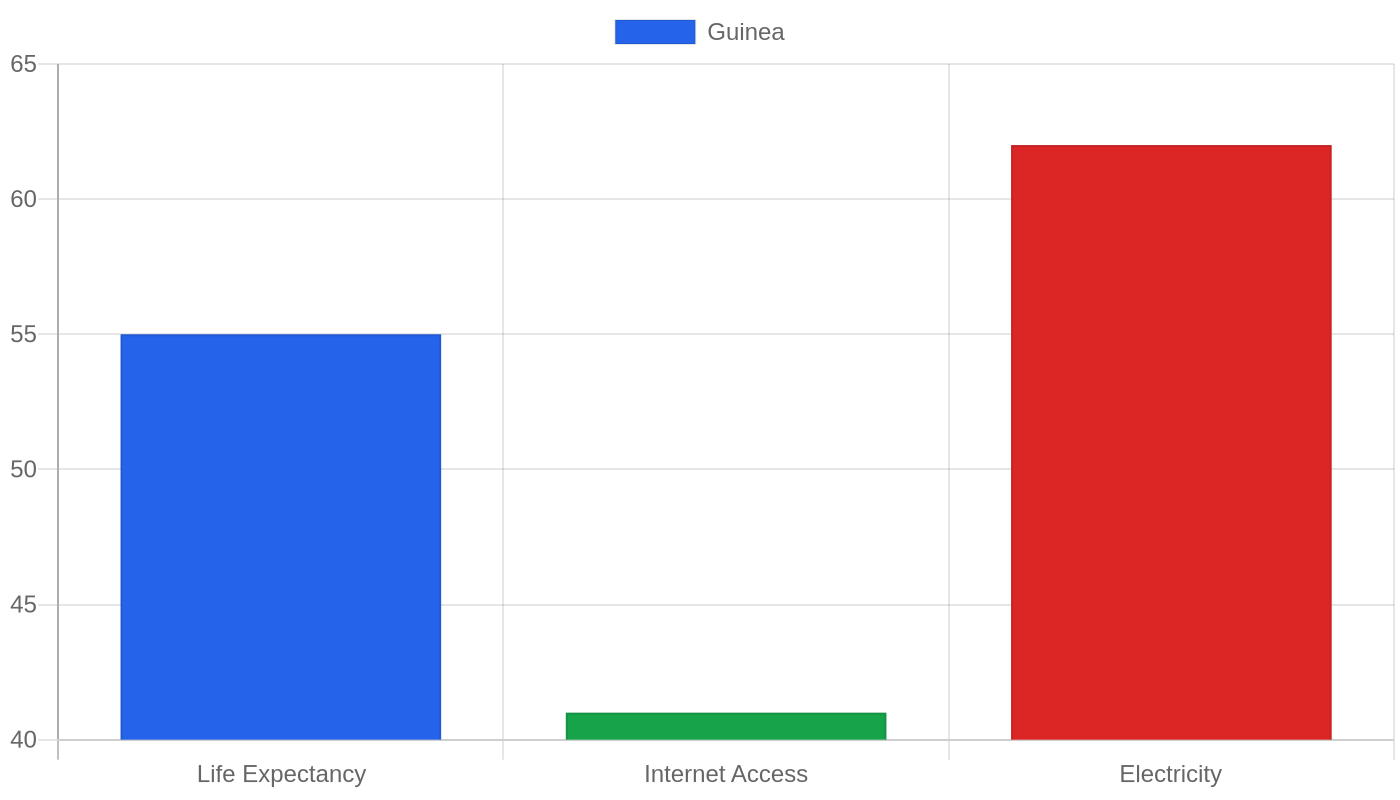
– Data Scarcity Challenge: The absence of basic economic indicators from the World Bank — GDP growth, inflation, unemployment — is itself a telling data point.
It reflects the institutional fragility that hampers policy-making and investment planning in Guinea.
The Bauxite Balancing Act — An Economy Built on Red Rock
The Guinean economy is, in many respects, a one-story building with a very strong foundation. That foundation is bauxite. The World Bank data, while frustratingly incomplete on headline figures like GDP growth and inflation, reveals the essential character of the economy through its corporate landscape. The list of top companies reads like a who’s who of global aluminium supply chains: Compagnie des Bauxites de Guinée, Compagnie des bauxites de Kindia, Halco Mining, and Alumina Company of Guinea.
These are not small players — they are the arteries through which flows the raw material that becomes the aluminium in your smartphone, your car, and your window frames. The sheer concentration is both a strength and a profound vulnerability. When global aluminium demand surges, Guinea’s economy hums. When it falters, the entire country feels the tremor.
Yet the absence of basic World Bank data — no GDP figure, no inflation rate, no unemployment number — speaks volumes about the state of economic governance. In functioning economies, these numbers are published quarterly, scrutinised by analysts, and debated by policymakers. In Guinea, the statistical apparatus appears either incapable or unwilling to produce them.
This data vacuum creates a fog that makes it extraordinarily difficult for investors to assess risk, for donors to target aid, and for citizens to hold their government accountable. The mining sector operates as a semi-autonomous economic zone, generating revenue that flows through channels that are opaque to the public.
The real economy — the markets of Conakry, the farms of the Fouta Djallon highlands, the fishing villages along the coast — operates largely on cash and informal credit, beyond the reach of formal measurement. Until Guinea develops the institutional capacity to measure its own economic activity, it will remain a country that investors approach with caution and citizens experience with frustration.
Conakry’s Concrete Ceiling — The Real Cost of Living in a Capital of Contradictions
Life in Guinea’s capital, Conakry, is a study in contrasts that would be almost absurd if it weren’t so painful for those living through it. The city sprawls across the narrow Kaloum Peninsula, a bottleneck of humanity where luxury SUVs from the mining companies share potholed roads with battered taxis and donkey carts.
Housing costs in decent neighbourhoods approach those of much wealthier West African capitals like Accra or Abidjan, yet wages for the vast majority of workers remain anchored to a subsistence level. The absence of reliable data from the World Bank on cost of living indices does not obscure the lived reality: a teacher or nurse in Conakry can spend 60 to 70 percent of their monthly income on rent alone for a modest two-bedroom apartment in a safe area.
The daily grind is equally punishing. Basic foodstuffs — rice, oil, tomatoes, onions — have seen prices climb steadily, driven by a combination of currency depreciation, fuel costs, and the inefficiencies of a supply chain that depends on roads that turn to mud during the six-month rainy season. Imported goods carry a heavy premium, making everything from second-hand clothing to mobile phones significantly more expensive than in neighbouring Senegal or Côte d’Ivoire.
For the majority of Guineans who work in the informal sector — market vendors, taxi drivers, artisans — the gap between earnings and expenses has become a chasm. The mining companies, with their enclave economies of company housing, imported food, and private power generation, exist in a parallel universe. The cost of living crisis in Guinea is not a matter of statistics; it is a daily negotiation with survival.
Digging for Dollars — Investment Climate in the Shadow of the Coup
For investors looking at Guinea, the question is not whether the country has resources — it clearly does — but whether the political and regulatory environment can be trusted to protect long-term capital. The corporate landscape, as documented by the World Bank, reveals a striking dichotomy.
On one side stand the mining giants: Compagnie des Bauxites de Guinée, a joint venture that has operated for decades, and Halco Mining, which controls the massive Simandou iron ore project that could transform the global steel industry. These companies have the scale, the legal firepower, and the diplomatic backing to navigate Guinea’s treacherous business environment.
On the other side sit companies like Air Guinee Express, Office de la poste guinéenne, and the various domestic airlines — businesses that require functional infrastructure, predictable regulation, and a stable currency to thrive. Their presence among the top companies is less a sign of strength than a reminder of how thin Guinea’s private sector truly is outside of mining.
The 2021 coup has created a peculiar investment climate. On paper, the military authorities have signalled openness to business, recognising that mining revenues are the lifeblood of the state. In practice, the suspension of the National Assembly and the concentration of power in the hands of a small military junta has increased political risk. Contracts signed with the previous civilian government are being reviewed. New mining concessions are being negotiated behind closed doors.
The judicial branch, nominally headed by the Supreme Court of Guinea, operates in an environment where the line between law and executive decree has blurred. For a mining company with a 30-year investment horizon, this uncertainty is manageable — they have seen coups come and go. For a manufacturer, a hotelier, or a tech entrepreneur, it is a deal-breaker. Guinea’s business climate, in short, is excellent for those who can protect themselves and perilous for everyone else.
The Generals’ Republic — Safety, Politics, and the Price of Stability
The political landscape of Guinea, as described in the available data, presents a textbook case of the gap between constitutional form and political reality. The country is a republic *de jure*, with a directly elected president, a unicameral National Assembly, and a Supreme Court. *De facto*, since the 2021 coup d’état, it has been governed as a military autocracy. The National Assembly, which was meant to be the legislative body whose members are directly elected by the people, has been suspended.
The president, who according to the constitution is both head of state and head of government, is now a military officer who came to power through the barrel of a gun. The Supreme Court of Guinea remains the highest and final court of appeal in the country, but its independence in a military-dominated system is a matter of reasonable doubt.
For ordinary Guineans, this political reality translates into a daily calculus of safety and survival. The Crime Index and Safety Index data from the World Bank are marked as unavailable, which is itself a statement. In the absence of reliable crime statistics, perception becomes reality. Conakry is generally considered safer than some other West African capitals, but the combination of youth unemployment, weak policing, and a political system that offers no peaceful avenue for change creates an underlying tension.
The military’s grip on power has brought a certain surface-level stability — no one is expecting a counter-coup tomorrow — but it has also closed off the democratic space. Protests are met with force. Civil society operates under constraints. The quality of life in Guinea is not just a matter of income or housing; it is a question of whether citizens feel they have a voice in their own future. At the moment, the answer is a resounding no.
The Waiting Game — What’s Happening in Guinea Right Now
As of early 2026, Guinea is in a state of suspended animation, waiting for the military junta to make good on its promise to return the country to civilian rule. The timeline, initially set for 2024, has slipped. The suspension of the National Assembly remains in place, and the generals show no signs of relinquishing control over the lucrative mining sector. Behind the scenes, however, there is movement.
The Simandou iron ore project — one of the largest untapped deposits in the world — is slowly advancing, with international partners and the Guinean government locked in complex negotiations over infrastructure financing, transport corridors, and revenue sharing. If Simandou comes online, it would fundamentally reshape not just Guinea’s economy but the global iron ore market, challenging the dominance of Australia and Brazil.
In the broader economy, the absence of World Bank data on inflation and growth does not mean nothing is happening. The Guinean franc has been under pressure, and the cost of imported goods — from rice to fuel to construction materials — has been rising. The mining sector continues to produce and export bauxite at a steady clip, providing the government with a stream of foreign exchange, but the benefits are not trickling down.
The domestic airlines — Air Guinee Express, Eagle Air, Guinee Air Service — are struggling with fuel costs and maintenance challenges, a microcosm of the broader economy’s infrastructure deficit. The military government has launched some infrastructure projects, particularly in road construction and electricity generation, but progress is slow and opaque.
For the average Guinean, the question is not when the next election will be held, but whether the lights will stay on and whether the rice will be affordable next month. That is the real economic pulse of Guinea right now.
The Bottom Line
Guinea is a country that investors and policymakers cannot afford to ignore, but should approach with eyes wide open. Its mineral wealth is extraordinary, and the potential for transformative projects like Simandou is real. But the political instability, institutional weakness, and lack of basic economic data create a risk profile that only the most patient and well-connected capital can tolerate.
For now, Guinea remains a story of what could be — a nation whose people deserve better than the hand they have been dealt, and whose leaders, whether in uniform or not, have yet to prove they can turn geological fortune into broad-based prosperity. Watch Guinea for the mining deals, but do not expect the benefits to reach the street anytime soon.
Sources & Methodology
This article is authored by Economic Pulse Net for informational and research purposes. Economic Pulse Net sources its data from multilateral institutions, national statistics bureaus, and proprietary databases. All data is believed to be current as of the date of publication.
Published: July 19, 2026 | Category: Research — Guinea
Use these signals in your own platform
Economic Pulse publishes its live signal feed through a documented, read-only API. Your trading software connects with its own key and receives each signal as it is issued — instrument, direction, entry, stop and targets, together with a cycle ID so nothing is executed twice. The feed is independent of this website and cannot change it.
Signals are informational only and are not financial advice.