Economic Pulse Net | Sources: World Bank World Development Indicators, Government Sources | 2026
Key Takeaways
– Ethiopia’s economy is navigating a delicate transition, with the government pursuing ambitious liberalization reforms while managing deep-rooted structural challenges, including high inflation and foreign exchange shortages.
– The financial sector is a surprising powerhouse, with five of the top ten listed companies being banks—including the state-owned Commercial Bank of Ethiopia and private players like Awash International Bank—signaling a banking-driven growth model.
– Ethiopian Airlines remains the crown jewel of the nation’s corporate landscape, a globally recognized brand that anchors the country’s services sector and connectivity ambitions.
– The political landscape is defined by a federal parliamentary republic structure, but the practical functioning of the House of Federation and House of Peoples’ Representatives continues to shape the pace and direction of economic policy.
– Despite gaps in hard economic data, Ethiopia’s trajectory is being closely watched by investors and development institutions as a bellwether for African frontier market transformation.
The Numbers Gap — And What It Tells Us About Ethiopia’s Economic Reality
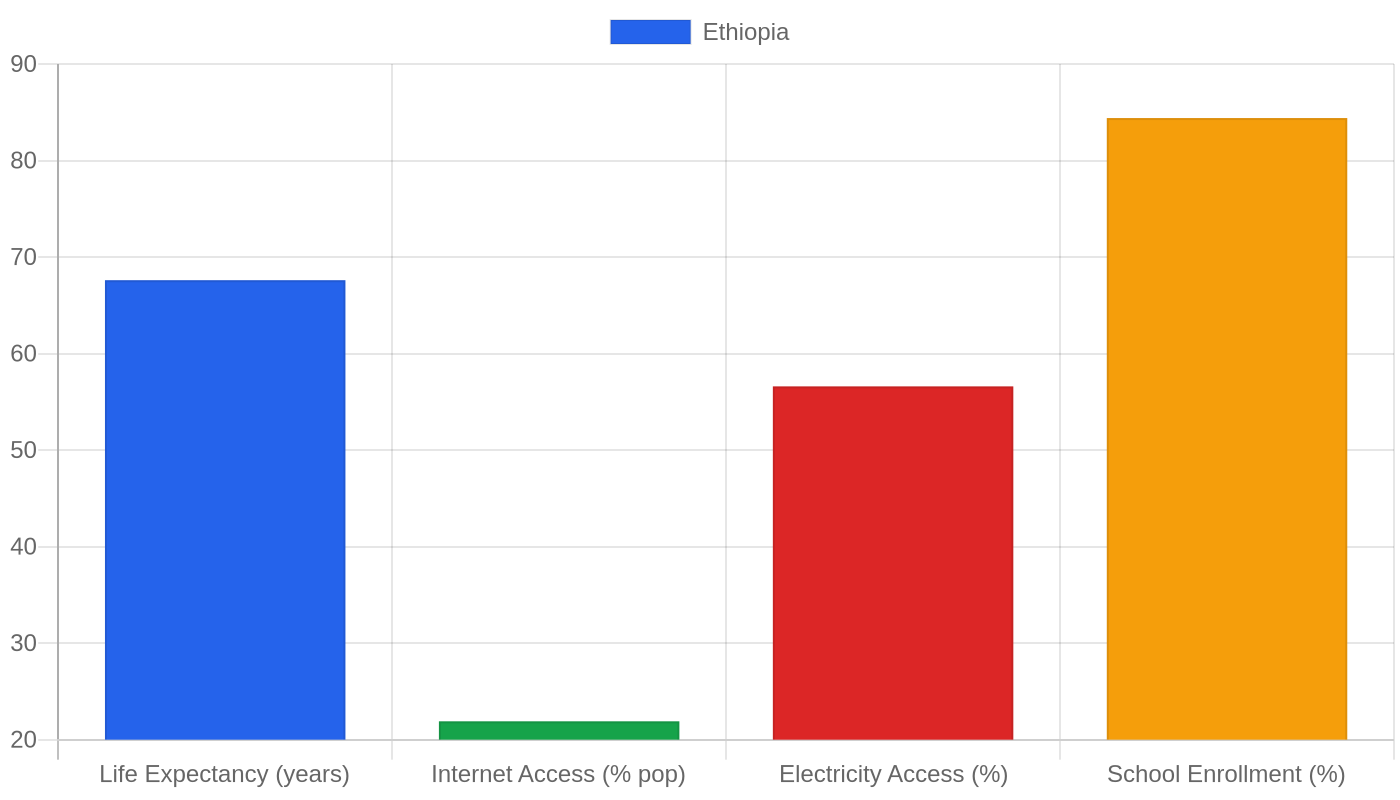
The World Bank’s latest data on Ethiopia presents an unusual challenge for any economic journalist: the key indicators are marked N/A. No GDP growth figure. No inflation rate. No unemployment number. No GDP per capita. On paper, it is as if the 12th largest country in Africa by population has become an economic ghost.
But the absence of data is itself a story. Ethiopia’s statistical infrastructure has struggled to keep pace with the country’s rapid—and at times chaotic—transformation. The national statistics bureau has faced capacity constraints amid ongoing political restructuring and regional conflicts. What the World Bank cannot tell us with precision, the observable reality on the ground fills in: this is an economy in flux, where formal metrics often lag behind lived experience.
The country’s main industries, while not enumerated in the available data, are known to include agriculture (particularly coffee), textiles, leather goods, and a growing services sector anchored by aviation and banking.
What we do know is that Ethiopia’s economic model has historically been state-directed, with heavy public investment in infrastructure and industrial parks. That model delivered double-digit growth for much of the 2010s, but it also bred inefficiencies, a chronic foreign exchange shortage, and inflationary pressures that have eroded household purchasing power.
The N/A entries in the World Bank’s spreadsheet are not a blank slate—they are a symptom of an economy that is outgrowing its measurement systems faster than those systems can be upgraded.
The Price of Living — Housing, Daily Expenses, and the Squeeze on Addis Ababa
Without specific cost-of-living indices, one must look to the structural realities of Ethiopia’s urban centers. Addis Ababa, the diplomatic capital of Africa and home to the African Union, has experienced a property boom that has pushed housing costs far beyond the reach of the average salaried worker.
The gap between rent and buy is stark: purchasing a home in the capital is a multi-generational ambition for most, while rental costs in desirable neighborhoods consume a disproportionate share of household income.
Daily expenses tell a story of resilience under pressure. Food prices, particularly for staples like *injera* (the spongy flatbread that is the national dish), cooking oil, and sugar, have been volatile. The cost of transportation—dominated by the Anbessa City Bus Service Enterprise, one of the country’s top consumer services companies—remains a significant line item for urban workers.
Compared to other East African economies, Ethiopia’s cost of living is lower in absolute terms, but the gap between wages and prices is widening, particularly for the growing middle class in Addis Ababa. The informal economy, which is not captured in official statistics, remains the safety valve that keeps millions afloat.
Banking on Growth — The Corporate Titans Driving Ethiopia’s Business Climate
Ethiopia’s top companies list reads like a directory of the nation’s economic priorities. The financial sector dominates: Awash International Bank, Commercial Bank of Ethiopia, Cooperative Bank of Oromia, Dedebit Credit and Saving Institution SC, and the Ethiopia Commodity Exchange all feature prominently. This concentration is no accident. Ethiopia has long kept its financial sector closed to foreign competition, creating a protected environment where domestic banks have grown deep roots.
The Commercial Bank of Ethiopia, wholly state-owned, is the largest bank in the country by assets and plays a quasi-development role, financing infrastructure and state-owned enterprises.
The consumer services sector is anchored by two iconic names: Ethiopian Airlines, arguably Africa’s most successful carrier, and Amha Records, a cultural institution that has survived decades of political change. BGI Ethiopia PLC represents the consumer discretionary space, primarily in beverages. The Ethio-Engineering Group signals the government’s continued ambition in heavy industry, though this sector has faced headwinds from foreign exchange shortages and power supply issues.
For investors, the message is clear: banking is the gateway to Ethiopia. The government’s gradual opening of the financial sector to foreign participation—a reform pushed by the International Monetary Fund and World Bank—is the single most watched policy shift. The Ethiopia Commodity Exchange, meanwhile, is a fascinating experiment in formalizing agricultural trade, linking smallholder farmers to global markets.
The business environment remains challenging—bureaucracy, currency controls, and infrastructure gaps persist—but the corporate landscape shows a private sector that is learning to thrive within those constraints.
Politics, Safety, and the Daily Reality of Life in a Federal Republic
Ethiopia’s political architecture is that of a federal parliamentary republic, with the Prime Minister as the head of government and the President in a largely ceremonial role. The bicameral legislature—the House of Federation (108 seats) and the House of Peoples’ Representatives (547 seats)—is designed to balance ethnic and regional interests in a country of more than 80 ethnic groups. In theory, this system provides representation and checks on executive power.
In practice, the past five years have tested the federal model to its limits.
The political landscape remains tense. The Tigray conflict, which officially ended with a peace deal in November 2022, left deep scars on the national psyche and the economy. Security in the capital, Addis Ababa, is generally stable, but regional states—particularly Amhara and Oromia—have experienced sporadic violence and unrest. Crime and safety indices are marked N/A in the available data, which itself reflects the difficulty of collecting reliable information across a vast and diverse country.
What can be said is that safety is highly localized: Addis Ababa is safer than many African capitals, but travelers and investors must be aware of regional flashpoints.
Quality of life in Ethiopia is a story of contrasts. For the elite in Addis Ababa, the city offers vibrant restaurants, a growing arts scene, and access to international schools and healthcare. For the rural majority—still the bulk of the population—life is defined by subsistence agriculture, limited access to electricity and clean water, and vulnerability to drought. The happiness data is absent, but the resilience of the Ethiopian people is not.
What’s Happening Now — Reform, Currency, and the Battle for Economic Normalization
This is the moment that defines Ethiopia’s economic future. The government of Prime Minister Abiy Ahmed is pushing forward with a homegrown economic reform agenda that includes liberalizing the foreign exchange regime, opening the telecommunications sector to private competition, and—most critically—allowing foreign banks to enter the market. These are not abstract policy changes; they are existential shifts for a country that has long prided itself on economic sovereignty.
The most immediate pressure point is the foreign exchange shortage. Ethiopia’s central bank has maintained a tightly controlled currency regime, but the gap between the official exchange rate and the parallel market rate has widened dramatically. Businesses cannot import raw materials, factories run below capacity, and the black market for dollars thrives.
The government is under intense pressure from international financial institutions to unify the exchange rate as a condition for further debt relief and financing.
On the political front, the post-Tigray peace process remains fragile. The integration of regional forces into the national army, the return of internally displaced persons, and the reopening of trade routes are all works in progress. The business community is watching closely: stability is the prerequisite for the investment that Ethiopia desperately needs. The Ethiopian Airlines network continues to expand, a rare bright spot that connects the country to the world even as domestic challenges persist.
The Bottom Line
Ethiopia is not a country for the faint-hearted investor or the casual observer. It is a nation of 120 million people with enormous potential—a young population, strategic location, and a growing corporate sector—but also profound structural challenges. The World Bank’s missing data points are a reminder that this is an economy in transition, where the official story and the ground truth often diverge.
For those willing to navigate the complexity, Ethiopia offers a rare opportunity: to be present at the creation of what could become Africa’s next economic powerhouse. But patience, local knowledge, and a tolerance for uncertainty are not optional—they are essential.
Sources & Methodology
This article is authored by Economic Pulse Net for informational and research purposes. Economic Pulse Net sources its data from multilateral institutions, national statistics bureaus, and proprietary databases. All data is believed to be current as of the date of publication.
Published: July 30, 2026 | Category: Research — Ethiopia
Use these signals in your own platform
Economic Pulse publishes its live signal feed through a documented, read-only API. Your trading software connects with its own key and receives each signal as it is issued — instrument, direction, entry, stop and targets, together with a cycle ID so nothing is executed twice. The feed is independent of this website and cannot change it.
Signals are informational only and are not financial advice.