Economic Pulse Net | Sources: World Bank World Development Indicators, Government Sources | 2026
Key Takeaways
– Algeria’s economy operates under the shadow of “le pouvoir”—a shadowy network of civilian and military décideurs who wield de facto control, rendering elected officials largely ceremonial.
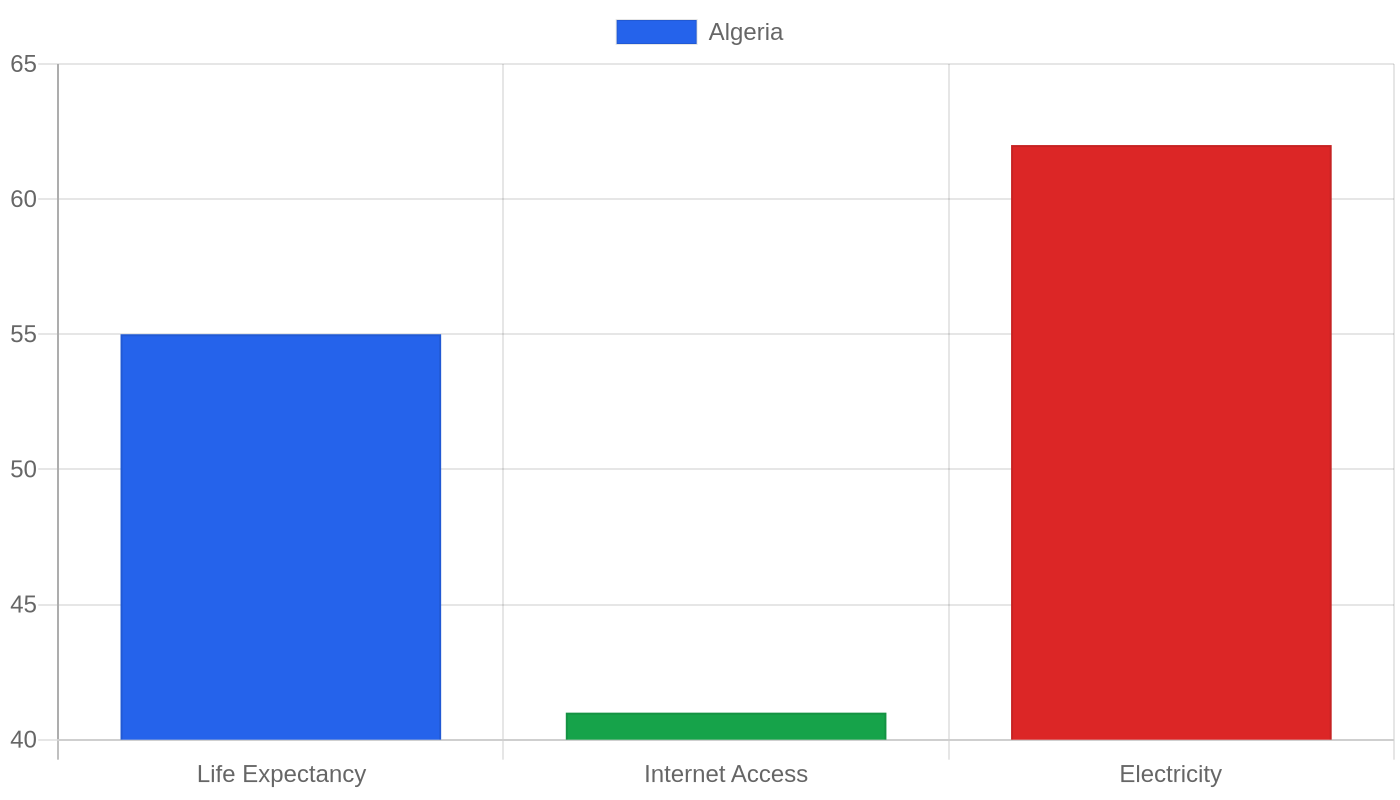
– Key economic indicators from the World Bank remain unpublished, reflecting either data opacity or deliberate obscurity in a system where transparency is not prioritized.
– Major state-owned enterprises dominate key sectors—telecommunications, transport, and consumer services—while private giants like Cevital offer glimpses of entrepreneurial potential.
– Political stability is maintained through authoritarian governance, but the 2019 protests demonstrated that public pressure can force even the most powerful intelligence chiefs from power.
– For investors, Algeria presents a high-risk, high-control environment where business success depends less on market forces and more on navigating opaque power structures.
The Paradox of Plenty — An Economy in the Shadows
Algeria’s economy presents a peculiar challenge for analysts: the World Bank, the global arbiter of economic data, offers no figures for GDP growth, inflation, unemployment, or GDP per capita. This absence is not accidental. In a country where the state controls vast hydrocarbon wealth and where “le pouvoir” — the unelected civilian and military decision-makers — operate behind a veil of officialdom, data becomes a political tool. What is not published cannot be scrutinized.
The lack of World Bank data suggests either that Algeria’s statistical agencies are under-resourced or that the government chooses not to release numbers that might reveal uncomfortable truths. What we do know is that Algeria’s economy has historically been reliant on oil and gas revenues, which account for roughly 95% of export earnings and 60% of the state budget. When global energy prices fluctuate, the entire national economy swings with them.
Without current inflation figures, it is impossible to say with certainty how ordinary Algerians are faring, but anecdotal evidence from regional reports suggests that purchasing power has eroded significantly since the 2014 oil price crash.
Unemployment data is equally absent, but Algeria’s demographic reality is well-documented: a young population with limited formal job opportunities. The state remains the largest employer, a legacy of the socialist-era development model that has proven difficult to reform. The World Bank’s silence on these metrics should be read not as a data gap but as a statement about governance — an economy that does not measure itself cannot be held accountable.
The Cost of Living — Between State Subsidies and Black Markets
Housing in Algeria tells a story of two economies. On one side, there is the formal market, where state-subsidized housing programs offer apartments at artificially low prices to qualifying families. On the other, there is the informal sector — a sprawling network of unregistered rentals, family compounds, and self-built homes that exist outside official statistics. The cost of living data is unavailable from standard sources, but regional comparisons offer clues.
Algeria’s neighbors, Morocco and Tunisia, have relatively affordable housing markets by global standards, and Algeria likely follows a similar pattern — except that state controls on basic goods like bread, fuel, and cooking oil keep daily expenses artificially low.
This system creates a paradox: official prices are low, but availability is often limited. Queues for subsidized housing can stretch for years, and the black market for essential goods thrives when shortages occur. Rent in major cities like Algiers and Oran is significantly higher than in rural areas, driven by internal migration and a concentration of government jobs in the capital.
For the average Algerian family, housing consumes a large portion of income — but without reliable CPI data, the precise burden remains opaque. What is clear is that the cost of living is a deeply political issue, one that has sparked protests in the past and will likely do so again.
Investment & Business Climate — The Power of the State-Owned Giant
Algeria’s corporate landscape is dominated by state-owned enterprises that function as extensions of government policy. Air Algérie, Algérie Télécom, and Algérie Poste are not just companies; they are instruments of state control over strategic sectors. The telecommunications sector features a rare private competitor — Djezzy — but even here, the state retains significant influence through regulatory oversight and ownership stakes.
For foreign investors, the message is clear: you can enter the market, but you will do so on the government’s terms.
The most notable private success story is Cevital, a consumer goods conglomerate that has expanded from food processing into retail, electronics, and international markets.
Cevital’s founder, Issad Rebrab, has been both celebrated as a symbol of Algerian entrepreneurship and targeted by state authorities in tax disputes — a reminder that even the most successful private players operate at the pleasure of “le pouvoir.” The basic materials sector, represented by Asmidal, reflects Algeria’s natural资源优势 in phosphates and fertilizers, but production remains state-dominated.
For investors considering Algeria, the key question is not about market size or growth potential — both are significant — but about the rule of law. Contracts can be renegotiated, licenses revoked, and profits taxed unpredictably when the line between business and politics is blurred. The absence of reliable economic data from the World Bank only reinforces the perception that Algeria is a market where information asymmetry favors the well-connected.
Safety, Politics & Quality of Life — The Authoritarian Bargain
Algeria’s crime and safety indices are unavailable, which in itself is telling. In many authoritarian states, crime data is either suppressed or manipulated to project an image of stability. What is known is that Algeria is not a high-crime society by regional standards; street crime exists but is not endemic. The real safety concern for Algerians is political — the safety that comes from not challenging the system.
The political landscape is defined by what analysts call “le pouvoir” — a network of military intelligence officers, security chiefs, and civilian bureaucrats who make the real decisions. Elected politicians, including the president, have relatively little sway over affairs, according to multiple sources. The most powerful figure for many years was Mohamed Mediène, the head of military intelligence, who was brought down during the 2019 protests.
That moment — when millions of Algerians took to the streets in the Hirak movement — showed that even the most entrenched power can be challenged. But the system itself survived. The décideurs adapted, allowing a new president while maintaining their grip on the economy and security apparatus.
Quality of life in Algeria is a mixed picture. Public healthcare and education are free but underfunded. Internet access is widespread but monitored. Algerians enjoy a rich cultural heritage — from Roman ruins to Saharan landscapes — but freedom of expression remains constrained. The trade-off is the authoritarian bargain: stability and basic services in exchange for political quiescence. For now, most Algerians accept this bargain, but the 2019 protests showed that patience has limits.
What’s Happening Now — The Post-Mediene Era Takes Shape
The most significant recent development in Algeria is the aftermath of the 2019 Hirak movement and the fall of Mohamed Mediène. While the protests succeeded in removing one of the most powerful figures in the country, they did not dismantle “le pouvoir” itself. Instead, the system has evolved. New faces have emerged within the security establishment, and President Abdelmadjid Tebboune — elected in 2019 amid widespread boycott — has attempted to project an image of reform.
Constitutional changes were passed in 2020, limiting presidential terms and creating a more formalized role for parliament, but critics argue these changes are cosmetic.
Economically, Algeria faces the same structural challenges it has for decades: over-reliance on hydrocarbons, a bloated public sector, and a private sector stifled by bureaucracy. The government has announced plans to diversify the economy, including investments in renewable energy and manufacturing, but implementation has been slow. The telecommunications sector, with players like Algérie Télécom and Djezzy, is undergoing gradual liberalization, but the state retains majority control.
What makes the current moment particularly interesting is the generational shift. Younger Algerians, who grew up with the internet and global connectivity, are less willing to accept the old system’s constraints. The Hirak movement was driven by youth, and while it has subsided, the underlying grievances remain. For now, the government has managed to buy time through a combination of repression and limited concessions, but the fundamental question — who really rules Algeria? — remains unanswered.
The Bottom Line
Algeria is a country of immense potential — vast energy reserves, a young population, and strategic geographic position — hamstrung by a political system that prioritizes control over growth. Investors and analysts should watch Algeria not for its current economic data (which is largely unavailable) but for the political dynamics that will determine its future.
The post-Mediene era is still unfolding, and the outcome will shape whether Algeria becomes a more open economy or retreats further into authoritarian stagnation. For now, the smart money waits — and watches the shadows.
Sources & Methodology
This article is authored by Economic Pulse Net for informational and research purposes. Economic Pulse Net sources its data from multilateral institutions, national statistics bureaus, and proprietary databases. All data is believed to be current as of the date of publication.
Published: July 18, 2026 | Category: Research — Algeria
Use these signals in your own platform
Economic Pulse publishes its live signal feed through a documented, read-only API. Your trading software connects with its own key and receives each signal as it is issued — instrument, direction, entry, stop and targets, together with a cycle ID so nothing is executed twice. The feed is independent of this website and cannot change it.
Signals are informational only and are not financial advice.