Economic Pulse Net | Sources: World Bank World Development Indicators, Government Sources | 2026
Key Takeaways
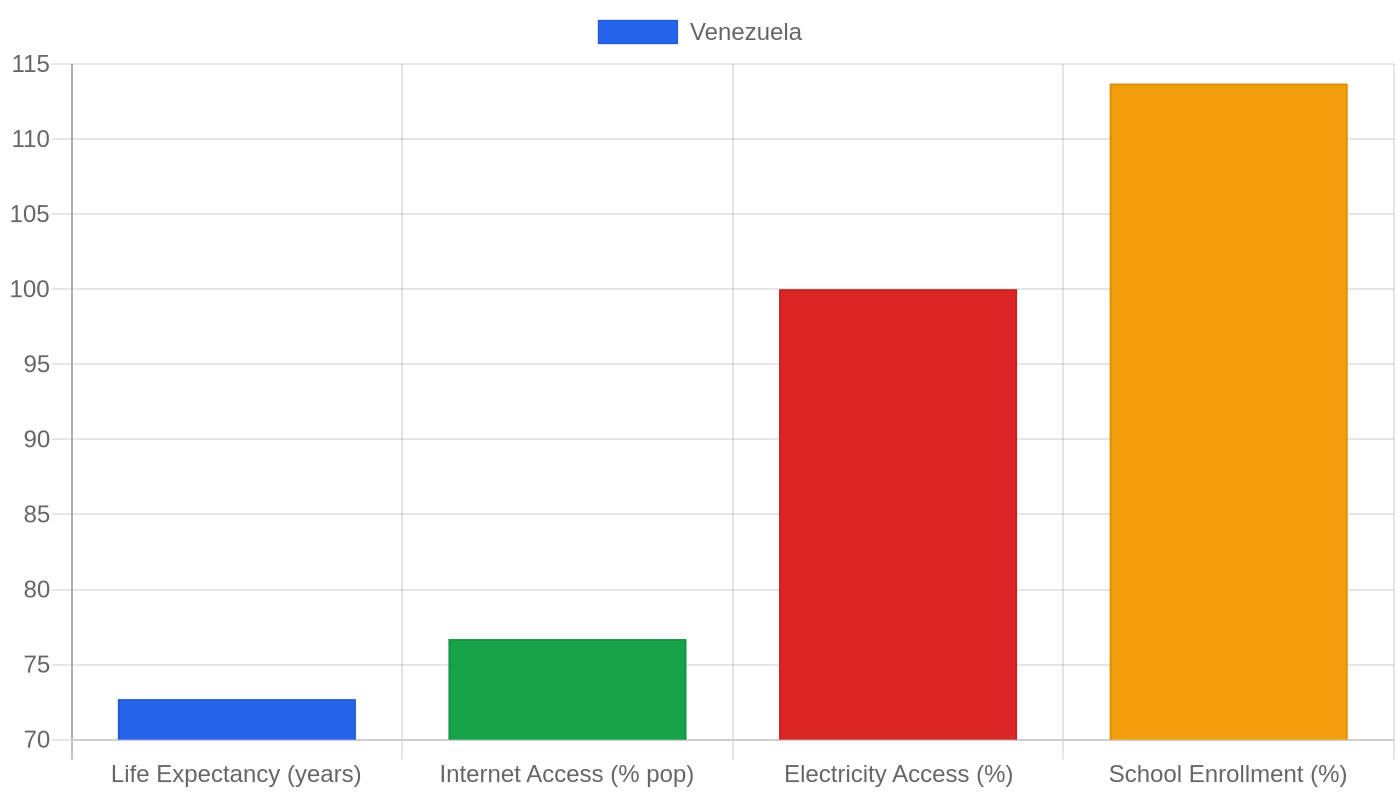
– Venezuela’s economy continues to operate without official macroeconomic data from the World Bank, reflecting the profound collapse of institutional reporting capacity and statistical governance.
– The political landscape remains sharply polarised between the ruling leftist United Socialist Party of Venezuela (PSUV) and its allies, and the opposition Mesa de la Unidad Democrática coalition, creating a persistent governance deadlock.
– Major companies operating in Venezuela are concentrated in consumer services and consumer goods, with household names like Alimentos Polar and state-linked enterprises such as Alcasa still active despite the broader economic contraction.
– No reliable data exists for GDP growth, inflation, unemployment, or income levels, making Venezuela one of the world’s most opaque economies for researchers and investors alike.
The Vanishing Economy — What the Numbers Don’t Say
The World Bank’s latest data for Venezuela is a blank page. GDP growth is unrecorded. Inflation, unemployment, GDP per capita, and GNI per capita are all listed as unavailable. This absence is not a statistical oversight — it is the single most telling economic indicator the country has. For an economy that was once the wealthiest in Latin America, the disappearance of basic macroeconomic data signals a collapse in state capacity that rivals any war zone.
Without official figures, analysts rely on informal estimates and satellite data to gauge the scale of the contraction. The economy has shrunk by an estimated three-quarters since 2013, a peacetime economic collapse without modern precedent. The main industries that once drove Venezuelan prosperity — oil extraction, petrochemicals, and heavy manufacturing — have seen production plummet due to underinvestment, sanctions, and the exodus of skilled labour.
The World Bank data provides no sectoral breakdown, but the anecdotal evidence from the ground tells a story of deindustrialisation and informal survival.
The absence of inflation data is particularly striking. Hyperinflation, which peaked at astronomical levels in 2018 and 2019, has reportedly moderated in recent years due to partial dollarisation of the economy, but no official CPI figure is available to confirm this. The World Bank’s silence on unemployment reflects the reality that most Venezuelans now work in the informal sector, where formal job counts are meaningless.
What remains is an economy where the state no longer measures, and where citizens have learned to live without official statistics.
The Price of Survival — Housing and Daily Life in a Dollarised Ruin
Housing costs in Venezuela have become a tale of two currencies. The bolívar, the national currency, has lost so much value that rent is often quoted in US dollars, even though the government officially discourages dollar transactions. In Caracas, a modest apartment in a safe neighbourhood can cost anywhere from $200 to $500 per month — a sum that is utterly out of reach for the majority of Venezuelans earning in bolívars at the official exchange rate.
Daily expenses tell a similarly brutal story. A basic basket of food staples — rice, oil, beans, flour — now costs more than the monthly minimum wage, which hovers around the equivalent of $5 to $10 depending on the parallel exchange rate. The cost of living has effectively become dollar-denominated for those who can access foreign currency, while those dependent on bolívar incomes face chronic food insecurity.
Utility costs are heavily subsidised in nominal terms, but intermittent electricity and water cuts mean that households often spend additional money on generators, water tanks, and private delivery services.
Renting is the dominant form of housing tenure, as property purchases have collapsed due to legal uncertainty and the difficulty of enforcing ownership rights. Regional comparisons are difficult without data, but anecdotal reports suggest that Caracas remains cheaper than other major Latin American capitals for dollar earners, while being prohibitively expensive for local wage workers.
The housing market reflects the broader economic schizophrenia — a parallel system where some live in relative comfort while the majority scrapes by.
Business Against the Odds — Venezuela’s Corporate Survivors
The list of top companies in Venezuela, as provided by available data, is dominated by consumer services and consumer goods firms. ACO, C.A., Aero Ejecutivos, and Aeropostal Alas de Venezuela represent the aviation and logistics sector, which has struggled with fuel shortages and reduced demand.
Alimentos Polar and Alimentos La Giralda are household names in food processing, producing everything from corn flour to beer, and have managed to maintain operations through creative supply chain management and dollar-based pricing.
Alcasa, listed under basic materials, is a state-owned aluminium company that symbolises the broader decline of Venezuela’s industrial base. Once a pillar of the state-led development model, Alcasa now operates at a fraction of its capacity due to power outages, lack of spare parts, and the departure of skilled engineers. The business environment remains extraordinarily difficult: property rights are weak, the legal system is unpredictable, and corruption is endemic.
Yet these companies persist, adapting to a market where survival depends on access to hard currency and political connections.
Sectors to watch include food processing, which benefits from inelastic demand, and aviation, which serves a diaspora desperate to leave or maintain links abroad. The consumer services sector, including media outlets like Agencia Venezolana de Noticias and Asamblea Nacional Televisión, reflects the politicised nature of the economy, where state-linked entities continue to operate alongside private firms.
For any investor, the message is clear: Venezuela is not a market for the faint-hearted, but it offers outsized returns for those who can navigate the chaos.
Divided We Stand — Politics, Safety, and the Quality of Life
Venezuela’s political landscape is defined by two irreconcilable blocs. On one side stands the incumbent leftist coalition led by the United Socialist Party of Venezuela (PSUV), alongside its allies Fatherland for All (PPT) and the Communist Party of Venezuela (PCV). On the other side is the opposition Mesa de la Unidad Democrática, a broad coalition that includes A New Era (UNT), Project Venezuela, Justice First, and Movement for Socialism (MAS).
This binary divide has paralysed governance for over a decade, with each side questioning the legitimacy of the other.
The crime and safety indices are listed as unavailable, but the lived reality is well-documented. Caracas has consistently ranked among the world’s most dangerous cities, with homicide rates that, even after recent declines, remain orders of magnitude higher than regional averages. The political polarisation extends into daily life, with protests, crackdowns, and periods of intense instability shaping the rhythm of urban existence.
Safety is a luxury good — those who can afford private security, gated communities, and armoured vehicles do so, while the majority rely on informal neighbourhood networks.
Quality of life is correspondingly low. The collapse of public services — healthcare, education, water, electricity — has driven an estimated seven million Venezuelans to emigrate since 2015. Those who remain endure frequent blackouts, fuel shortages, and a health system that lacks basic medicines. The happiness data is absent, but the exodus speaks volumes. Venezuela is a country where politics has become a matter of survival, and where the quality of life is measured not in GDP but in the ability to leave.
The Present Tense — What Is Happening in Venezuela Right Now
As of the latest available reporting, Venezuela remains locked in a political and economic stalemate. The opposition coalition, Mesa de la Unidad Democrática, continues to push for electoral reforms and the release of political prisoners, while the PSUV government maintains its grip on state institutions and the armed forces. There is no recent news data provided on specific policy shifts or inflation trends, but the broader trajectory is one of managed decline rather than recovery.
The partial dollarisation of the economy has brought a measure of stability, with prices in dollars holding relatively steady even as the bolívar continues to depreciate. Businesses have adapted by pricing in dollars, and many Venezuelans now earn and spend in foreign currency, creating a two-tier economy that bypasses official channels. The government has tacitly accepted this reality, even as it maintains capital controls and a heavily overvalued official exchange rate.
On the political front, negotiations between the government and opposition have stalled repeatedly, with each side accusing the other of bad faith. The international community, including regional powers and European mediators, continues to push for a negotiated solution, but no breakthrough appears imminent. For now, Venezuela remains in a holding pattern — not collapsing, not recovering, but surviving in a state of chronic crisis that has become the new normal.
The Bottom Line
Venezuela is a country that every serious economist and geopolitical analyst should watch, not for its current data — which is effectively non-existent — but for what it represents. It is the most dramatic example of peacetime economic collapse in modern history, a case study in how political polarisation, resource dependency, and institutional decay can destroy a nation’s prosperity. For investors with high risk tolerance and long time horizons, the eventual recovery could offer extraordinary returns.
But for the average Venezuelan, the bottom line is simple: survival remains the only game in town.
Sources & Methodology
This article is authored by Economic Pulse Net for informational and research purposes. Economic Pulse Net sources its data from multilateral institutions, national statistics bureaus, and proprietary databases. All data is believed to be current as of the date of publication.
Published: July 21, 2026 | Category: Research — Venezuela
Use these signals in your own platform
Economic Pulse publishes its live signal feed through a documented, read-only API. Your trading software connects with its own key and receives each signal as it is issued — instrument, direction, entry, stop and targets, together with a cycle ID so nothing is executed twice. The feed is independent of this website and cannot change it.
Signals are informational only and are not financial advice.