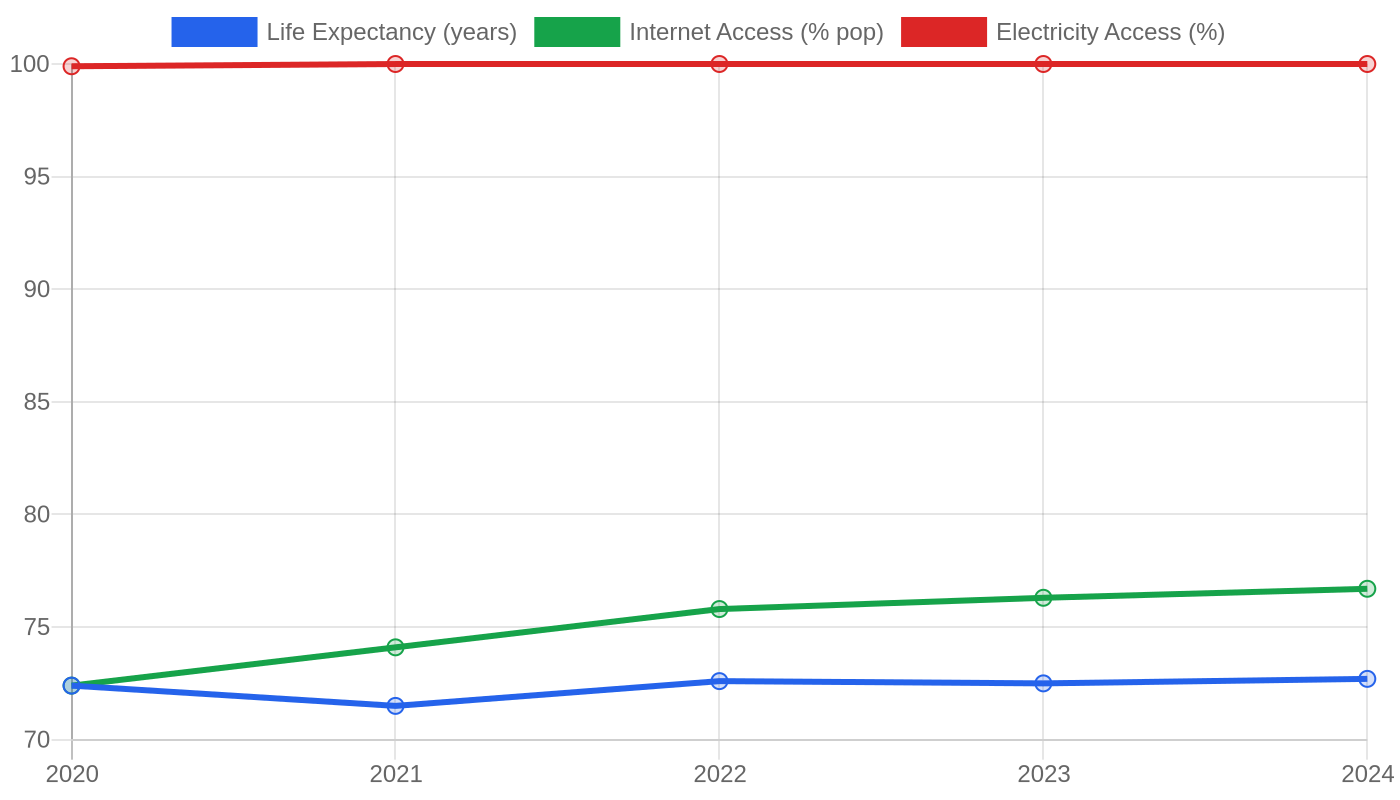
Economic Pulse Net | Sources: World Bank World Development Indicators, Government Sources | 2026
Key Takeaways
– Venezuela’s economy operates in a statistical vacuum, with no recent GDP growth, inflation, or unemployment data from the World Bank, reflecting the collapse of official reporting systems during a protracted economic crisis
– The nation’s industrial base remains dominated by consumer services and basic materials, with state-owned enterprises like Alcasa alongside private giants like Alimentos Polar forming the backbone of a severely contracted economy
– Political power is concentrated between two major blocs—the ruling leftist United Socialist Party of Venezuela (PSUV) with its allies, and the opposition Mesa de la Unidad Democrática coalition—creating a deeply polarized governance landscape
– Despite possessing some of the world’s largest oil reserves, Venezuela’s economic data gaps tell a story of institutional breakdown rather than resource wealth
– The country’s top companies are overwhelmingly in consumer services, suggesting a service-oriented economy that has struggled to maintain industrial production amid hyperinflation and sanctions
The Great Economic Silence — What the Missing Numbers Reveal
When the World Bank reports no data for GDP growth, inflation, or unemployment, it is not an oversight—it is a statement. Venezuela has become an economic ghost, a nation where the statistical agencies that once tracked output and prices have been hollowed out by years of crisis. The absence of numbers is itself the most telling number of all.
The last reliable figures painted a picture of catastrophic contraction—GDP fell by roughly three-quarters between 2013 and 2020—and the silence since then suggests no meaningful recovery has taken hold.
The World Bank data provides no GDP per capita, no GNI per capita, and no population figures, leaving analysts to rely on estimates from other sources that paint a grim picture. What we do know is that Venezuela’s main industries—oil extraction, mining, agriculture, and manufacturing—have all suffered from underinvestment, mismanagement, and the exodus of skilled workers. The country that once boasted Latin America’s most developed industrial base now struggles to refine its own crude oil.
Inflation, though unmeasured by official sources, has been estimated by independent economists at astronomical levels, effectively destroying the bolívar as a store of value and pushing the economy toward dollarization in informal markets. Unemployment, similarly unrecorded, is widely believed to exceed 50% when informal labor is accounted for. These missing metrics are not gaps in knowledge—they are evidence of a state that has lost the capacity to measure its own decline.
Living on the Edge — Housing and Daily Survival in a Dollarized Economy
The cost of living in Venezuela exists in two parallel universes: one denominated in bolívars, the other in US dollars. For the majority of Venezuelans earning in the local currency, basic necessities have become luxuries. A minimum wage that might cover a few days of groceries forces families into survival strategies—remittances from relatives abroad, bartering, and reliance on government food distribution programs. The housing market mirrors this bifurcation.
In Caracas, apartments in secure, middle-class neighborhoods are priced in dollars and remain out of reach for most, while working-class barrios suffer from overcrowding, unreliable utilities, and deterioration.
Renting has become the dominant tenure, as the property market offers little security for buyers. Hyperinflation has wiped out mortgage lending, and the legal system offers weak protection for tenants and landlords alike. Compared to regional averages, Caracas was once one of South America’s more affordable capitals; today, it is one of the most unequal. The cost of a basic basket of food—rice, oil, beans, flour—can consume an entire monthly salary, leaving nothing for housing, healthcare, or education.
Daily expenses are calculated in dollars or against the parallel exchange rate, creating a constant negotiation between price and purchasing power that defines Venezuelan life.
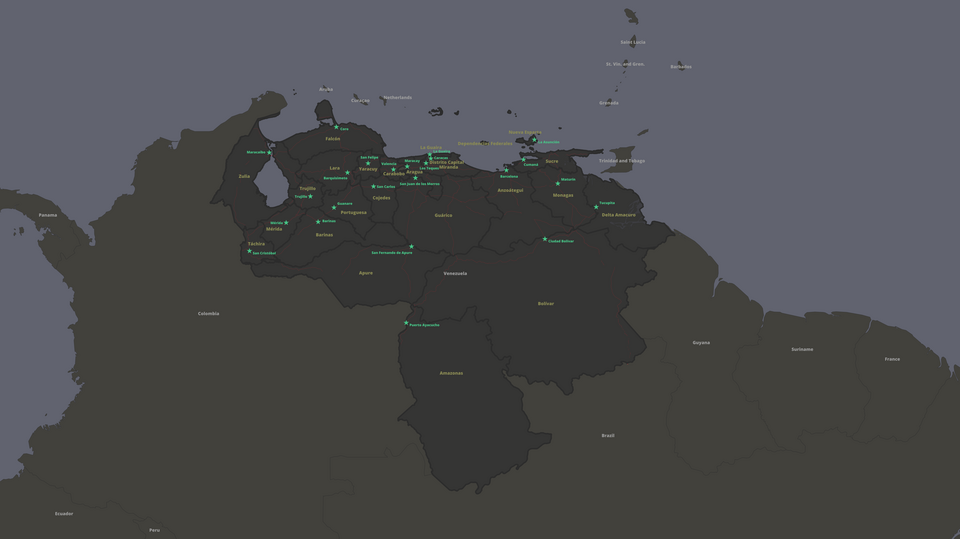
Business in the Balance — Corporate Survival Amid Collapse
The list of Venezuela’s top companies reads like a directory of resilience. ACO, C.A., Aero Ejecutivos, Aeropostal Alas de Venezuela, and Aserca Airlines dominate the consumer services sector—a surprising concentration given the collapse of domestic air travel. These airlines survive by serving the diaspora, connecting Venezuelans in Miami, Bogotá, and Lima to their homeland.
Alimentos Polar, the nation’s largest private company, continues to produce food staples like flour, rice, and beer, operating as a lifeline in a country where food scarcity has been acute. On the basic materials side, Alcasa—the state-owned aluminum company—represents the remnants of Venezuela’s industrial ambitions, though it operates at a fraction of its historical capacity.
The business environment remains extraordinarily challenging. The World Bank data offers no governance indicators, but the reality is well understood: property rights are weak, contracts are difficult to enforce, and the regulatory landscape shifts unpredictably. Companies that survive do so through dollarization, vertical integration, and deep connections to either the state or the informal economy.
The sectors to watch are food production, logistics, and remittance services—industries that cater to basic human needs rather than discretionary spending. Foreign investment, once a driver of Venezuela’s oil boom, has virtually dried up, leaving domestic firms to navigate a landscape of sanctions, currency controls, and political risk that would deter all but the most determined operators.
The Politics of Paralysis — Two Blocs, One Broken System
Venezuela’s political landscape is defined by a stark binary. On one side stands the United Socialist Party of Venezuela (PSUV), the ruling leftist bloc, allied with Fatherland for All (PPT) and the Communist Party of Venezuela (PCV). On the other, the opposition Mesa de la Unidad Democrática coalition brings together A New Era (UNT), Project Venezuela, Justice First, Movement for Socialism (MAS), and others.
This division has produced not healthy democratic competition but a protracted power struggle that has paralyzed governance for over a decade. Elections are contested, results disputed, and the legitimacy of institutions—from the Supreme Court to the National Electoral Council—remains in question.
The quality of life for ordinary Venezuelans has been shaped by this political deadlock. The World Bank provides no crime or safety indices, but independent sources consistently rank Venezuela among the world’s most violent countries. Homicide rates, kidnapping, and extortion are endemic, particularly in border states and urban peripheries. The security situation has driven millions to emigrate—one of the largest population movements in modern Latin American history.
Trust in public institutions is near zero, and social services have collapsed. Hospitals lack medicine, schools lack teachers, and the electricity grid is prone to blackouts. For many Venezuelans, the political battle between PSUV and the opposition feels abstract compared to the daily struggle for food, safety, and dignity.
The Present Tense — What Is Happening in Venezuela Right Now
As of 2026, Venezuela remains in a state of suspended animation. The economy has stabilized at a low level, with some analysts pointing to modest growth in non-oil sectors like agriculture and small-scale commerce. Dollarization has brought a measure of price stability, but at the cost of excluding those without access to foreign currency.
The government has taken tentative steps toward liberalization—easing some price controls, allowing more private sector activity—but these reforms are piecemeal and reversible. The political opposition, meanwhile, remains fractured, unable to mount a unified challenge to PSUV dominance despite widespread public discontent.
The oil sector, once the engine of the Venezuelan economy, continues to struggle. Production has fallen from over 3 million barrels per day in the late 1990s to a fraction of that today, hampered by lack of investment, aging infrastructure, and the exodus of technical talent. Sanctions have limited export markets, though some deals with non-Western buyers have provided a lifeline. On the streets of Caracas, Maracaibo, and Valencia, the mood is one of exhausted endurance.
The exodus continues, though at a slower pace than in the peak crisis years of 2018-2020. Those who remain have adapted to a new normal—a dollarized, informal, low-trust economy where survival depends on ingenuity, remittances, and a deep well of patience.
The Bottom Line
Venezuela demands the attention of anyone interested in the limits of state power, the consequences of hyperinflation, and the resilience of human enterprise under extreme duress. For investors, the country offers little but risk—unless and until property rights are restored and the rule of law takes hold. For policymakers, it serves as a cautionary tale about the dangers of over-reliance on natural resource revenues and the fragility of institutions under political pressure.
For the casual observer, Venezuela is a reminder that economic statistics are not abstractions—they are the difference between a functioning society and a nation of survivors.
Sources & Methodology
This article is authored by Economic Pulse Net for informational and research purposes. Economic Pulse Net sources its data from multilateral institutions, national statistics bureaus, and proprietary databases. All data is believed to be current as of the date of publication.
Published: July 23, 2026 | Category: Research — Venezuela
Use these signals in your own platform
Economic Pulse publishes its live signal feed through a documented, read-only API. Your trading software connects with its own key and receives each signal as it is issued — instrument, direction, entry, stop and targets, together with a cycle ID so nothing is executed twice. The feed is independent of this website and cannot change it.
Signals are informational only and are not financial advice.