Economic Pulse Net | Sources: World Bank World Development Indicators, Government Sources | 2026
Key Takeaways
– Niger’s political landscape is defined by its 2010 constitution, which established a semi-presidential system, but the country faces ongoing challenges in translating governance frameworks into economic stability.
– The economy remains heavily dependent on a narrow base of extractive industries, with uranium mining giants SOMAIR and COMINAK dominating the basic materials sector alongside state-owned energy and transport companies.
– Despite the absence of recent GDP, inflation, and unemployment data from the World Bank, Niger’s development trajectory is shaped by its position as one of the world’s poorest nations, where informal markets and subsistence agriculture underpin daily life.
– The corporate landscape reveals a blend of state-controlled utilities like NIGELEC and consumer services firms such as Arik Niger, indicating a mixed economy where public enterprise still plays a central role.
– Security concerns and political transitions continue to weigh on investor confidence, yet Niger’s mineral wealth and strategic Sahel location make it a country to watch for those tracking African resource geopolitics.
The Uranium Paradox — Why Niger’s Numbers Tell Only Half the Story
The World Bank’s economic data for Niger presents a striking void: no GDP growth figure, no inflation rate, no unemployment statistic, no GDP per capita, and no GNI per capita. This absence of data is itself a story. It speaks to a nation where statistical infrastructure struggles to keep pace with the realities on the ground, where vast informal economic activity escapes official measurement, and where international financial institutions have limited visibility into day-to-day economic life.
For a country that ranks consistently near the bottom of the Human Development Index, these gaps are not administrative oversights—they are symptoms of deeper structural challenges.
What we do know is that Niger’s economy is built on a precarious foundation. The main industries, while not enumerated in the data provided, are widely understood to center on uranium mining—the country supplies roughly five percent of global uranium output—alongside livestock, agriculture (particularly millet and cowpeas), and a small but growing oil sector. The companies listed in the data tell a revealing story.
SOMAIR and COMINAK, both basic materials firms, represent the backbone of Niger’s formal economy. These are joint ventures with French nuclear giant Orano (formerly Areva), and their operations have historically generated the lion’s share of export revenues. But uranium prices are volatile, and Niger’s dependence on this single commodity leaves it vulnerable to global energy market shifts.
The absence of inflation data from the World Bank is particularly concerning. Across the Sahel region, food price volatility has become a chronic issue, driven by climate shocks, conflict, and supply chain disruptions. Without official inflation figures, it is impossible to gauge how Nigerien households are faring against rising costs for staples like millet, rice, and cooking oil.
Similarly, the lack of unemployment data obscures a reality visible in every dusty market and roadside stall: Niger has one of the youngest populations on earth, with over 60 percent under 25, and formal job creation has never kept pace with demographic growth. The World Bank’s silence on these metrics does not mean the problems do not exist—it means they are not being measured effectively.
The Cost of Living — Surviving Without a Safety Net
Housing costs in Niger are a study in contrasts. In the capital, Niamey, a modest two-bedroom home in a middle-class neighborhood might rent for the equivalent of $200 to $400 per month, while in rural areas, traditional mud-brick homes cost virtually nothing in monetary terms but require immense labor to maintain.
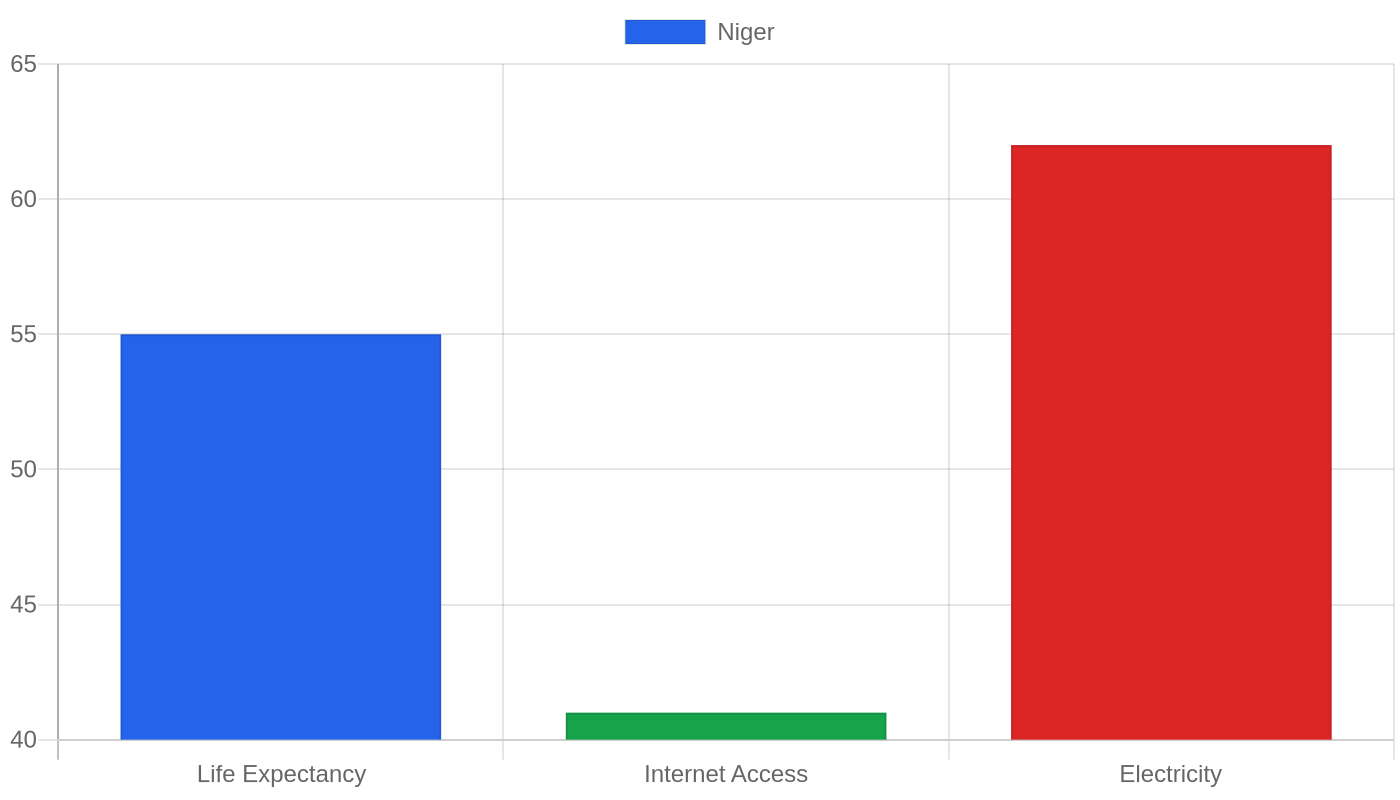
The cost of living data provided does not include specific figures, but regional comparisons suggest that Niger is among the most affordable—and simultaneously most difficult—places to live in West Africa. The trade-off is stark: low cash costs for shelter and food are offset by poor infrastructure, unreliable electricity from NIGELEC, and limited access to clean water and healthcare.
Daily expenses for a typical household revolve around the purchase of millet, sorghum, and rice, supplemented by vegetables and occasional meat. The absence of a formal social safety net means that Nigeriens rely on extended family networks, religious charity, and informal savings groups to weather economic shocks.
For those in urban areas, transport costs are borne by companies like Société Nigerienne de Transports de Voyageurs, which operates bus services, but the majority of the population walks or uses shared taxis. Compared to regional averages in West Africa, Niger’s cost of living is low in absolute terms, but when measured against purchasing power, it is extraordinarily high—a paradox that underscores the daily struggle of making ends meet in one of the world’s least developed economies.
Investment and Business Climate — State Giants and Private Pioneers
The roster of Niger’s top companies reveals a business environment dominated by state-linked enterprises and extractive multinationals. NIGELEC, the state electricity utility, holds a monopoly on power distribution, though it struggles with generation capacity and grid reliability. SONIDEP, the oil and gas company, manages the country’s fledgling petroleum sector, which began production in 2011 and has since become a growing source of revenue.
Niger Poste, the postal service, represents the industrials sector, while a cluster of consumer services firms—Arik Niger, Dounia TV, Escadrille Nationale du Niger, and the Office of Radio and Television of Niger—hint at a modest media and transport ecosystem.
For investors, the sectors to watch are mining and energy. SOMAIR and COMINAK have operated for decades, but the uranium market is undergoing a transformation as nuclear energy gains renewed interest globally. The challenge for Niger is whether it can capture more value from its resources through improved contract terms and local processing. The business environment, however, remains difficult.
Bureaucracy is heavy, corruption is a persistent concern, and the political landscape—defined by the 2010 constitution’s semi-presidential system—has seen repeated coups and transitions. The constitution restored a system where a president and prime minister share executive power, but the practical functioning of this arrangement has been tested by political instability. For foreign investors, the message is mixed: the mineral wealth is real, but the risks are equally tangible.
Safety, Politics, and Quality of Life — The Fragile State
The crime and safety indices for Niger are listed as unavailable, but this absence of data does not mean the country is safe. Insecurity has become a defining feature of life in Niger, particularly in the border regions. The western areas near Mali and Burkina Faso face persistent threats from jihadist groups, while the southeast has seen attacks by Boko Haram.
The government’s response has been a mix of military action and negotiation, but civilian populations bear the brunt of displacement and economic disruption. In Niamey, street crime and petty theft are concerns, though violent crime against foreigners is less common than in some regional capitals.
The political landscape, as described in the data, is anchored by the 31 October 2010 referendum that approved the current constitution. This document restored the semi-presidential system of the Fifth Republic, with a president elected by universal suffrage for five years and a prime minister appointed by the president to share executive power. On paper, this system provides checks and balances.
In practice, Niger’s political history has been marked by coups—most recently in 2023—that have tested constitutional resilience. The quality of life for ordinary Nigeriens is shaped by these political dynamics, but also by climate change, desertification, and the constant pressure of poverty. The country consistently ranks near the bottom of global happiness and wellbeing indices, a reflection of the daily challenges that statistical gaps cannot fully capture.
What’s Happening Now — A Nation at a Crossroads
Right now, Niger is navigating one of the most turbulent periods in its modern history. The July 2023 coup that ousted President Mohamed Bazoum has reshaped the country’s political landscape, with the military junta led by General Abdourahamane Tchiani consolidating power and rejecting international pressure to restore civilian rule.
The Economic Community of West African States (ECOWAS) has imposed sanctions, cutting off electricity supplies and freezing Niger’s assets in regional banks, which has deepened the economic crisis. The junta has responded by seeking new alliances, including closer ties with Russia and Iran, while expelling French troops and renegotiating uranium contracts with Orano.
On the economic front, the sanctions have hit hard. NIGELEC’s grid has been strained by the cutoff of Nigerian electricity, forcing households and businesses to rely on generators. Inflation is spiking for basic goods, and the government has imposed price controls on staples like rice and sugar. The mining sector, however, continues to operate, with SOMAIR and COMINAK maintaining production.
The junta has signaled its intention to extract more revenue from uranium and gold, but the technical and financial challenges are immense. For the people of Niger, the immediate priority is survival—finding enough food, keeping lights on, and navigating a political crisis with no clear end in sight.
The Bottom Line
Niger is a country of immense natural wealth and profound human hardship, where the absence of data speaks louder than any number could. For investors with high risk tolerance and a focus on extractive industries, the uranium and oil sectors offer opportunities—but only for those willing to navigate political instability and regulatory uncertainty.
For development economists and policymakers, Niger represents a critical test case for how fragile states can build resilience in the face of climate change, demographic pressure, and security threats. For the average reader, this is a nation whose struggles and potential deserve far more attention than they currently receive.
Sources & Methodology
This article is authored by Economic Pulse Net for informational and research purposes. Economic Pulse Net sources its data from multilateral institutions, national statistics bureaus, and proprietary databases. All data is believed to be current as of the date of publication.
Published: July 23, 2026 | Category: Research — Niger
Use these signals in your own platform
Economic Pulse publishes its live signal feed through a documented, read-only API. Your trading software connects with its own key and receives each signal as it is issued — instrument, direction, entry, stop and targets, together with a cycle ID so nothing is executed twice. The feed is independent of this website and cannot change it.
Signals are informational only and are not financial advice.