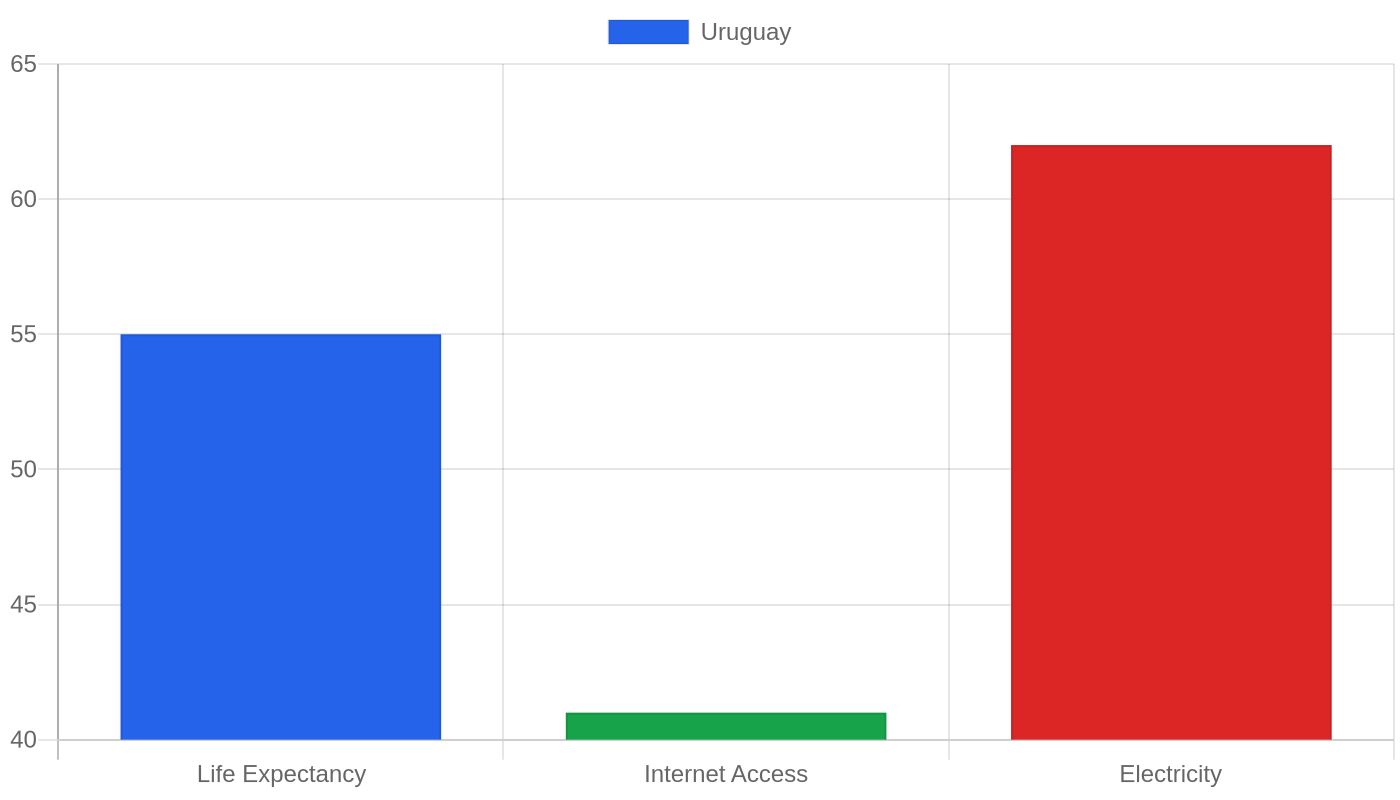
Economic Pulse Net | Sources: World Bank World Development Indicators, Government Sources | 2026
Key Takeaways
– Uruguay operates as a mature, stable representative democratic republic with a presidential system, underpinned by a constitution that mandates a strict separation of powers.
– The state remains a dominant force in the economy, with flagship enterprises like ANCAP (oil & gas), ANTEL (telecoms), and UTE (utilities) shaping the national industrial landscape.
– As a unitary state, Uruguay administers justice, education, health, security, foreign policy, and defence nationwide, creating a highly centralized governance model.
– The financial sector is anchored by the Banco de la República Oriental del Uruguay and the Bolsa de Valores de Montevideo, signaling a formal, institutionalized capital market.
– For investors and observers, Uruguay represents a bet on institutional continuity rather than explosive growth — a slow-burn play in a region known for volatility.
The Macroeconomic Canvas: Growth Without the Headlines
When economists scan Latin America for drama, Uruguay rarely tops the list. That, in itself, is the story. According to the World Bank’s latest dataset, headline figures for GDP growth, inflation, and unemployment are currently unavailable — a data gap that, for once, does not signal crisis but rather reflects the quiet, unglamorous nature of this small Southern Cone nation.
Uruguay has long traded on its reputation as the region’s most dependable performer, a country where institutions outlast administrations and where policy shifts are evolutionary rather than revolutionary.
The economic architecture is defined by a powerful public sector. ANCAP holds the reins in oil and gas, UTE dominates the utilities landscape, and ANTEL controls the telecommunications backbone. This is not a free-market free-for-all; it is a mixed economy where the state sets the tempo. For a nation of roughly 3.4 million people, the presence of a state-owned oil company and a state-run power utility means that fiscal policy and energy policy are inextricably linked.
When global commodity prices swing, Uruguay feels it through its public balance sheet — a vulnerability, yes, but also a buffer, because the state can smooth the shocks that would cripple a purely private system.
The absence of hard numbers from the World Bank should not be misread as an absence of economic activity. Rather, it invites a closer look at the structural realities: a small, open economy heavily reliant on agriculture, livestock, and increasingly, renewable energy and technology services.
Uruguay’s economic narrative is one of resilience through diversification — but the diversification is still a work in progress, and the state’s heavy hand in key sectors means private enterprise often plays second fiddle to public priorities.
The Price of Living: A Middle-Class Compact Under Pressure
Cost of living data for Uruguay remains sparse in the current dataset, but the country’s social contract tells a clear story. Uruguay has historically been one of the most expensive countries in South America, with Montevideo consistently ranking among the region’s pricier capitals. This is the price of stability: a broad middle class, strong public services, and a social safety net that requires significant tax revenue to sustain.
Housing in Montevideo’s better neighborhoods commands premiums that rival Buenos Aires or Santiago, while everyday goods — groceries, utilities, transport — carry a distinctly first-world price tag in a third-world economy.
The tension is palpable. Uruguayans enjoy a quality of life that many neighbors envy, but that lifestyle is increasingly expensive to maintain. The centralized, unitary state ensures that services are delivered uniformly across the country, but it also means that cost pressures in the capital are not offset by cheaper alternatives elsewhere — the state’s reach is nationwide, and so are its price tags.
For the average household, the equation is simple: salaries are moderate, but the cost of maintaining a middle-class existence is high. The rent-versus-buy calculus in Montevideo tilts toward renting for younger cohorts, as property prices remain elevated relative to income levels. This is a country where comfort is attainable, but affluence is hard-earned.
The Business Climate: Where the State Leads, Capital Follows
For private investors, Uruguay offers a paradox: a deeply institutionalized economy where the most significant players are state-owned, yet where the rules of the game are transparent and consistently applied. The Bolsa de Valores de Montevideo provides a formal capital market, though it remains small by regional standards. The financial sector is anchored by the Banco de la República Oriental del Uruguay, a state bank that dominates retail and corporate lending.
This is not a frontier market in the traditional sense; it is a mature, regulated environment where due diligence is straightforward and contracts are enforceable.
The sectors to watch are those where Uruguay has natural advantages: agriculture and livestock, which remain the backbone of exports; renewable energy, where the country has made significant strides; and a nascent technology services sector that leverages Uruguay’s high literacy rates and stable telecom infrastructure — the latter courtesy of ANTEL.
The business climate is characterized by low corruption relative to regional peers, a skilled workforce, and a government that, while interventionist, is predictable. The challenge for foreign investors is not navigating chaos but accepting a slower pace of return, as the state’s presence in key industries limits the scope for private sector dominance.
Safety, Politics, and the Quality of Life: The Republic of Rules
Uruguay’s political landscape is the envy of the region. A representative democratic republic with a presidential system, the country operates under a constitution that establishes a clear separation of powers and a system of checks and balances. Members of government are elected for five-year terms by universal suffrage, and the transition of power is smooth, legal, and uncontested.
This is a country where politics is a matter of public service, not personal enrichment — or at least, that is the ideal the constitution strives to enforce.
As a unitary state, Uruguay administers justice, education, health, security, foreign policy, and defence nationwide. There are no powerful regional governors challenging the central government; there is one government, and it is accountable to the entire electorate. This centralization has its drawbacks — Montevideo dominates political and economic life — but it also means that policy implementation is consistent and uniform.
In terms of safety, Uruguay has historically maintained lower crime rates than its regional neighbors, though urban crime in Montevideo has been a growing concern in recent years. The country’s social fabric remains strong, buttressed by a robust middle class and a culture that values civic participation. This is a nation where the rule of law is not an aspiration but a daily reality.
Current Affairs: The Calm Before the Next Cycle
As of the latest reporting, Uruguay finds itself in a familiar position: stable, understated, and waiting for the next electoral cycle to shape its trajectory. With a five-year presidential term, the political calendar is always in motion, and the current period is one of consolidation rather than transformation.
The state-owned enterprises — ANCAP, ANTEL, UTE — continue to operate as the pillars of the economy, but there is ongoing debate within policy circles about the pace of liberalization and the role of private capital in sectors traditionally reserved for the state.
The financial sector is quietly modernizing, with the Bolsa de Valores de Montevideo seeking to deepen its role as a regional capital market. Meanwhile, the government’s focus on renewable energy and digital infrastructure suggests a forward-looking agenda, even if the pace of change is measured.
Inflationary pressures and cost-of-living concerns remain live issues for Uruguayan households, and the central government’s ability to manage these without resorting to drastic measures will be the key test of its competence. For now, Uruguay is not making headlines — and for its citizens, that is precisely the point. This is a country that has learned to fear excitement, and it has built a political and economic system designed to avoid it.
The Bottom Line
Uruguay is not a market for those seeking quick returns or dramatic turnarounds. It is a country for long-term investors, policy wonks, and anyone who believes that boring is beautiful. The state’s dominance in key sectors, the centralized governance structure, and the measured pace of reform make it a predictable, if unexciting, environment.
For those watching Latin America, Uruguay offers a crucial counter-narrative: proof that stability, transparency, and institutional continuity are not just buzzwords but achievable outcomes. Watch this country not for its headlines, but for its steady, unglamorous march forward.
Sources & Methodology
This article is authored by Economic Pulse Net for informational and research purposes. Economic Pulse Net sources its data from multilateral institutions, national statistics bureaus, and proprietary databases. All data is believed to be current as of the date of publication.
Published: August 28, 2026 | Category: Research — Uruguay
Use these signals in your own platform
Economic Pulse publishes its live signal feed through a documented, read-only API. Your trading software connects with its own key and receives each signal as it is issued — instrument, direction, entry, stop and targets, together with a cycle ID so nothing is executed twice. The feed is independent of this website and cannot change it.
Signals are informational only and are not financial advice.