Economic Pulse Net | Sources: World Bank World Development Indicators, Government Sources | 2026
Key Takeaways
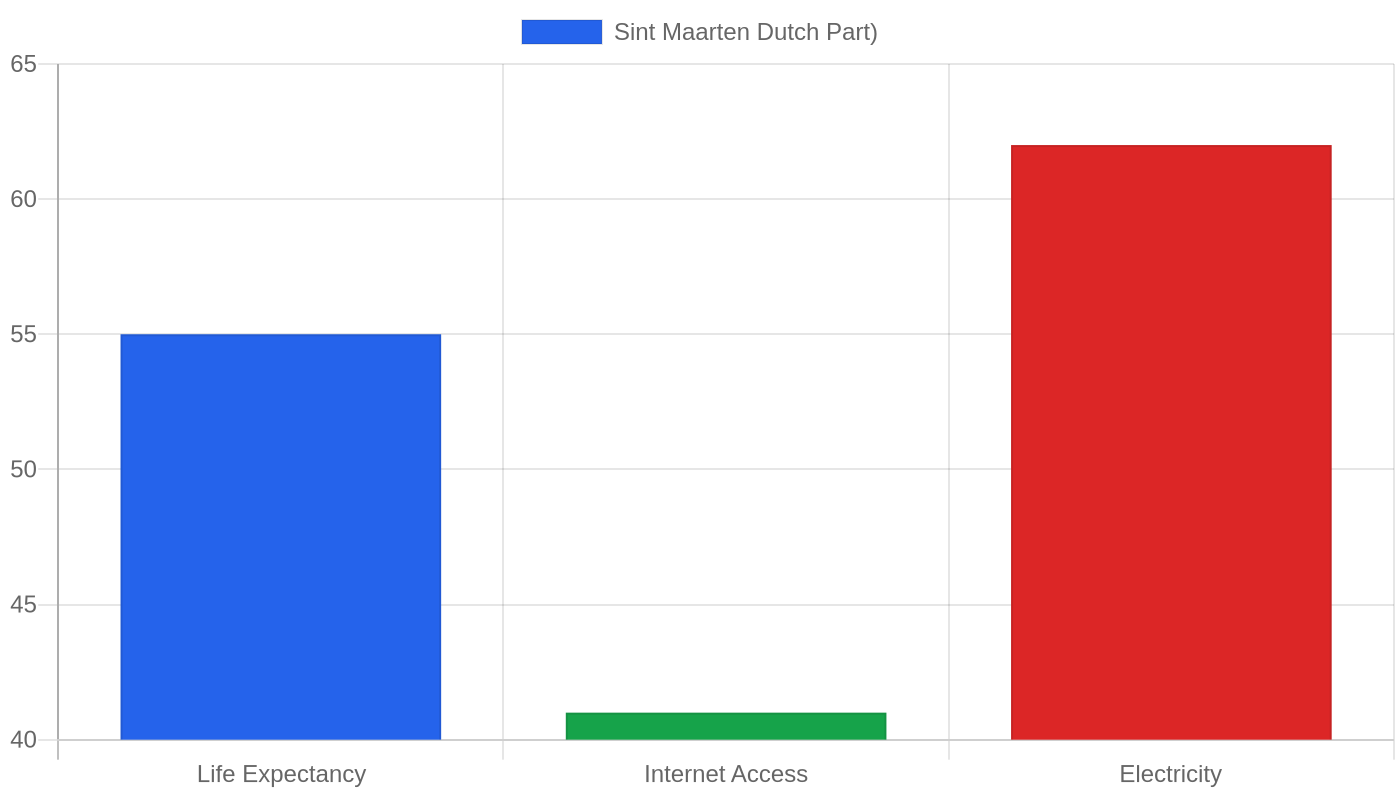
* Data Scarcity: Official macroeconomic indicators, including GDP growth, inflation, and unemployment rates, are currently reported as N/A by the World Bank, creating a significant blind spot for investors and policymakers.
Tourism Reliance: The island’s economic identity is intrinsically linked to its main industries, which remain undefined in current datasets, suggesting a heavy reliance on services rather than diversified manufacturing or agriculture.
Quality of Life Metrics: Standard safety indices, such as Crime and Safety scores, are unavailable, leaving residents and visitors without quantifiable benchmarks for personal security assessments.
Political Ambiguity: The political landscape lacks detailed reporting, indicating potential stability or opacity that makes governance trends difficult to track through standard economic news channels.
The Invisible Engine: Economic Uncertainty in a Small Island State
The economic narrative of Sint Maarten (Dutch Part) is currently defined more by absence than presence. When analysts look to the World Bank for guidance on the island’s financial health, they are met with a series of “N/A” entries across the most critical metrics. GDP growth is unreported, meaning there is no official consensus on whether the economy is expanding, contracting, or stagnating.
This lack of data extends to inflation, where the Consumer Price Index (CPI) is also marked as N/A, preventing economists from measuring the erosion of purchasing power or the effectiveness of monetary policy. Unemployment figures are similarly missing, leaving labor market dynamics—a crucial indicator of social stability and consumer spending power—completely opaque.
Without a recorded GDP in USD or a PPP-adjusted per capita income, it is impossible to benchmark Sint Maarten against other Caribbean nations or emerging markets. This data vacuum suggests either a breakdown in statistical collection infrastructure or a deliberate withholding of sensitive economic information. For international investors, this ambiguity represents a high-risk environment where due diligence cannot rely on standardized global metrics.
The absence of Gross National Income (GNI) per capita further complicates efforts to assess the general welfare and development level of the population. Consequently, any discussion of the island’s economic trajectory must acknowledge that the foundation of analysis is currently hollow.
Living on the Edge: The Cost of Daily Existence
For those residing in or visiting Sint Maarten (Dutch Part), the tangible experience of the economy may differ from the invisible statistics. However, the cost of living remains an unquantified variable in current reports. Housing costs, whether for rent or purchase, are not detailed in the available dataset, making it difficult to determine if real estate is a barrier to entry for new residents or a lucrative investment vehicle.
Daily expenses, which typically include groceries, utilities, and transportation, are similarly undefined, preventing comparisons with regional averages in the Caribbean. In many small island developing states, import dependency drives up the cost of basic goods, but without specific CPI data, we cannot confirm if this pressure is currently affecting Sint Maarten.
The lack of housing data also obscures the wealth gap; if property prices are high while incomes are stagnant, social tension could arise, yet this dynamic is hidden behind the “N/A” labels. Furthermore, the absence of crime and safety indices means that the “hidden costs” of security—such as insurance premiums, private guards, or restricted movement—are not factored into any public quality-of-life assessment.
Residents likely navigate these challenges intuitively, but for external observers, the daily economic reality is a black box. This lack of granularity forces individuals to rely on anecdotal evidence rather than empirical data when planning their financial lives on the island.
Business Horizons: Companies and Corporate Structures
The corporate landscape of Sint Maarten (Dutch Part) is equally shrouded in mystery regarding its top players. No major companies are listed in the provided data, which raises questions about the concentration of economic power. Are there dominant local conglomerates controlling key sectors, or is the business environment fragmented among numerous small and medium-sized enterprises?
The main industries are also unspecified, leaving it unclear whether the island’s commercial activity is centered around tourism, offshore finance, light manufacturing, or agricultural exports. This ambiguity makes it challenging to identify sectors with high growth potential or those facing structural decline. For entrepreneurs looking to enter the market, the lack of a clear industry map increases the risk of misaligned investments.
Additionally, the business climate is often shaped by regulatory frameworks and tax policies, but without political landscape details, the stability of these rules is unknown. Investors typically look for transparency in corporate governance and market competition, both of which are obscured by the current data gaps. The absence of identifiable top companies also suggests that the economy may be driven by foreign-owned entities or informal sector activities that do not appear in formal registries.
Ultimately, the business environment appears to operate in a low-transparency mode, requiring heightened caution and localized intelligence for any serious commercial engagement.
Safety, Politics, and Social Fabric
The social and political dimensions of Sint Maarten (Dutch Part) present another layer of uncertainty. Crime and safety indices are both reported as N/A, meaning there is no standardized measure of violent crime, petty theft, or overall public safety. This absence makes it difficult to advise tourists or expatriates on security precautions, forcing them to rely on travel advisories or personal networks instead.
The political landscape is similarly undefined, with no information on current parties, leadership stability, or policy directions. In small jurisdictions, political shifts can have outsized effects on economic policy and social cohesion, yet the current status quo remains unclear. Happiness data and broader quality-of-life metrics are also missing, leaving no psychological or sociological baseline for the population’s well-being.
This lack of political insight can be interpreted as stability, where no major upheavals are occurring, or as neglect, where governance issues are not being tracked by international observers. For citizens, the inability to gauge the political mood can hinder civic engagement and accountability. The interplay between safety, politics, and economic opportunity is complex, and without data, the connections remain speculative.
Residents must therefore navigate their social environment based on immediate community feedback rather than systemic indicators.
Current Affairs: The Silence Speaks Volumes
In the realm of current affairs, the most striking feature of Sint Maarten (Dutch Part) is the silence. There are no recent news items, live indicators, or breaking developments to report. This lack of activity does not necessarily mean nothing is happening; rather, it suggests that events are not reaching international media outlets or that domestic reporting is not capturing significant shifts.
Reforms, elections, or inflation trends are not visible in the current news cycle, implying a period of quiet or low visibility. Policy shifts, if they are occurring, are not being documented in accessible formats, leaving stakeholders in the dark. Business developments, such as new infrastructure projects or changes in trade agreements, are absent from the record.
This quietude contrasts sharply with the vibrant, often chaotic news cycles of larger economies, highlighting the marginalization of smaller territories in global information flows. It is possible that internal discussions are taking place behind closed doors, but they have not translated into public knowledge. For journalists and analysts, this presents a challenge: how to report on a story that has no visible headlines?
The answer lies in recognizing that the absence of news is itself a news item, reflecting the island’s position in the global hierarchy. Stakeholders must wait for data to emerge or seek out alternative, non-traditional sources of information.
The Bottom Line
Sint Maarten (Dutch Part) remains a case study in data scarcity, where the lack of information is as defining as the information itself. Potential investors should approach with extreme caution, recognizing that traditional due diligence tools are ineffective in this environment. The country is best suited for those who already have strong local networks and rely on ground-level intelligence rather than published reports.
Until macroeconomic and social data become available, Sint Maarten will remain an enigma, offering opportunities but obscuring risks. Watch this space for future data releases, but do not expect clarity in the immediate term.
Sources & Methodology
This article is authored by Economic Pulse Net for informational and research purposes. Economic Pulse Net sources its data from multilateral institutions, national statistics bureaus, and proprietary databases. All data is believed to be current as of the date of publication.
Published: October 24, 2026 | Category: Research — Sint Maarten Dutch Part)
Use these signals in your own platform
Economic Pulse publishes its live signal feed through a documented, read-only API. Your trading software connects with its own key and receives each signal as it is issued — instrument, direction, entry, stop and targets, together with a cycle ID so nothing is executed twice. The feed is independent of this website and cannot change it.
Signals are informational only and are not financial advice.