Economic Pulse Net | Sources: World Bank World Development Indicators, Government Sources | 2026
Key Takeaways
– Guyana is undergoing a historic economic transformation driven by offshore oil discoveries, yet the World Bank data provided shows significant gaps in conventional macroeconomic indicators, reflecting the challenge of tracking a rapidly evolving economy.
– The country’s political landscape remains a source of tension, with a history of election-related violence that investors and residents must navigate alongside the boom.
– Traditional industries like sugar, rum, and broadcasting continue to employ thousands, even as the energy sector reshapes the national balance sheet.
– Cost of living pressures are emerging as a critical issue, with housing and daily expenses rising in the capital Georgetown as new wealth flows in.
– The telecommunications and utilities sectors are dominated by state-linked and legacy companies, creating a mixed picture for business openness.
The Paradox of Plenty — An Economy in Two Speeds
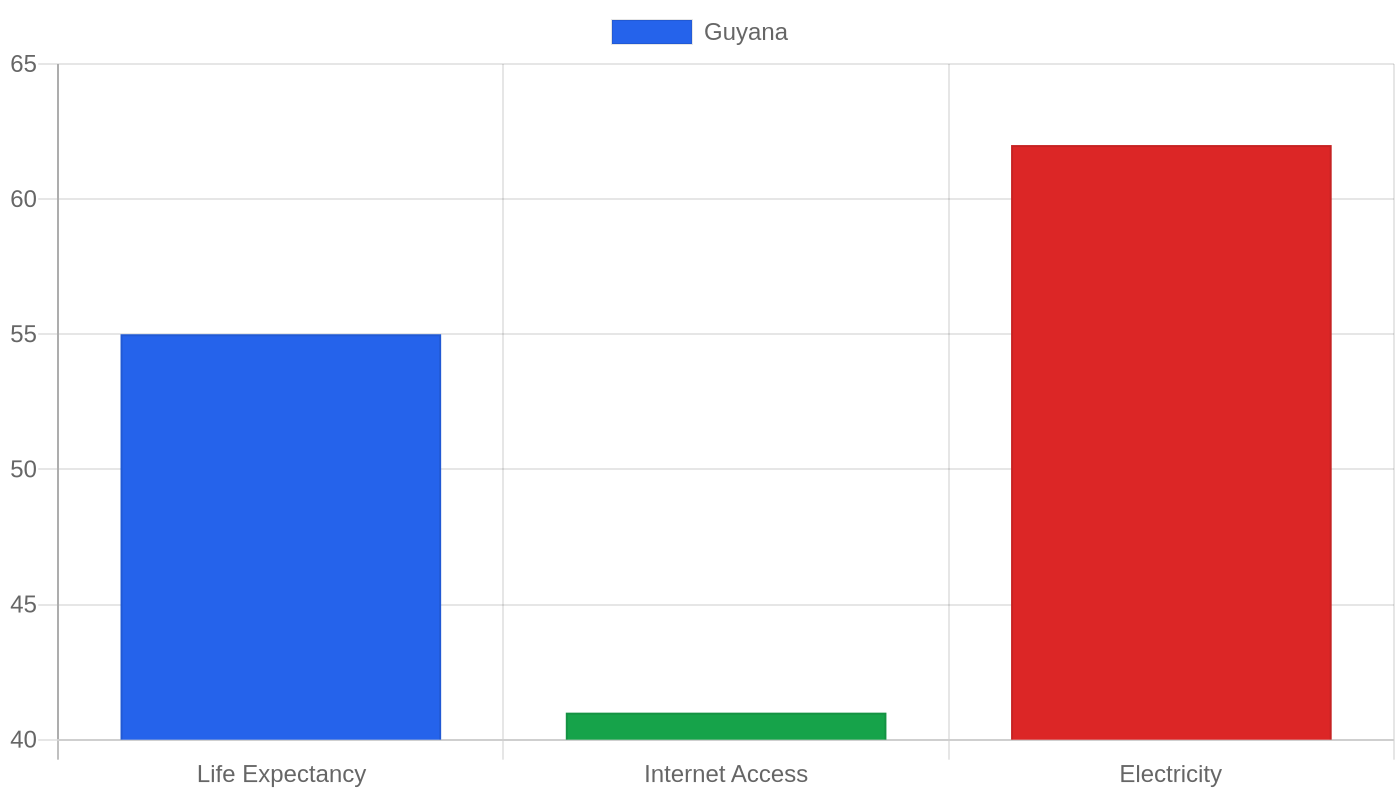
Guyana stands at a crossroads few nations ever experience. The World Bank data provided for this feature lists GDP growth, inflation, unemployment, GDP in dollar terms, GDP per capita, and GNI per capita all as “N/A” — a statistical silence that speaks volumes. This is not a data failure but a reflection of a country in the midst of such rapid structural change that traditional yardsticks struggle to keep pace.
Guyana has vaulted from one of South America’s poorest nations to the world’s fastest-growing economy in recent years, driven by massive offshore oil discoveries that began production in late 2019. Yet the World Bank’s blank cells remind us that official statistics often lag reality, especially when a single sector — energy — is rewriting the national story so quickly.
The real economy remains a tale of two worlds. On one side, the oil sector generates billions in revenue and has attracted international attention. On the other, the traditional industries that have long defined Guyanese life — sugar, rum, broadcasting, and utilities — continue to operate with the rhythms of a previous era. The main industries listed in the data are dominated by consumer goods, telecommunications, and utilities companies.
Banks DIH, Demerara Distillers, and Guyana Sugar Corporation are household names, producing everything from soft drinks to the famous El Dorado rum that graces bars worldwide. These are not sunset industries; they are the backbone of employment for hundreds of thousands of Guyanese who may never work on an offshore platform.
The inflation picture is equally opaque from the data provided, but the absence of a World Bank figure does not mean prices are stable. In economies experiencing sudden resource booms, inflation is almost always a concern — imported goods become more expensive as the local currency strengthens, and housing costs in urban centers climb as expatriate workers and new businesses compete for space.
The Bank of Guyana, the country’s central bank and one of the top companies listed in the data, faces the delicate task of managing monetary policy in an environment where the rules are being written in real time. For the average Guyanese, the boom may feel less like a rising tide lifting all boats and more like a fast current that is difficult to navigate.
The Cost of Living — Georgetown’s New Price Tags
Housing is where the transformation hits hardest. The data provided does not include specific rental or purchase prices, but any observer of resource-driven economies knows the pattern: when oil money arrives, real estate in the capital becomes a battleground. Georgetown, a city of wooden colonial buildings and canals, has seen a surge in demand for modern apartments and gated communities, driven by international oil workers, consultants, and local professionals who have benefited from the boom.
Rents that were once modest by regional standards have climbed sharply, pushing affordable housing further from the city center and straining household budgets for teachers, civil servants, and retail workers.
Daily expenses tell a similar story. Guyana imports a significant portion of its food and manufactured goods, and global supply chain pressures have combined with local demand to push up prices at markets and supermarkets. The cost of a basket of staples — rice, cooking oil, chicken, vegetables — has risen noticeably, even as the official inflation data remains unavailable in the provided World Bank figures.
For families in the interior regions, far from Georgetown’s new prosperity, the gap between the headline economic story and lived reality is even starker. Housing in rural areas remains significantly cheaper, but access to services, healthcare, and employment opportunities is limited. The choice for many Guyanese is between affordability and opportunity — a trade-off that defines life in a country undergoing rapid change.
Investment and Business Climate — Legacy Giants Meet New Money
The corporate landscape of Guyana, as revealed by the data, is dominated by companies that have been part of the national fabric for decades. Banks DIH, Demerara Distillers, and Guyana Sugar Corporation are not just businesses; they are institutions. The Guyana Power and Light Company provides electricity to a nation where reliability has historically been a challenge. Guyana Telephone and Telegraph Company, alongside ENet, shapes how Guyanese connect to each other and the world.
The Guyana Broadcasting Corporation and newspapers like the Guyana Chronicle and Kaieteur News remain central to public discourse, even as digital media grows.
For international investors, the opportunity set is clear but narrow. The energy sector is the obvious draw, but it operates in a highly regulated environment with significant state involvement. Outside of oil, the most promising sectors are those that serve a growing population with rising expectations: construction, logistics, financial services, and technology.
The Bank of Guyana, as the financial regulator, sets the rules for a banking system that is still developing its capacity to handle large-scale capital flows. The presence of multiple telecommunications companies suggests competition, but the dominance of legacy players means new entrants face barriers. The business climate is improving, but it remains one where relationships and local knowledge matter as much as balance sheets.
Safety, Politics, and Quality of Life — The Tension Beneath the Surface
The data provided lists both the Crime Index and Safety Index as “N/A,” but the political landscape section offers a more telling indicator of the challenges Guyanese face. The description is blunt: “Historically, politics is a source of tension in the country, and violent riots have often broken out during elections.” This is not a footnote; it is a central feature of life in Guyana.
The country operates as a parliamentary representative democratic republic with a multi-party system, but the divisions between the two main ethnic and political blocs — Afro-Guyanese and Indo-Guyanese — have deep roots and have periodically erupted into unrest.
Election periods are particularly fraught. The 2020 general elections were marred by controversy and delays, with international observers raising concerns about transparency. The memory of the 1960s and 1970s, when political violence was widespread, still shapes how many Guyanese view their institutions. For the average citizen, quality of life is influenced not just by economic opportunity but by a sense of stability and safety.
The absence of a formal crime index in the data does not mean crime is absent; in Georgetown, petty theft and property crime are concerns, and the rapid influx of wealth has created new opportunities for both legitimate business and illicit activity. The challenge for the government is to ensure that the oil boom strengthens social cohesion rather than exacerbating existing tensions.
What’s Happening Now — The Boom Years Arrive
Right now, Guyana is living through a moment that will define the next generation. The oil fields off the coast are producing at levels that have transformed the country’s fiscal position almost overnight. The government, operating within the framework described in the political landscape data — executive power exercised by the president and government, legislative power shared with the National Assembly — is grappling with how to manage a windfall that dwarfs anything in the nation’s history.
Debates over a sovereign wealth fund, infrastructure spending, and debt management are no longer theoretical; they are the stuff of daily headlines in the Guyana Chronicle and Kaieteur News.
The sugar industry, long a source of national pride and employment, continues its long decline, with Guyana Sugar Corporation facing the same global pressures that have reshaped the sector across the Caribbean. Meanwhile, Demerara Distillers has leaned into premium rum exports, finding success in markets that value heritage and quality.
The telecommunications sector is evolving, with ENet and Guyana Telephone and Telegraph Company competing to connect a population that is increasingly online but still faces significant infrastructure gaps. The Bank of Guyana is working to modernize the financial system, introducing new regulations and exploring digital currency options.
For anyone watching the country, the question is not whether change is coming — it is already here — but whether the institutions built for a smaller, poorer Guyana can manage the demands of a wealthier, more complex one.
The Bottom Line
Guyana is a country to watch for anyone interested in the real-world consequences of resource wealth. The oil boom offers an unprecedented opportunity to lift living standards, improve infrastructure, and build a more diversified economy. But the political tensions, rising costs, and institutional gaps revealed by the data are warning signs that wealth alone does not guarantee progress. Investors should approach with a long-term horizon and a deep understanding of local dynamics.
For policymakers and development practitioners, Guyana is a case study in how to — and how not to — manage a resource windfall in a democracy. The next few years will write a chapter that the entire region will read closely.
Sources & Methodology
This article is authored by Economic Pulse Net for informational and research purposes. Economic Pulse Net sources its data from multilateral institutions, national statistics bureaus, and proprietary databases. All data is believed to be current as of the date of publication.
Published: July 30, 2026 | Category: Research — Guyana
Use these signals in your own platform
Economic Pulse publishes its live signal feed through a documented, read-only API. Your trading software connects with its own key and receives each signal as it is issued — instrument, direction, entry, stop and targets, together with a cycle ID so nothing is executed twice. The feed is independent of this website and cannot change it.
Signals are informational only and are not financial advice.