Economic Pulse Net | Sources: World Bank World Development Indicators, Government Sources | 2026
Key Takeaways
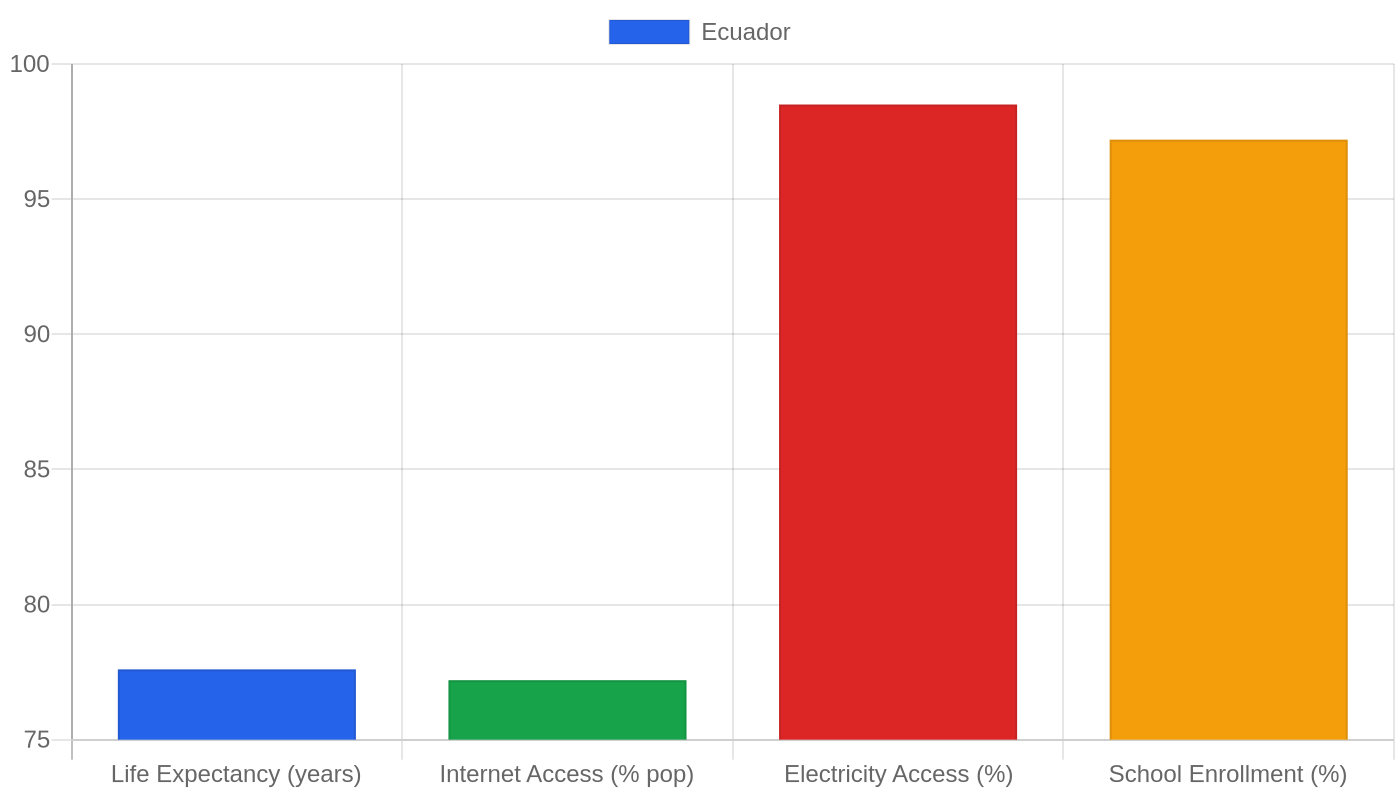
– Ecuador’s economy remains heavily dependent on its oil and gas sector, with Petroecuador standing as a state-owned titan, yet the country faces structural challenges that leave key macroeconomic indicators—GDP growth, inflation, and unemployment—unreported by the World Bank, suggesting either data gaps or a period of significant flux.
– The telecommunications sector is a surprising powerhouse, with Claro Ecuador and **CNT EP** dominating alongside a diverse mix of consumer goods, dairy, and aviation companies, indicating a service-oriented economy that is more diversified than its oil reputation suggests.
– A fragmented political system with five branches of government—including a dedicated Transparency and Social Control branch—creates a unique governance environment that can both enable oversight and slow decision-making, directly impacting business confidence and investment timelines.
– The cost of living and safety indices are not quantified in available data, leaving analysts to rely on qualitative observations from company performance and political structure to gauge daily life, a gap that itself tells a story of incomplete economic transparency.
The Missing Numbers and the Real Economy
The World Bank’s data on Ecuador presents an intriguing puzzle: GDP growth, inflation, unemployment, and even total GDP in US dollars are all listed as “N/A.” For an economy that is the eighth largest in Latin America by nominal GDP, this absence is not a void—it is a signal. It suggests either a period of statistical recalibration, a lag in reporting due to political instability, or an economy in such rapid transition that traditional metrics have not yet been captured.
What we do know, from the list of top companies, is that Ecuador runs on two parallel tracks. One track is industrial and state-driven: Petroecuador dominates the oil and gas sector, a legacy of the country’s position as an OPEC member and a major crude exporter. The other track is consumer-facing and private: **Claro Ecuador** and **CNT EP** power the nation’s communications, while **Ecuavisa** shapes its media landscape, and **Marathon Sports** and **Tía** serve its retail needs.
This duality means that when oil prices fluctuate—a perennial reality for petro-states—the entire economy feels the tremor. Yet the presence of Tonicorp in dairy products and **Ecua-Andino Hats** in consumer goods shows a domestic market that is not merely waiting for oil revenues to trickle down. The missing GDP data from the World Bank forces us to look at these companies as proxies.
If **TAME**, the state-owned airline, is still operating, it implies a level of domestic connectivity that supports business travel and tourism. If **Correos del Ecuador** remains a key industrial player, logistics and trade are moving. The economy is alive—it is simply not fully measured in the public data.
The Price of Living in a Dollarized Economy
Ecuador is one of the few countries in the world to have fully dollarized its economy, abandoning the sucre in 2000 after a severe banking crisis. This means that while inflation data from the World Bank is marked “N/A,” the practical reality is that Ecuador’s price stability is tied directly to the purchasing power of the US dollar—not to its own monetary policy. For Ecuadorians, this is a double-edged sword.
On one hand, dollarization eliminates the risk of hyperinflation and currency devaluation that plagues neighbors like Argentina. On the other hand, it means the country cannot print money to stimulate growth or devalue its currency to boost exports.
Housing costs, daily expenses, and rent-versus-buy decisions are therefore shaped by global dollar dynamics, not local policy. The presence of Tía, a major discount retail chain, suggests that consumers are price-sensitive and that the cost of living is a constant negotiation. **Marathon Sports** indicates that discretionary spending exists—people buy athletic gear and lifestyle products—but the absence of a quantified cost-of-living index from the data means we must infer from corporate behavior.
If **Tonicorp** can sustain a dairy business, basic foodstuffs are likely affordable for a significant portion of the population. The real question is whether that affordability extends to housing, and without data, the answer lies in the political choices the government makes about subsidies and social spending.
Business in the Shadow of Five Branches of Government
The list of Ecuador’s top companies reads like a blueprint for where the smart money is going. Claro Ecuador and **CNT EP** dominate telecommunications, a sector that is essential for modern commerce and is likely to grow as digital services expand. **Petroecuador** remains the 800-pound gorilla, but the presence of **Ecua-Andino Hats**—a company built on the country’s famous Panama hat tradition—shows that niche manufacturing and export-oriented consumer goods have a place.
**Ecuavisa** as a top company underscores the importance of media and advertising in a country where television remains a primary source of information.
The business climate, however, must be understood through the lens of Ecuador’s unique political structure. The state consists of five branches: Executive, Legislative, Judicial, Electoral, and Transparency and Social Control. This fifth branch is particularly noteworthy. It is designed to oversee public officials and combat corruption, but in practice, it can also create layers of bureaucracy that slow down permits, contracts, and foreign investment approvals.
For a company like Petroecuador, which operates in a capital-intensive and politically sensitive industry, this means that every major decision—from exploration contracts to refinery upgrades—must navigate a governance maze that is more complex than in many other oil-producing nations.
For smaller players like **Marathon Sports** or **Tía**, the challenge is different: they must manage supply chains and retail operations in a dollarized economy where labor costs are relatively high by regional standards, but where the consumer base is price-conscious and demanding.
Safety, Politics, and the Quality of Life Question
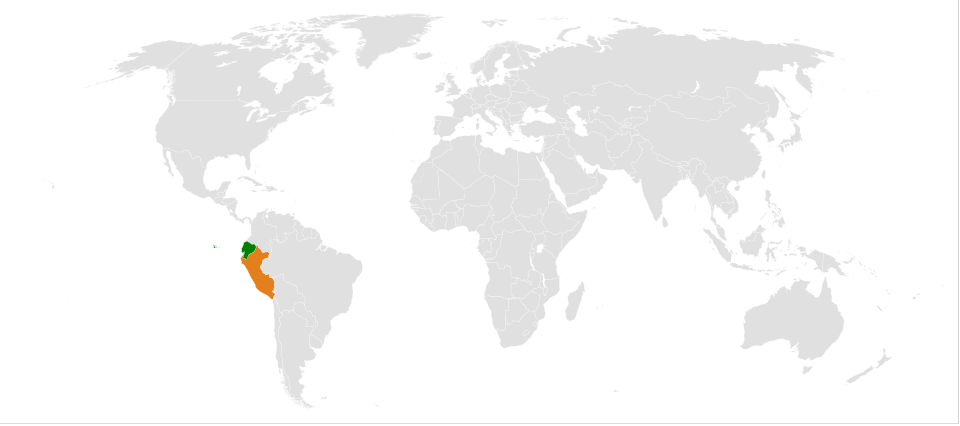
The crime and safety indices from the data are marked “N/A,” which is itself a troubling indicator for a country that has seen fluctuating security conditions in recent years. Ecuador sits between Colombia and Peru, two major cocaine-producing nations, and has experienced spillover violence from drug trafficking routes. The absence of a crime index does not mean crime is absent—it means the data is either not collected, not published, or not reliable enough for the World Bank to include.
For residents, this creates an environment of uncertainty where perceptions of safety can vary dramatically between Quito, Guayaquil, and the coastal regions.
Politically, the five-branch system is an experiment in democratic transparency. The Electoral Branch ensures that elections are independently managed, while the Transparency and Social Control branch is meant to hold all other branches accountable. In theory, this should lead to higher trust in institutions. In practice, it can lead to gridlock, especially when different branches are controlled by different political factions.
The quality of life in Ecuador is therefore a tale of two cities: one where the dollarized economy provides stability and where companies like Ecuavisa and **Marathon Sports** cater to a middle class, and another where the lack of safety data and the complexity of governance create friction for ordinary people trying to get things done.
What’s Happening Now — The Economy in Real Time
Right now, Ecuador is navigating a period of political and economic recalibration. The absence of fresh GDP and inflation data from the World Bank is not just a statistical gap—it reflects a country where the government may be prioritizing other metrics or where the economic picture is changing too quickly for traditional reporting to keep up.
The presence of TAME as a top company suggests that domestic aviation is still operational, but state-owned airlines across Latin America have faced financial pressures, and Ecuador is no exception.
The telecommunications sector, led by Claro Ecuador and **CNT EP**, is likely undergoing rapid change as 5G and digital services expand. **Petroecuador** continues to be the engine of export revenues, but global energy transitions and fluctuating oil prices mean that the company—and the country—must constantly adapt.
The consumer goods sector, from **Ecua-Andino Hats** to **Tonicorp**, is a reminder that Ecuador has a domestic economy that is resilient and entrepreneurial, even when the headline numbers are missing. The political landscape, with its five branches, is currently testing whether this elaborate system of checks and balances can deliver the stability that investors and citizens demand.
The Bottom Line
Ecuador is a country that defies easy categorization. It is an oil exporter with a diversified consumer economy, a dollarized nation in a region of volatile currencies, and a democracy with an unusually complex system of governance. Investors should watch Ecuador for its telecommunications and consumer goods potential, but they must be prepared for a business environment where political transparency comes at the cost of bureaucratic speed.
For the casual observer, Ecuador is a case study in how a middle-income country can build a modern service economy while still wrestling with the legacy of resource dependence and incomplete data. It is a nation of paradoxes—and that is precisely what makes it worth watching.
Sources & Methodology
This article is authored by Economic Pulse Net for informational and research purposes. Economic Pulse Net sources its data from multilateral institutions, national statistics bureaus, and proprietary databases. All data is believed to be current as of the date of publication.
Published: July 22, 2026 | Category: Research — Ecuador
Use these signals in your own platform
Economic Pulse publishes its live signal feed through a documented, read-only API. Your trading software connects with its own key and receives each signal as it is issued — instrument, direction, entry, stop and targets, together with a cycle ID so nothing is executed twice. The feed is independent of this website and cannot change it.
Signals are informational only and are not financial advice.