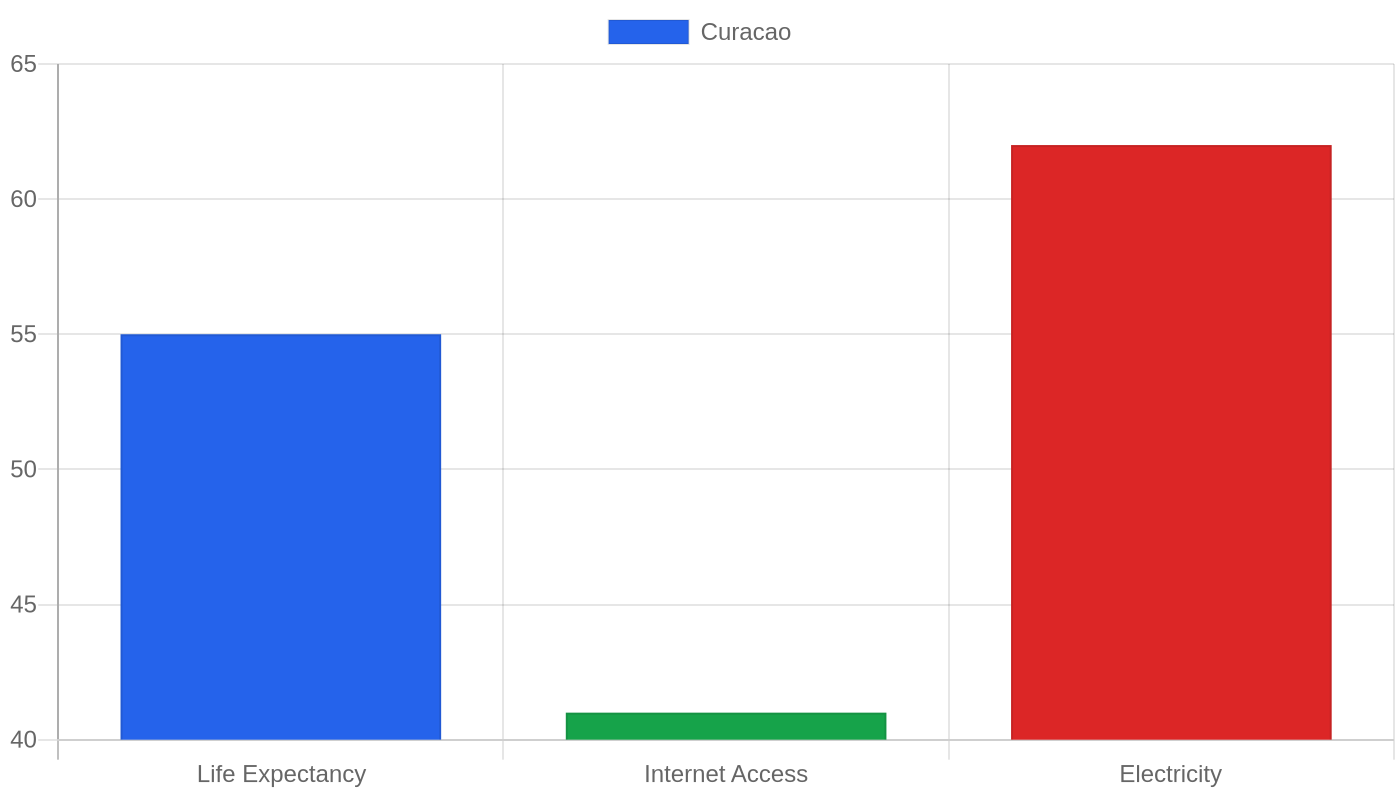
Economic Pulse Net | Sources: World Bank World Development Indicators, Government Sources | 2026
Key Takeaways
* Curacao operates as an autonomous constituent country within the Kingdom of the Netherlands, maintaining a unique parliamentary representative democracy that blends local autonomy with Dutch constitutional frameworks.
The island’s governance structure is defined by a dual headship: the King of the Netherlands serves as the ceremonial head of state, represented locally by the Governor, while the Prime Minister holds executive power as head of government.
Economic metrics such as GDP growth, inflation rates, and unemployment figures are currently reported as unavailable, requiring investors to rely on structural and political analysis rather than quantitative performance indicators.
The business environment is characterized by a lack of detailed data on major corporate entities and cost-of-living benchmarks, suggesting a market where qualitative insights into political stability may outweigh traditional financial metrics for now.
Safety indices and crime statistics are not currently quantified in available datasets, leaving the assessment of quality of life reliant on the broader political context of its ties to the European Union via the Netherlands.
Structural Foundations of Governance
Understanding Curacao’s economic potential requires first understanding its political architecture, which serves as the bedrock for all foreign and domestic investment decisions. As a constituent country of the Kingdom of the Netherlands, Curacao enjoys a significant degree of self-governance while remaining under the sovereignty of the Dutch Crown. This arrangement creates a hybrid legal and administrative system that is distinct from independent nations but more autonomous than a standard province.
The system of government operates within a framework of parliamentary representative democracy, ensuring that local legislative bodies have substantial control over internal affairs, taxation, and social policy. At the apex of this structure, the King of the Netherlands serves as the head of state, a role that is largely symbolic but constitutionally vital for international representation.
Locally, this royal authority is exercised by the Governor of Curaçao, who acts as the link between the island and the Dutch monarchy. Meanwhile, the day-to-day executive power lies with the Prime Minister of Curaçao, who serves as the head of government and leads the cabinet responsible for implementing policy.
This separation of ceremonial and executive roles provides a layer of stability, insulating daily governance from direct changes in the Dutch royal court while aligning the island with Western democratic norms. For economists and policymakers, this structure implies that while Curacao can pursue independent fiscal strategies, it remains tethered to the broader economic health and regulatory standards of the Netherlands.
Economic Indicators and Industrial Landscape
The current economic portrait of Curacao is obscured by a significant gap in quantitative data, presenting a challenge for analysts accustomed to hard metrics. According to the World Bank, key indicators including GDP growth, inflation CPI, and unemployment rates are listed as N/A%, indicating a lack of recent or published statistical reporting. Similarly, macroeconomic figures such as total GDP in USD, GDP per capita in PPP terms, GNI per capita, and overall population size are also recorded as N/A.
This absence of data does not necessarily imply economic stagnation; rather, it suggests that the economy may be transitioning, or that statistical collection methods are undergoing revision. Without concrete numbers on GDP or inflation, traditional models of economic forecasting cannot be applied, forcing observers to look at structural pillars instead.
The main industries driving the island remain undefined in the provided dataset, making it difficult to pinpoint whether the economy is heavily reliant on tourism, oil refining, or financial services. Consequently, any assessment of economic health must be qualitative, focusing on the resilience of existing sectors rather than growth trajectories.
Investors looking for clear signals of expansion or contraction will find themselves without the usual compass of percentage points and dollar values, requiring a reliance on anecdotal evidence and long-term structural trends.
Cost of Living and Housing Dynamics
For expatriates and businesses considering entry into the Curacao market, the cost of living presents a similar puzzle of missing information. Detailed breakdowns of housing costs, rental versus purchase prices, and daily consumer expenses are not available in the current data set. Typically, one would expect to see comparisons against regional averages to gauge affordability, but without specific figures, these comparisons cannot be made.
The top companies operating in the region are also unlisted, preventing an analysis of wage levels or corporate spending power that often correlates with local price indices. In the absence of hard data, prospective residents and business owners must assume that the cost structure is influenced by the island’s status as part of the Dutch Kingdom, which often implies higher standards of infrastructure and potentially higher prices compared to non-EU Caribbean neighbors.
However, without explicit confirmation, any assumption about premium pricing remains speculative. The lack of transparency in cost-of-living metrics can itself be a barrier to entry, as individuals struggle to budget accurately for relocation or operational expenses. This opacity highlights a need for localized, ground-level research before committing resources, as digital data sources currently offer no clear picture of financial requirements.
Investment Climate and Business Environment
The investment landscape in Curacao is framed by its political integration with the Netherlands rather than by visible corporate giants or sector-specific booms. Since the list of top companies is empty in the provided data, identifying “sectors to watch” relies on inferring strength from the political framework. The parliamentary representative democracy offers a predictable legal environment, which is a critical factor for long-term capital allocation.
Businesses operating here benefit from the rule of law associated with Dutch judicial systems, even if specific corporate tax incentives or industrial zones are not detailed. The business environment appears stable from a governance perspective, but opaque from a commercial activity perspective. Potential investors must navigate a vacuum of information regarding which firms dominate the market or what the competitive landscape looks like.
This lack of visibility could deter risk-averse capital, yet it may also present opportunities for early entrants who are willing to conduct primary research to identify emerging players. The absence of data on major corporations suggests that the market may be fragmented or dominated by small-to-medium enterprises whose activities are not captured in high-level economic reports.
Safety, Politics, and Quality of Life
Quality of life assessments for Curacao are currently limited by the unavailability of safety metrics. The Crime Index and Safety Index are both reported as N/A, removing two crucial variables from the equation of livability. Without these indices, it is impossible to quantify the physical security of residents or tourists, a key consideration for any destination.
However, the political landscape offers some reassurance; the operation of a parliamentary representative democracy suggests a level of civil order and institutional stability. The presence of elected officials and a structured government implies that public services and law enforcement operate within a recognized framework. Happiness data or subjective well-being scores are also not provided, leaving the emotional and social dimensions of life on the island unmeasured.
Nevertheless, the connection to the Netherlands often brings expectations of high public service standards and social safety nets, which indirectly contribute to quality of life. Prospective residents must therefore weigh the known political stability against the unknown variables of crime and daily comfort, relying on personal due diligence rather than statistical guarantees.
Current Affairs and Policy Trajectories
In the realm of current affairs, the narrative around Curacao is one of constitutional continuity rather than dramatic shift. With no recent news items or live indicators provided, there are no immediate reforms, elections, or policy shifts to report on. The economy is not currently experiencing visible inflationary spikes or deflationary traps, as those metrics are absent. Instead, the “now” of Curacao is defined by its enduring status within the Kingdom of the Netherlands.
This static nature can be interpreted as stability, but it also means that the country is not currently at the center of global economic headlines. Any developments in business or politics are likely incremental, focused on maintaining the balance between local autonomy and Dutch oversight. For journalists and analysts, the lack of fresh news underscores the importance of long-term structural observation over short-term event tracking.
The country is essentially holding steady, waiting for new data releases or political events to provide a sharper focus for coverage.
The Bottom Line
Curacao represents a case study in political stability masked by statistical silence. It is a jurisdiction where the rules of the game are clear—rooted in Dutch democratic tradition—but the scoreboard is blank. Investors and researchers should watch this country not for explosive growth metrics, but for signs of data normalization and deeper integration with Dutch economic networks.
Until concrete figures emerge, Curacao remains a place of potential rather than proven performance, best approached with caution and a focus on structural fundamentals.
Sources & Methodology
This article is authored by Economic Pulse Net for informational and research purposes. Economic Pulse Net sources its data from multilateral institutions, national statistics bureaus, and proprietary databases. All data is believed to be current as of the date of publication.
Published: October 27, 2026 | Category: Research — Curacao
Use these signals in your own platform
Economic Pulse publishes its live signal feed through a documented, read-only API. Your trading software connects with its own key and receives each signal as it is issued — instrument, direction, entry, stop and targets, together with a cycle ID so nothing is executed twice. The feed is independent of this website and cannot change it.
Signals are informational only and are not financial advice.