Economic Pulse Net | Sources: World Bank World Development Indicators, Government Sources | 2026
Key Takeaways
* Robust Expansion: India is projected to achieve a robust GDP growth rate of approximately 7.57% in 2025, signaling continued resilience in the world’s fifth-largest economy.
Price Stability: With inflation managed at a low CPI of roughly 2.4%, the central bank has successfully navigated global volatility to maintain consumer purchasing power.
Labor Market Health: An unemployment rate of 4.219% indicates a tight labor market, reflecting strong domestic demand and industrial activity.
Political Continuity: The foundational federal structure established by the Constitution continues to provide a stable framework for legislative power and economic policy implementation.
Economic Engine: Driving Global Growth
India’s macroeconomic profile presents a compelling narrative of sustained expansion amidst a complex global environment. According to World Bank data, the country’s GDP growth is projected to hit 7.56666179284244% in 2025, a figure that underscores its role as a primary engine of global economic recovery. This high growth trajectory is supported by a massive total GDP of $3.95 trillion (USD), which places India firmly among the top five economies worldwide.
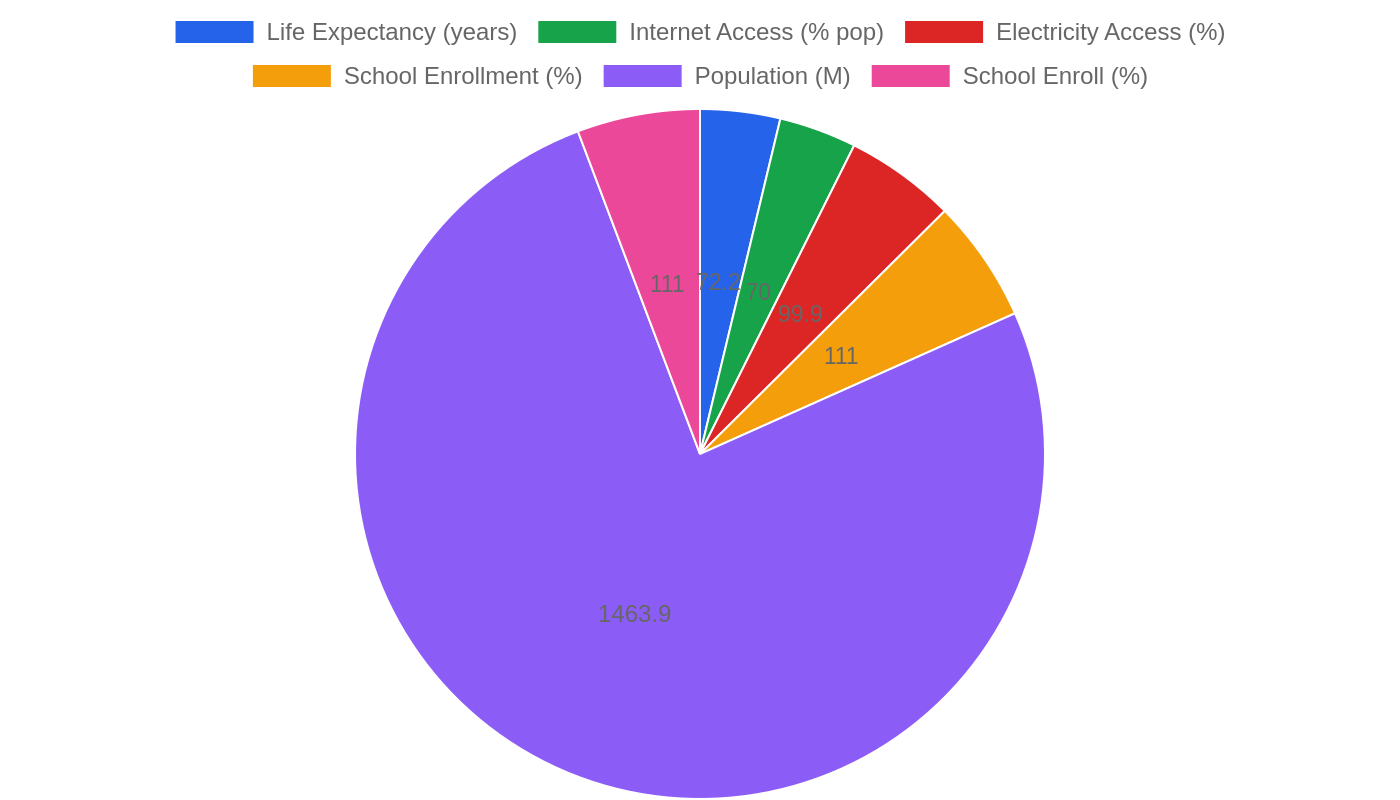
However, the sheer scale of this output must be viewed through the lens of its population; with over 1.46 billion citizens, the GDP per capita (PPP) stands at $11,747.91, indicating significant room for middle-class expansion but also highlighting the challenge of distributing wealth equitably across such a vast demographic. Furthermore, the GNI per capita of $2,760 suggests that while aggregate national income is rising, individual household incomes are still catching up to global averages.
Inflation remains well-anchored at 2.39884954182294%, a testament to effective monetary policy that prevents price shocks from eroding the gains made by workers and businesses. Crucially, the unemployment rate sits at a healthy 4.219%, suggesting that the labor force is being absorbed into productive sectors rather than sitting idle. These numbers collectively paint a picture of an economy that is not only growing fast but doing so with a degree of stability that attracts long-term foreign direct investment.
Living Costs and Housing Dynamics
For expatriates and local residents alike, understanding the cost of living is essential when evaluating India’s economic appeal. While specific housing indices are not detailed in the current dataset, the low inflation rate of nearly 2.4% implies that daily expenses are relatively stable compared to many emerging markets experiencing higher price volatility. This price stability likely extends to core necessities, making basic sustenance affordable for the majority of the 1.46 billion population.
However, the disparity between the high aggregate GDP and the lower GNI per capita ($2,760) suggests a dual economy where urban centers may offer premium services at international rates, while rural areas operate on much tighter budgets. Rent versus buy decisions in major metropolitan hubs like Mumbai or Bangalore are influenced by this dichotomy, with real estate often serving as both a utility and a primary store of value for the growing middle class.
Daily expenses, from transportation to food, are generally manageable given the controlled inflation environment, allowing households to save more than they might in high-inflation counterparts. Nevertheless, the gap between the PPP-adjusted GDP per capita and nominal figures highlights that while purchasing power parity offers a more realistic view of living standards, cash income constraints remain a reality for many families navigating the urban landscape.
Investment & Business Climate
The Indian business landscape is characterized by a diverse array of conglomerates and specialized firms driving innovation across multiple sectors. Major players such as the Adani Group dominate as conglomerates, influencing infrastructure, energy, and logistics, thereby setting the pace for large-scale industrial development. In the technology sector, companies like 63 Moons Technologies are pushing boundaries in digital services, reflecting India’s strength as a global IT hub.
Meanwhile, the industrial and manufacturing sectors are bolstered by entities like ACC, Action Construction Equipment, and ABG Shipyard, which contribute significantly to infrastructure build-out and maritime capabilities. The energy sector sees active participation from firms like Aban Offshore, ensuring that power needs are met for both domestic consumption and export markets.
Additionally, the financial services sector is evolving with new entrants like Acko General Insurance, which brings fresh competition and innovation to traditional insurance models. For investors, these companies represent a mix of established giants and agile specialists, offering exposure to both defensive staples and high-growth tech ventures.
The presence of diverse industry leaders from consumer services (ABP Group) to industrials suggests a resilient ecosystem where no single sector holds a monopoly on risk, providing a balanced portfolio opportunity for institutional and retail investors alike.
Safety, Politics & Quality of Life
Navigating the socio-political fabric of India requires an appreciation of its constitutional foundations and current safety metrics. The political landscape is anchored by the Constitution of India, drafted between 1946 and 1949, which merges federalism and parliamentarianism to create a unique balance of dispersed authority and centralized legislative power.
This framework, modeled partially on the Government of India Act 1935, provides a stable legal environment for business operations and civil rights, despite historical disruptions like Partition. Regarding personal security, current data indicates that Crime Index and Safety Index figures are listed as N/A, meaning precise statistical comparisons cannot be drawn at this moment.
However, the stability implied by the enduring constitutional structure suggests a predictable regulatory environment for residents and businesses. Quality of life varies drastically across regions, influenced by the stark contrast between the high GDP growth and the modest GNI per capita. Urban centers offer modern amenities and digital connectivity, while rural areas face different challenges related to infrastructure and service access.
Ultimately, the political continuity provided by the existing constitutional order serves as a bedrock for social cohesion, even as the nation grapples with the complexities of managing a population of over 1.46 billion people.
What’s Happening Now / Current Affairs
In the realm of current affairs and market dynamics, India is witnessing significant shifts in both traditional and digital finance sectors. Recent reports highlight the performance of crypto assets, with Bitcoin hovering near $80,000 and Ethereum at $2,370, driven by macro uncertainty and weak institutional flows, as noted in coverage from *Economic Times*. This global crypto trend intersects with India’s own burgeoning digital economy, where fintech innovations are reshaping how citizens interact with money.
Simultaneously, market snapshots from *Livemint* indicate active trading environments, reflecting investor interest in domestic equities amid global headwinds. The *Economic Times* also features exclusives from Harvard Business Review, suggesting a growing intellectual engagement with management practices and corporate strategy within Indian enterprises. Trending topics in markets point to a dynamic stock exchange where both domestic capital and foreign institutional investors are actively positioning themselves.
These developments underscore a country that is not just passively observing global trends but actively participating in them, particularly in technology and finance. The interplay between global crypto volatility and domestic market trends creates a complex but exciting environment for stakeholders looking to understand the pulse of India’s financial sector.
The Bottom Line
India represents a critical watchlist for any global investor seeking high-growth opportunities with manageable inflation risks. The combination of nearly 7.6% GDP growth and sub-3% inflation offers a rare blend of expansion and stability that is hard to find in other emerging markets. While data gaps exist regarding precise safety indices and granular cost-of-living breakdowns, the overarching economic indicators point to a robust and resilient system.
Stakeholders should focus on the interplay between large conglomerates and specialized tech firms, as these entities drive the majority of value creation. For those willing to navigate the nuances of a federal political structure and a diverse cultural landscape, India offers substantial long-term rewards.
Sources & Methodology
This article is authored by Economic Pulse Net for informational and research purposes. Economic Pulse Net sources its data from multilateral institutions, national statistics bureaus, and proprietary databases. All data is believed to be current as of the date of publication.
Published: October 27, 2026 | Category: Research — India
Use these signals in your own platform
Economic Pulse publishes its live signal feed through a documented, read-only API. Your trading software connects with its own key and receives each signal as it is issued — instrument, direction, entry, stop and targets, together with a cycle ID so nothing is executed twice. The feed is independent of this website and cannot change it.
Signals are informational only and are not financial advice.