Economic Pulse Net | Sources: World Bank World Development Indicators, Government Sources | 2026
Key Takeaways
* Moderate but Steady Growth: Brazil’s economy is projected to expand by approximately 2.29% in 2025, reflecting a resilient but cautious recovery trajectory.
Inflation Under Control: With CPI hovering near 5.02%, the central bank appears to have stabilized price pressures, though they remain above ideal targets.
Labor Market Tightness: Unemployment stands at a relatively low 5.97%, indicating a tight labor market despite slower overall economic expansion.
Industrial Diversity: From agribusiness giants like Amaggi to consumer staples provider AmBev, Brazil’s corporate landscape is anchored by resource-heavy and domestic-consumption sectors.
Political Continuity: Under President Luiz Inácio Lula da Silva, the presidential system established in 1993 continues to drive policy, balancing democratic stability with complex governance demands.
Economic Momentum Amidst Global Headwinds
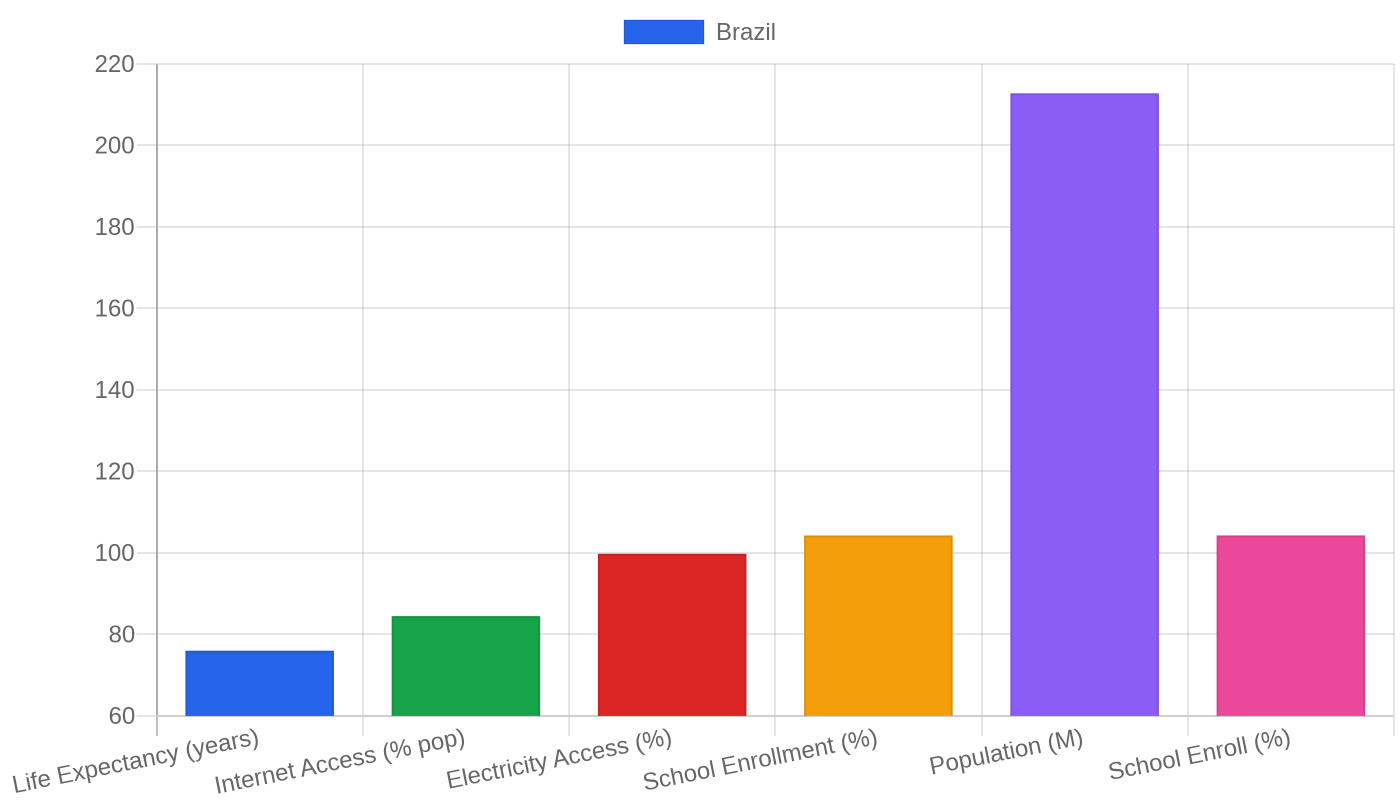
Brazil’s economic narrative in 2025 is defined by resilience rather than explosive growth. According to World Bank data, the country’s GDP growth is projected at 2.2857464902475% for the year, a figure that suggests steady, albeit modest, expansion. This growth rate is significant because it indicates that the world’s largest country in South America is maintaining momentum despite global volatility.
However, this expansion comes with a cost of living pressure; the Consumer Price Index (CPI) is recorded at 5.01675279604836%. While inflation has likely cooled from previous peaks, it remains a critical variable for policymakers, as sustained double-digit inflation would erode purchasing power. On the employment front, the unemployment rate sits at 5.97%, a level that suggests a healthy labor market where businesses are still competing for talent.
This tightness in the labor market supports domestic consumption, which is vital for an economy with a population of 212,812,405.0 people. The sheer size of the economy, valued at $2,279,920,092,492.13 in USD, underscores Brazil’s status as a major global player. Yet, the disparity between nominal GDP and GNI per capita ($10,550.0) highlights income inequality, a structural challenge that limits the broad-based benefits of this growth.
Ultimately, the 2.29% growth figure is not just a number; it represents a fragile equilibrium between robust industrial output and persistent social disparities.
Cost of Living and Daily Expenses
For residents and expatriates alike, navigating Brazil’s cost of living requires understanding the interplay between wage levels and inflationary pressures. With a GDP per capita (PPP) of $23,433.2897595431, the average standard of living shows that while aggregate wealth is high, individual purchasing power varies significantly across regions. The CPI of roughly 5.02% directly impacts daily expenses, meaning that essential goods and services are becoming progressively more expensive for the average household.
Although specific housing cost metrics are not detailed in the current dataset, the general inflation trend suggests that rent and utility costs are likely rising in tandem with broader price indices. For the middle class, represented by companies like Algar in telecommunications or Alupar in utilities, service costs are a major component of monthly budgets.
The contrast between the high nominal GDP and the moderate GNI per capita implies that basic necessities may consume a larger share of income for lower-income groups. Consequently, financial planning in Brazil must account for these inflationary headwinds, as savings lose value faster than in economies with stricter price controls. The absence of specific crime indices also means that safety considerations often indirectly influence housing choices, potentially driving up rents in secure urban enclaves.
Therefore, while the PPP figure offers a baseline for comparison, the real-world experience is shaped by the 5% inflation rate and the diverse economic stratification within the population.
Investment Landscape and Corporate Power
Brazil’s business environment is dominated by a mix of state-influenced entities and private conglomerates that leverage the country’s vast natural resources and large domestic market. Investors looking at the top companies will find heavyweights in agribusiness and consumer goods, sectors that are crucial for both local sustenance and export revenue.
Amaggi Group stands out in agribusiness, capitalizing on Brazil’s position as a global food supplier, while AmBev dominates the consumer goods sector, reflecting strong domestic brand loyalty. In the industrial and utilities space, companies like Airship do Brasil and Alupar provide essential infrastructure services, making them stable, if less glamorous, investment targets.
The presence of conglomerates such as Andrade Gutierrez indicates a diversified industrial base that spans construction, energy, and other key areas. Meanwhile, firms like Aperam South America and Aracruz Celulose highlight the importance of basic materials, tying Brazil’s economy closely to global commodity cycles. Telecommunications provider Algar and consumer services firm AstralSat further illustrate the shift toward digital and service-oriented industries.
For foreign investors, these companies offer entry points into a market that is less reliant on volatile oil prices and more focused on agricultural and industrial production. However, the political landscape under President Lula da Silva adds a layer of complexity, as policy shifts can impact regulatory environments for these major players. Understanding the dynamics of these top firms is essential for anyone seeking to navigate Brazil’s corporate terrain.
Safety, Politics, and Quality of Life
The quality of life in Brazil is deeply intertwined with its political structure and security environment. Politically, the country operates as a democratic federative republic with a presidential system, a framework solidified by a 1993 referendum. President Luiz Inácio Lula da Silva holds the dual role of head of state and government, elected for a four-year term with the possibility of re-election.
His administration appoints Ministers of State who form the cabinet, creating a centralized executive branch that drives national policy. This political stability is a key factor for long-term planning, although the concentration of power in the presidency can lead to rapid policy shifts. On the safety front, the Crime Index and Safety Index are listed as N/A, which presents a challenge for assessing personal security risks accurately.
Without specific data, potential residents and investors must rely on localized reports and anecdotal evidence to gauge safety conditions. The lack of transparent safety metrics can deter some international talent, particularly those with families. However, the democratic nature of the government provides a check on arbitrary power, contributing to a sense of institutional predictability. The combination of a robust political system and undefined safety metrics creates a mixed bag for quality of life assessments.
Residents must balance the benefits of democratic participation against the uncertainties of personal security in various urban centers.
Current Affairs and Policy Shifts
Right now, the focus in Brazil is on how President Lula da Silva’s administration is managing the delicate balance between economic growth and social equity. With inflation at 5.02%, the central bank is likely maintaining a cautious monetary stance to prevent price spirals while supporting the 2.29% GDP growth target. The political landscape is active, with the president leveraging his cabinet to implement reforms that aim to address inequality without stifling industrial output.
Recent developments suggest a continued emphasis on strengthening the agribusiness and utility sectors, given the prominence of companies like Amaggi and Alupar in the national economy. The labor market, with unemployment at 5.97%, remains a point of pride for the government, showcasing job creation as a key achievement. However, the gap between the high GDP and lower GNI per capita indicates that inclusive growth remains a work in progress.
Political analysts are watching closely to see if the president can secure re-election or maintain support through effective economic management. The upcoming fiscal years will test whether Brazil can sustain its growth trajectory amidst global economic uncertainties. For now, the narrative is one of cautious optimism, with policies aimed at stabilizing prices while fostering industrial development.
The Bottom Line
Brazil presents a compelling case for investors and observers willing to navigate its complexities. The country offers a large, growing economy with a strong industrial base and a stable democratic framework. However, the challenges of inflation and unclear safety metrics require careful due diligence. Those interested in agribusiness, consumer staples, and utilities will find significant opportunities among the nation’s top corporations.
Ultimately, Brazil is a market where patience and local knowledge are rewarded, making it a strategic play for long-term global portfolios.
Sources & Methodology
This article is authored by Economic Pulse Net for informational and research purposes. Economic Pulse Net sources its data from multilateral institutions, national statistics bureaus, and proprietary databases. All data is believed to be current as of the date of publication.
Published: October 29, 2026 | Category: Research — Brazil
Use these signals in your own platform
Economic Pulse publishes its live signal feed through a documented, read-only API. Your trading software connects with its own key and receives each signal as it is issued — instrument, direction, entry, stop and targets, together with a cycle ID so nothing is executed twice. The feed is independent of this website and cannot change it.
Signals are informational only and are not financial advice.