Economic Pulse Net | Sources: World Bank World Development Indicators, Government Sources | 2026
Key Takeaways
* Data Deficit: Official macroeconomic indicators, including GDP growth, inflation, and unemployment rates, are currently unavailable from the World Bank, creating a significant blind spot for international investors.
Political Volatility: While democratic traditions exist since 1982, the nation has experienced three abrupt presidential departures in recent decades, signaling underlying institutional fragility.
Sector Concentration: The corporate landscape is heavily dominated by financial services and consumer aviation, with major banks and airlines representing the core of the formal business ecosystem.
Safety Ambiguity: Reliable metrics for crime and safety indices are missing, making risk assessment for expatriates and foreign entities exceptionally difficult without on-the-ground intelligence.
The Paradox of Invisible Metrics
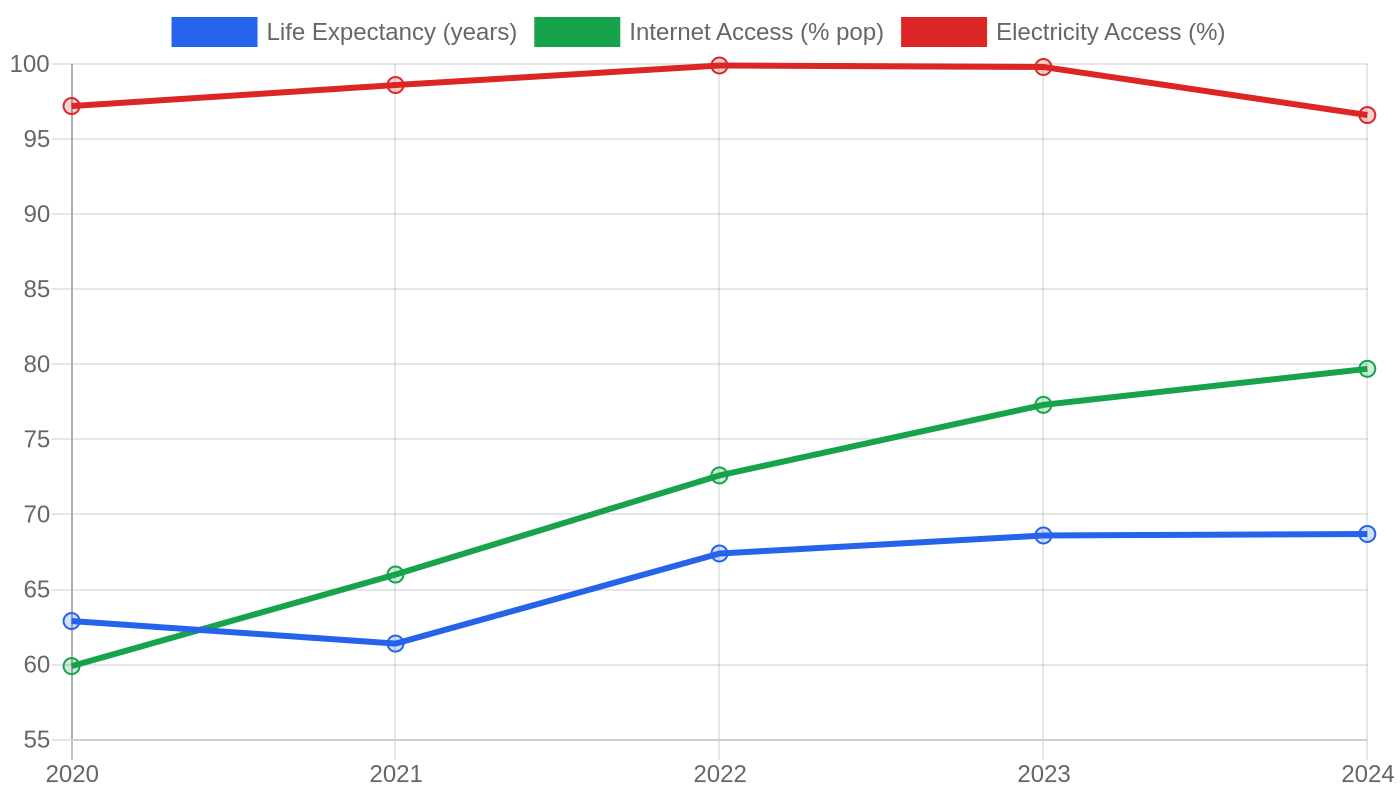
The most striking feature of Bolivia’s current economic profile is not what is growing, but what cannot be measured. According to the latest data from the World Bank, critical macroeconomic indicators such as GDP growth, inflation CPI, and unemployment rates are listed as “N/A.” This absence of data is more than a statistical gap; it represents a fundamental disconnect between the country’s economic activity and its ability to report it transparently.
Without clear figures on GDP per capita or GNI, analysts cannot accurately gauge the standard of living or the velocity of capital within the nation. This lack of visibility forces observers to rely on qualitative assessments rather than quantitative rigor, complicating any attempt to forecast short-term trends. When the primary source of global economic data cannot provide a baseline, the economy effectively operates in a vacuum, where policy impacts are felt but not recorded.
Consequently, any discussion of Bolivia’s economic health must acknowledge that we are navigating by intuition rather than precise coordinates, leaving the true scale of its industrial output and consumer spending largely obscured.
The Hidden Cost of Living
In the absence of official consumer price index data, understanding the cost of living in Bolivia requires a shift from national averages to localized realities. While specific inflation percentages are unreported, the daily expenses faced by residents likely reflect the broader economic uncertainties that plague nations with incomplete statistical frameworks.
Housing costs, whether renting or buying, are difficult to benchmark against regional averages because the necessary comparative data points are missing from the provided dataset. This makes it challenging for newcomers or returning citizens to budget effectively, as they cannot rely on standardized metrics for groceries, utilities, or transportation.
The lack of transparency in these everyday costs often leads to a dual reality: one for those with access to informal market knowledge and another for outsiders relying on potentially outdated or generalized information. Ultimately, the cost of living in Bolivia remains a variable equation, dependent heavily on individual location and social networks rather than predictable national trends.
Banking Giants and Aviation Links
When examining the investment climate, the corporate structure of Bolivia reveals a concentration of power in specific, traditional sectors. The list of top companies highlights a dominance by financial institutions, including Banco BISA, Banco de Crédito de Bolivia, Banco Mercantil Santa Cruz, Banco Nacional de Bolivia, and the Central Bank of Bolivia.
These entities form the backbone of the financial system, suggesting that credit availability and monetary policy implementation are central to the country’s operational stability. Beyond finance, the consumer services sector is anchored by major aviation players such as Aerocon, AeroSur, Boliviana de Aviación, and the Bolivian Stock Exchange. The presence of Agencia Boliviana de Correos indicates a reliance on state-linked infrastructure for logistics and communication.
This narrow base of prominent corporations suggests that investment opportunities may be limited to established players with deep government ties or historical precedence. For foreign investors, the business environment appears defined less by a dynamic startup culture and more by the enduring influence of legacy banks and national carriers, which serve as the primary conduits for economic exchange.
Safety, Politics, and Social Stability
Navigating the social and political terrain of Bolivia requires an understanding of its complex history of governance. Since 1982, the country has been governed by democratically elected governments, marking a significant departure from its earlier era of various dictatorships. Presidents Hernán Siles Zuazo (1982–1985) and Víctor Paz Estenssoro (1985–1989) established a crucial tradition of peacefully ceding power, a norm that has generally held steady.
However, this stability has been punctuated by three instances of presidents stepping down under extraordinary circumstances: Gonzalo Sánchez de Lozada in 2003, Carlos Mesa in 2005, and Evo Morales in 2019. These events underscore a persistent volatility beneath the surface of electoral democracy. Furthermore, with Crime Index and Safety Index data listed as “N/A,” assessing personal security is impossible through standard metrics.
This lack of safety data complicates travel advisories and expatriate planning, forcing individuals to rely on anecdotal evidence and local community feedback rather than authoritative statistics.
Current Affairs and Institutional Fragility
The freshest developments in Bolivia are characterized less by new policy announcements and more by the lingering echoes of past political upheavals. The recent news landscape is dominated by the historical precedents of abrupt leadership changes, particularly the exit of Evo Morales in 2019, which serves as a constant reference point for current political tensions.
While no new elections or immediate reforms are detailed in the current data snapshot, the ongoing relevance of these past crises suggests that political risk remains a primary driver of public discourse. Investors and observers must remain vigilant regarding potential triggers for social unrest, given the precedent of presidents being forced out of office during periods of crisis.
The absence of fresh economic data means that current affairs are interpreted through the lens of political survival rather than economic performance. As such, the “now” in Bolivia is defined by caution, with stakeholders watching closely for any signs of renewed instability that could disrupt the fragile democratic norms established over the last four decades.
The Bottom Line
Bolivia presents a challenging case for international engagement due to the severe lack of transparent economic data and the persistent shadow of political volatility. It is a country where the rules of engagement are unclear, and the risks associated with safety and governance are difficult to quantify. Potential investors should approach with extreme caution, focusing on established financial and aviation sectors while remaining aware of the unpredictable political environment.
For now, Bolivia remains a nation of significant mystery, where decisions must be made with limited information and high sensitivity to historical precedents.
Sources & Methodology
This article is authored by Economic Pulse Net for informational and research purposes. Economic Pulse Net sources its data from multilateral institutions, national statistics bureaus, and proprietary databases. All data is believed to be current as of the date of publication.
Published: October 29, 2026 | Category: Research — Bolivia
Use these signals in your own platform
Economic Pulse publishes its live signal feed through a documented, read-only API. Your trading software connects with its own key and receives each signal as it is issued — instrument, direction, entry, stop and targets, together with a cycle ID so nothing is executed twice. The feed is independent of this website and cannot change it.
Signals are informational only and are not financial advice.