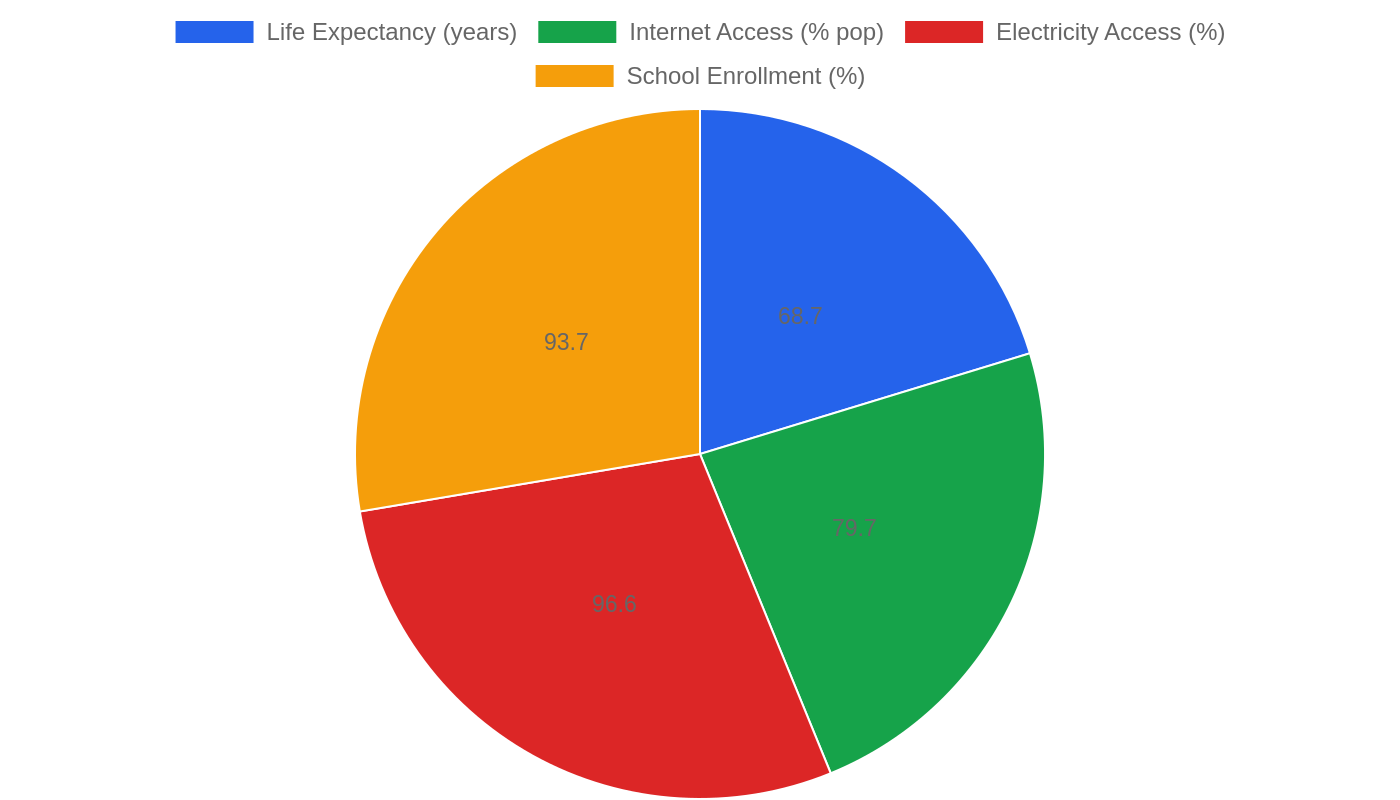
Economic Pulse Net | Sources: World Bank World Development Indicators, Government Sources | 2026
Key Takeaways
– Bolivia has maintained democratic governance since 1982, but political turbulence remains a defining feature, with three presidents forced from office in extraordinary circumstances between 2003 and 2019.
– The country’s financial sector is robust, anchored by major institutions including the Central Bank of Bolivia, the Bolivian Stock Exchange, and leading commercial banks such as Banco BISA and Banco Mercantil Santa Cruz.
– Bolivia’s aviation sector features prominently among its top companies, with carriers like Boliviana de Aviación and Aerocon serving as key players in a geographically challenging landscape.
– While specific economic indicators from the World Bank are currently unavailable, Bolivia’s story is one of a resource-rich nation navigating the complex interplay between democratic institutions and periodic political crisis.
The Paradox of Plenty — What Bolivia’s Economy Tells Us
Bolivia sits at a curious crossroads in its economic narrative. The World Bank data currently offers no specific figures for GDP growth, inflation, unemployment, or GDP per capita — a gap that itself tells a story about the challenges of data collection and economic transparency in a nation that has long struggled to translate its natural wealth into consistent, measurable prosperity.
What is clear from the available information is that Bolivia’s economic architecture rests on a foundation of financial services and transportation, two sectors that speak volumes about the country’s priorities and challenges.
The financial sector dominates Bolivia’s corporate landscape. The Central Bank of Bolivia stands as the monetary authority, while the Bolivian Stock Exchange provides a formal mechanism for capital markets. Major commercial lenders including Banco BISA, Banco de Crédito de Bolivia, Banco Mercantil Santa Cruz, and Banco Nacional de Bolivia form the backbone of the banking system.
This concentration suggests a formal economy that relies heavily on institutional finance rather than informal or commodity-driven growth, which is notable for a nation with significant natural resource endowments.
The prominence of aviation companies — Boliviana de Aviación, Aerocon, and AeroSur — reflects Bolivia’s geographic reality. This is a country of dramatic topography, where the Andes mountains create formidable barriers to ground transportation. Airlines are not luxuries here; they are economic lifelines connecting the highland administrative capital of La Paz with the lowland commercial hub of Santa Cruz and the constitutional capital of Sucre.
The presence of Agencia Boliviana de Correos, the national postal service, among the top companies further underscores the importance of connectivity in a nation where infrastructure remains a persistent challenge.
Without specific GDP or inflation figures from the World Bank, analysts must look to the structural composition of Bolivia’s economy for insight. The dominance of financial services suggests a mature banking sector capable of intermediating capital, but the absence of major industrial or manufacturing firms among the top companies raises questions about economic diversification.
Bolivia has historically relied on natural gas exports, mining, and agriculture, yet none of these sectors appear prominently in the corporate rankings — a discrepancy that may indicate either data limitations or a genuine shift toward services.
Living Costs in the Land of Extremes
Bolivia presents a unique cost of living environment shaped by its dramatic geography and dual capital cities. Without specific cost data available from the provided materials, what can be said is that Bolivia has traditionally been considered one of South America’s more affordable countries for both residents and visitors.
Housing costs typically vary dramatically between the high-altitude western cities and the warmer eastern lowlands, with La Paz commanding premium prices for its limited buildable land in a deep canyon setting.
The rental market in Bolivia operates largely on informal arrangements, particularly outside the major urban centers. Buying property has historically been more accessible to middle-class families than in many neighboring countries, though financing through the formal banking sector — dominated by institutions like Banco Nacional de Bolivia and Banco Mercantil Santa Cruz — remains the standard route for most purchasers.
Daily expenses for food, transportation, and utilities tend to track regional averages for the Andean nations, though Bolivia’s isolation from major ports has historically pushed certain imported goods to premium prices.
Banking on Bolivia — Investment Climate and Corporate Power
Bolivia’s investment climate is defined by the commanding presence of its financial sector. The top companies list reads like a who’s who of Bolivian banking, with five financial institutions — Banco BISA, Banco de Crédito de Bolivia, Banco Mercantil Santa Cruz, Banco Nacional de Bolivia, and the Central Bank of Bolivia — joined by the Bolivian Stock Exchange.
This concentration suggests that for investors, the financial sector represents the most formalized and accessible entry point into the Bolivian economy.
The aviation sector offers another compelling opportunity. Boliviana de Aviación serves as the national carrier, while Aerocon and AeroSur provide regional connectivity. These companies operate in a market where air travel is not merely convenient but often essential, given the country’s challenging topography.
The presence of three aviation companies among the top firms indicates a sector with significant operational scale and potential for growth, particularly as Bolivia’s middle class expands and demand for domestic travel increases.
Investors should note the absence of extractive industries, manufacturing, or technology firms among the top companies. This may reflect either the data’s focus on formal sector employment and revenue, or it may signal genuine gaps in Bolivia’s economic diversification. The financial sector’s dominance also means that the health of the banking system is effectively a proxy for the health of the broader formal economy — a concentration risk that prudent investors must weigh carefully.
Democracy Under Pressure — Safety, Politics, and Daily Life
Bolivia’s political landscape is a study in democratic resilience. Since 1982, the country has been governed by democratically elected governments, marking a decisive break from the dictatorships that preceded that year. The tradition of peaceful power transfer began with Presidents Hernán Siles Zuazo and Víctor Paz Estenssoro, but it has been tested repeatedly.
Three presidents have been forced to resign under extraordinary circumstances: Gonzalo Sánchez de Lozada in 2003, Carlos Mesa in 2005, and Evo Morales in 2019.
This pattern of political instability coexists with the formal continuity of democratic institutions. Bolivia has never returned to military rule since 1982, even as presidents have been ousted by mass protests and political crises. The 2019 resignation of Evo Morales, the country’s first indigenous president who had been in power since 2006, was particularly dramatic, sparking a period of intense political polarization that continues to shape the country’s trajectory.
The crime and safety indices are not available from the provided data, making it difficult to offer specific assessments of public security. What can be said is that Bolivia’s political volatility has at times manifested in street protests, blockades, and civil unrest, particularly in the capital cities. These disruptions can affect daily life and business operations, though they have not historically escalated into widespread violent crime on the scale seen in some neighboring countries.
Quality of life in Bolivia is heavily dependent on location, with urban professionals in La Paz and Santa Cruz enjoying amenities and services that contrast sharply with conditions in rural areas.
Current Crossroads — Bolivia’s Political Reckoning
Right now, Bolivia is navigating the aftermath of its most recent political crisis. The resignation of Evo Morales in November 2019 triggered a cascade of events that reshaped the country’s political landscape, including the brief interim presidency of Jeanine Áñez and the subsequent election of Luis Arce, Morales’s former finance minister, in 2020.
The political fault lines that emerged during this period remain raw, with the country deeply divided between supporters of the Movement Toward Socialism (MAS) party and opposition forces.
The economic implications of this political uncertainty are significant. The financial sector, anchored by institutions like the Central Bank of Bolivia and the Bolivian Stock Exchange, has had to navigate periods of capital flight, currency pressure, and policy uncertainty. The aviation industry, represented by carriers like Boliviana de Aviación, has faced the dual challenges of political disruption and the broader global pressures affecting air travel.
The national postal service, Agencia Boliviana de Correos, continues to operate as a critical infrastructure provider in a country where reliable communications remain essential.
Bolivia’s democratic institutions are being tested by the same forces that unseated three presidents in sixteen years. The question facing the country is whether its tradition of peaceful, if tumultuous, political transitions can evolve into a more stable governance model that allows for consistent economic policymaking.
The financial sector’s continued prominence suggests that capital and commerce have found ways to operate despite the political noise, but the absence of specific economic data from the World Bank serves as a reminder that transparency and institutional capacity remain works in progress.
The Bottom Line
Bolivia demands attention from anyone interested in the intersection of democratic governance, natural resource wealth, and political instability in Latin America. The country’s financial sector is surprisingly sophisticated for a nation of its size and income level, offering potential entry points for investors willing to navigate political risk. The aviation industry represents a critical infrastructure play in a geography that makes air travel essential rather than optional.
But Bolivia’s fundamental story is political: a democracy that has survived multiple crises but has yet to achieve the stability that would allow its considerable potential to be fully realized. Watch Bolivia for its lessons in democratic resilience — and for the moment when political stability finally catches up with institutional continuity.
Sources & Methodology
This article is authored by Economic Pulse Net for informational and research purposes. Economic Pulse Net sources its data from multilateral institutions, national statistics bureaus, and proprietary databases. All data is believed to be current as of the date of publication.
Published: July 19, 2026 | Category: Research — Bolivia
Use these signals in your own platform
Economic Pulse publishes its live signal feed through a documented, read-only API. Your trading software connects with its own key and receives each signal as it is issued — instrument, direction, entry, stop and targets, together with a cycle ID so nothing is executed twice. The feed is independent of this website and cannot change it.
Signals are informational only and are not financial advice.