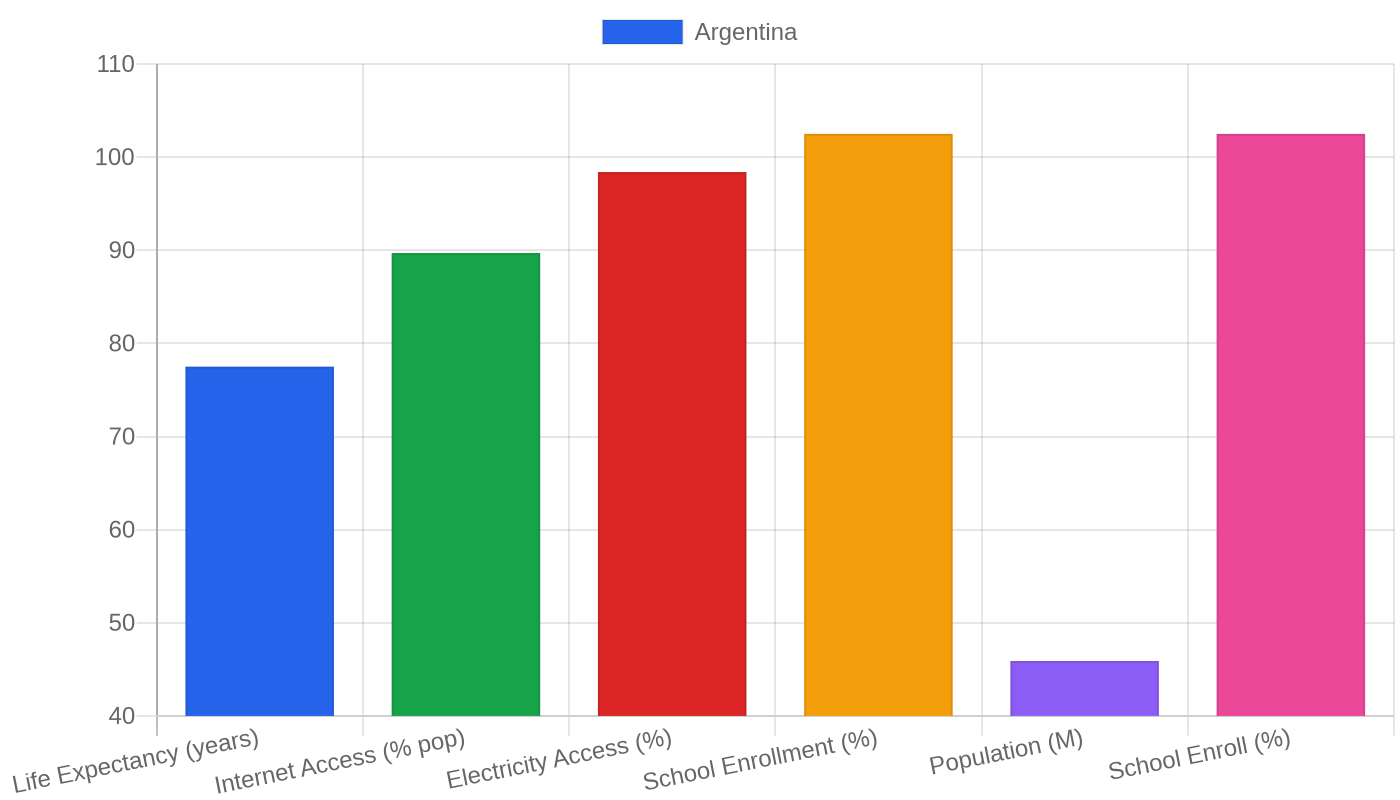
Economic Pulse Net | Sources: World Bank World Development Indicators, Government Sources | 2026
Key Takeaways
* Resilient Growth in Turbulent Times: Despite an astronomical inflation rate exceeding 219%, Argentina’s economy is projected to expand by over 4.3% in 2025, signaling a complex recovery phase.
High Cost of Living vs. Purchasing Power: With a GDP per capita (PPP) of roughly $32,586, there is a stark contrast between nominal income levels and the daily reality of soaring consumer prices.
Political Stability Returns: The nation has maintained democratic continuity since 1983, enduring major crises without reverting to military rule, providing a baseline for political risk assessment.
Industrial and Service Dominance: Major corporate players are concentrated in industrials, consumer services, and basic materials, reflecting a diversified but challenged industrial base.
Economic Resurgence Against Inflationary Headwinds
Argentina’s economic landscape in 2025 presents a paradox that demands careful scrutiny. According to World Bank data, the country’s GDP growth is projected at 4.37%, a figure that suggests robust expansion despite severe macroeconomic distortions. This growth trajectory is particularly notable given the staggering CPI inflation rate of 219.88%, which erodes purchasing power and complicates long-term planning for businesses and households alike.
However, when adjusting for purchasing power parity, the GDP per capita stands at approximately $32,586, indicating that while nominal costs are high, the underlying productive capacity of the workforce remains significant. Unemployment sits at 7.145%, suggesting that the labor market is absorbing workers even as price stability remains elusive. This combination of high growth and high inflation often points to an economy undergoing painful structural adjustments or recovering from a deep contraction.
For investors, this means that volume and activity may be returning, but real wage gains are being swallowed by the cost of living. The GNI per capita of $14,650 further highlights the disparity between national income metrics and individual financial comfort. Ultimately, the 4.3% growth rate indicates that the engine of the Argentine economy is running, even if the fuel mix is currently volatile and expensive.
The Daily Reality: Housing and Living Expenses
For residents and expatriates alike, the cost of living in Argentina is defined by the tension between high nominal prices and localized purchasing power. While specific housing indices are not provided in the current dataset, the broader context of a 219.88% inflation rate implies that rent and property values have likely adjusted rapidly to maintain real value.
Daily expenses for food, utilities, and transportation would be heavily influenced by this macroeconomic pressure, making budgeting exceptionally difficult for those earning in local currency. However, the relatively high GDP per capita (PPP) of $32,586 suggests that for those with access to international markets or premium sectors, the quality of life may remain comparable to other emerging markets.
Comparing this to regional averages is challenging without explicit comparative data, but the sheer scale of inflation suggests that Argentina is operating under unique price dynamics distinct from its neighbors. Consumers must navigate a environment where cash flow management is critical, as the rapid depreciation of currency value can quickly alter the affordability of basic goods.
Housing markets, therefore, likely reflect a dual reality: one driven by speculative investment to hedge against inflation, and another constrained by the shrinking disposable income of the average worker.
Investment Climate: Industrials and Services Lead
The business environment in Argentina is anchored by a diverse set of leading companies across several key sectors. In the industrials sector, firms like Aero Boero, AeroDreams, and Agrinar represent the backbone of manufacturing and agricultural processing, areas critical to the country’s export potential. Aluar, operating in basic materials, underscores the importance of resource extraction and processing in the national economy.
Meanwhile, the consumer services sector is dominated by major entities such as Aerolíneas Argentinas, Aero VIP, and media outlets like Ámbito Financiero and América 24. These companies indicate that despite economic volatility, core service industries and transportation networks remain active and consolidated. For foreign investors, these established players offer entry points into a market that still possesses significant domestic demand.
The presence of production houses like Aleph Producciones also hints at a vibrant creative industry contributing to the service economy. While crime and safety indices are unavailable, the operational continuity of these top companies suggests that the private sector is adapting to the regulatory and economic climate. Investors should watch the industrials and services sectors closely, as they appear to be the primary drivers of corporate revenue and employment in the current cycle.
Political Continuity and Social Safety
Argentina’s political history provides a crucial backdrop for understanding its current stability. Throughout the 20th century, the nation experienced significant turmoil, with the armed forces overthrowing six governments between 1930 and 1976, alternating between restricted democracy and military rule. However, the transition that began in 1983 marked a turning point, reestablishing full-scale democracy that has endured through subsequent challenges, including the severe 2001–02 crisis.
This historical resilience suggests that while policy shifts may occur frequently, the institutional framework of democracy remains intact, reducing the risk of abrupt regime changes. Regarding safety, specific crime and safety indices are not available in the current data set, leaving a gap in quantifying personal security risks for travelers and expats.
Nevertheless, the endurance of democratic norms since 1983 provides a predictable legal and political environment compared to many other regions with similar economic challenges. Quality of life assessments would typically rely on happiness and social cohesion data, which are not provided here, but the general political calm offers a foundation for social stability. Citizens and businesses operate within a system that, while politically dynamic, has proven durable against past shocks.
Current Affairs: Policy Shifts and Market Adaptation
Right now, Argentina is navigating a period where economic growth figures are decoupling from traditional inflation metrics. The projected 4.37% GDP growth for 2025 indicates that policymakers and market participants are finding ways to stimulate activity despite the 219.88% CPI surge. This suggests that recent reforms or monetary policies may be prioritizing output and employment over immediate price stabilization.
The unemployment rate of 7.145% reflects this focus, showing that job creation is occurring even as prices soar. Companies like Aerolíneas Argentinas and Aluar are likely adjusting their strategies to cope with input cost fluctuations, possibly passing some costs to consumers while maintaining volume. Media entities like Ámbito Financiero play a critical role in shaping public perception and market sentiment during such turbulent times.
The absence of specific recent news events in the data requires us to infer that the current narrative is dominated by the tension between growth targets and inflation control. Businesses are likely engaging in short-term planning horizons, reacting to weekly or monthly policy announcements rather than long-term forecasts. The key theme today is adaptation; the economy is growing, but it is doing so in a high-velocity environment that requires constant vigilance from all stakeholders.
The Bottom Line
Argentina represents a high-risk, high-reward scenario for economic observers. The combination of strong GDP growth and extreme inflation creates a unique investment landscape where volume and activity may outpace nominal returns. Those interested in industrials and consumer services should monitor the major listed companies for signs of sustainable profitability amidst the price chaos.
Political stability since 1983 provides a floor for risk, ensuring that democratic processes continue to manage economic transitions. Ultimately, Argentina is a case study in resilience, demonstrating how an economy can expand even under the most severe inflationary pressures.
Sources & Methodology
This article is authored by Economic Pulse Net for informational and research purposes. Economic Pulse Net sources its data from multilateral institutions, national statistics bureaus, and proprietary databases. All data is believed to be current as of the date of publication.
Published: September 28, 2026 | Category: Research — Argentina
Use these signals in your own platform
Economic Pulse publishes its live signal feed through a documented, read-only API. Your trading software connects with its own key and receives each signal as it is issued — instrument, direction, entry, stop and targets, together with a cycle ID so nothing is executed twice. The feed is independent of this website and cannot change it.
Signals are informational only and are not financial advice.