Economic Pulse Net | Sources: World Bank World Development Indicators, Government Sources | 2026
Key Takeaways
* Institutional Framework: The nation operates as a constitutional monarchy with a parliamentary system, where King Charles III is represented by a Governor-General appointed for five-year terms.
Legislative Dynamics: A unicameral parliament of 50 members holds significant power, including the ability to dissolve itself before the completion of its four-year term through a majority vote.
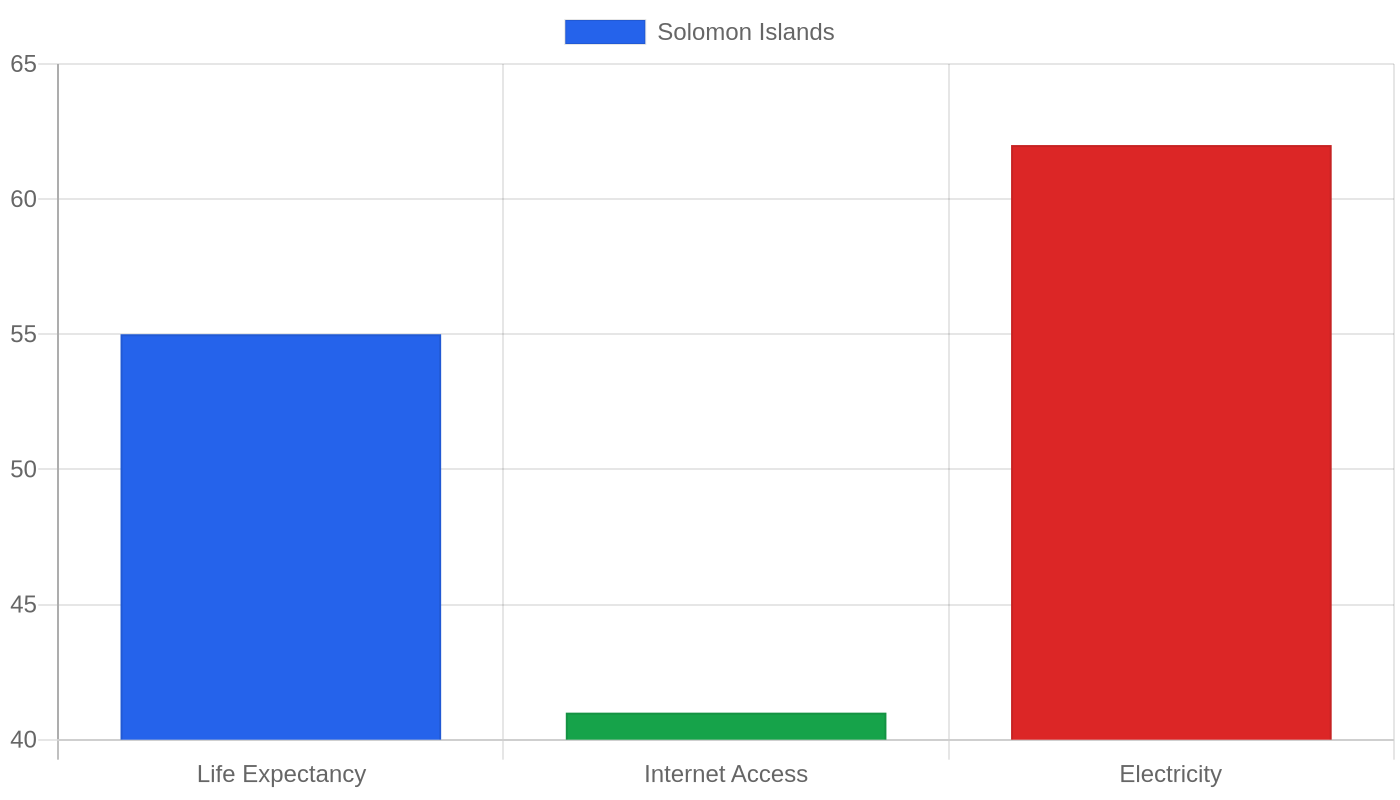
Data Transparency Challenges: Comprehensive macroeconomic indicators such as GDP growth, inflation rates, and unemployment figures are currently listed as unavailable in recent World Bank datasets.
Security Landscape: Specific crime and safety indices are not currently quantified, leaving a gap in standard metrics for assessing daily risk and public order.
Economic Opacity: Detailed breakdowns of main industries, cost of living benchmarks, and top corporate entities are absent from current reporting, necessitating a focus on structural governance rather than hard economic data.
The Architecture of Governance
Solomon Islands presents a unique case study in political stability within the Pacific region, defined less by explosive economic shifts and more by the steady mechanics of its constitutional framework. As a constitutional monarchy, the country maintains a deep historical tether to the British Crown, with King Charles III serving as the formal head of state.
This role is exercised locally by the Governor-General, who is selected by the Parliament for a fixed five-year term, providing a layer of ceremonial continuity amidst political changes. The real legislative power resides in the unicameral parliament, composed of 50 elected members who serve four-year terms.
This structure allows for a direct democratic mandate, yet it also introduces a dynamic element of political volatility; the parliament retains the authority to dissolve itself via a majority vote before its term expires. This provision means that political timelines can be unpredictable, potentially leading to early elections if coalition dynamics shift or confidence in the government wanes.
For observers, this suggests that policy continuity is tied closely to the health of parliamentary majorities rather than rigid electoral cycles. While the absence of specific GDP or inflation data prevents a traditional economic forecast, the political landscape remains the primary variable influencing any future economic planning. Investors and diplomats must therefore monitor parliamentary votes and coalition stability as leading indicators of national direction.
The system’s design balances tradition with modern parliamentary accountability, creating a resilient but occasionally fluid political environment. Understanding this mechanism is crucial, as legislative decisions regarding trade, resource management, and foreign relations flow directly from this unicameral body. Without concrete economic headlines, the rhythm of parliamentary sessions becomes the de facto barometer of national momentum.
Navigating the Cost of Living Void
Assessing the daily economic reality for residents and expatriates in Solomon Islands requires navigating a significant void in standardized cost-of-living data. Currently, there are no published figures detailing housing costs, rental markets, or general price levels for consumer goods. This lack of transparency makes it difficult to compare living expenses against regional averages or other Pacific Island nations using standard benchmarking tools.
Typically, in economies of similar size and development status, housing and import-dependent goods drive the highest household expenditures, but without specific CPI (Consumer Price Index) data, these assumptions remain unverified. The absence of inflation data further complicates budgeting, as it is unclear whether prices are trending upward due to global supply chain pressures or remaining stable.
For businesses attempting to establish operations, the inability to calculate precise operational costs based on local wage and rent indices poses a strategic challenge. However, this gap does not necessarily indicate an absence of market activity, but rather a limitation in statistical collection and reporting infrastructure. Residents likely rely on informal networks and local market observations to gauge value, suggesting that cash-based transactions and localized pricing may dominate the economy.
Consequently, financial planning for those considering relocation or investment must account for higher uncertainty regarding baseline living expenses. It is advisable to approach any financial projections with conservative buffers, acknowledging that official metrics do not reflect the actual purchasing power dynamics on the ground. Until comprehensive data emerges, the cost of living remains a qualitative experience rather than a quantitative metric for external analysts.
Investment Climate and Corporate Structure
The business environment in Solomon Islands is characterized by a notable absence of detailed information regarding major corporations and dominant industrial sectors. Current reports do not identify specific top companies or provide a breakdown of the main industries driving the national economy. This opacity makes it challenging to pinpoint key players in sectors such as agriculture, fisheries, or tourism, which are traditionally vital to Pacific island economies.
Without a list of leading enterprises, potential investors cannot easily assess market concentration, competitive landscapes, or established supply chains. Similarly, the lack of GDP per capita and GNI per capita data obscures the overall wealth distribution and consumer spending capacity within the country.
This data vacuum suggests that the private sector may be fragmented, dominated by small and medium-sized enterprises, or heavily reliant on subsistence activities that do not register in formal corporate registries. For international firms, this implies a need for extensive on-the-ground due diligence to identify viable partners and understand local regulatory nuances.
The business climate appears to operate below the threshold of formal statistical tracking, relying instead on informal trade and community-based economic structures. While this can offer opportunities for agile newcomers who can navigate local customs, it also raises risks regarding contract enforcement and market transparency. Investors must therefore prioritize relationship-building and local expertise over reliance on publicly available corporate filings.
The absence of industrial data does not preclude economic activity but highlights the importance of grassroots engagement in understanding where value is actually created. Future developments in corporate registration and industry reporting will be critical signals for improving the investment climate’s attractiveness.
Safety, Politics, and Quality of Life
Public safety and political stability form the foundational backdrop for life in Solomon Islands, though quantifying these aspects presents challenges. Official crime and safety indices are currently listed as unavailable, meaning there are no standardized scores to measure the prevalence of criminal activity or perceived security levels. This lack of data leaves residents and visitors to rely on anecdotal evidence or localized knowledge rather than comparative statistical rankings.
Politically, however, the landscape is well-defined by the constitutional monarchy and parliamentary democracy, which provides a structured, albeit flexible, framework for governance. The presence of a clear succession mechanism for the Governor-General and a defined parliamentary term offers a degree of institutional predictability. Yet, the ability of parliament to dissolve itself introduces an element of political risk that could impact social cohesion during transition periods.
Quality of life assessments are similarly hampered by the lack of broader socioeconomic data, making it difficult to correlate political stability with citizen well-being. In the absence of happiness indices or income data, the focus remains on the structural integrity of the state rather than individual prosperity metrics. This suggests that while the political system functions, the day-to-day experiences of citizens are not captured in mainstream economic reporting.
Observers should view the political structure as stable but politically sensitive, requiring careful navigation of local allegiances and parliamentary shifts. Safety considerations must therefore be approached with caution, given the absence of objective crime statistics that might otherwise guide security protocols.
What’s Happening Now: Political Fluidity
The most pressing narrative in Solomon Islands today revolves around the mechanics of its political system rather than economic fluctuations. With no recent news items or live indicators provided, the current affairs landscape is defined by the ongoing operation of its constitutional framework. The focus remains on the interplay between the Governor-General’s representative role and the unicameral parliament’s legislative authority.
Any shifts in parliamentary majority could trigger early dissolutions, making every vote a potential catalyst for political change. This environment creates a atmosphere of cautious optimism, where policy directions are subject to the whims of coalition politics. Without inflation trends or reform announcements to track, the “news” is essentially the status quo of governance.
Stakeholders are advised to monitor parliamentary proceedings closely, as these will be the first indicators of any significant policy shifts. The absence of economic headlines underscores that political stability is the primary concern for all external observers. In this context, maintaining diplomatic and business relationships requires patience and an understanding of local political rhythms. The current moment is one of waiting and watching, where the structure of government is the only reliable constant.
The Bottom Line
Solomon Islands represents a jurisdiction where political structure outweighs economic visibility in current analysis. Those interested in the country should focus on understanding its parliamentary dynamics and constitutional safeguards rather than seeking immediate financial returns. The lack of hard data necessitates a long-term, relationship-driven approach to any engagement. Patience and local insight are the most valuable assets for navigating this opaque but structurally sound environment.
Sources & Methodology
This article is authored by Economic Pulse Net for informational and research purposes. Economic Pulse Net sources its data from multilateral institutions, national statistics bureaus, and proprietary databases. All data is believed to be current as of the date of publication.
Published: October 15, 2026 | Category: Research — Solomon Islands
Use these signals in your own platform
Economic Pulse publishes its live signal feed through a documented, read-only API. Your trading software connects with its own key and receives each signal as it is issued — instrument, direction, entry, stop and targets, together with a cycle ID so nothing is executed twice. The feed is independent of this website and cannot change it.
Signals are informational only and are not financial advice.