Economic Pulse Net | Sources: World Bank World Development Indicators, Government Sources | 2026
Key Takeaways
* Political Structure: The nation operates as a constitutional monarchy with King Charles III as head of state, represented locally by a Governor-General appointed for a five-year term.
Legislative Dynamics: A unicameral parliament of 50 members holds significant power, including the ability to dissolve itself before the end of its four-year term through a majority vote.
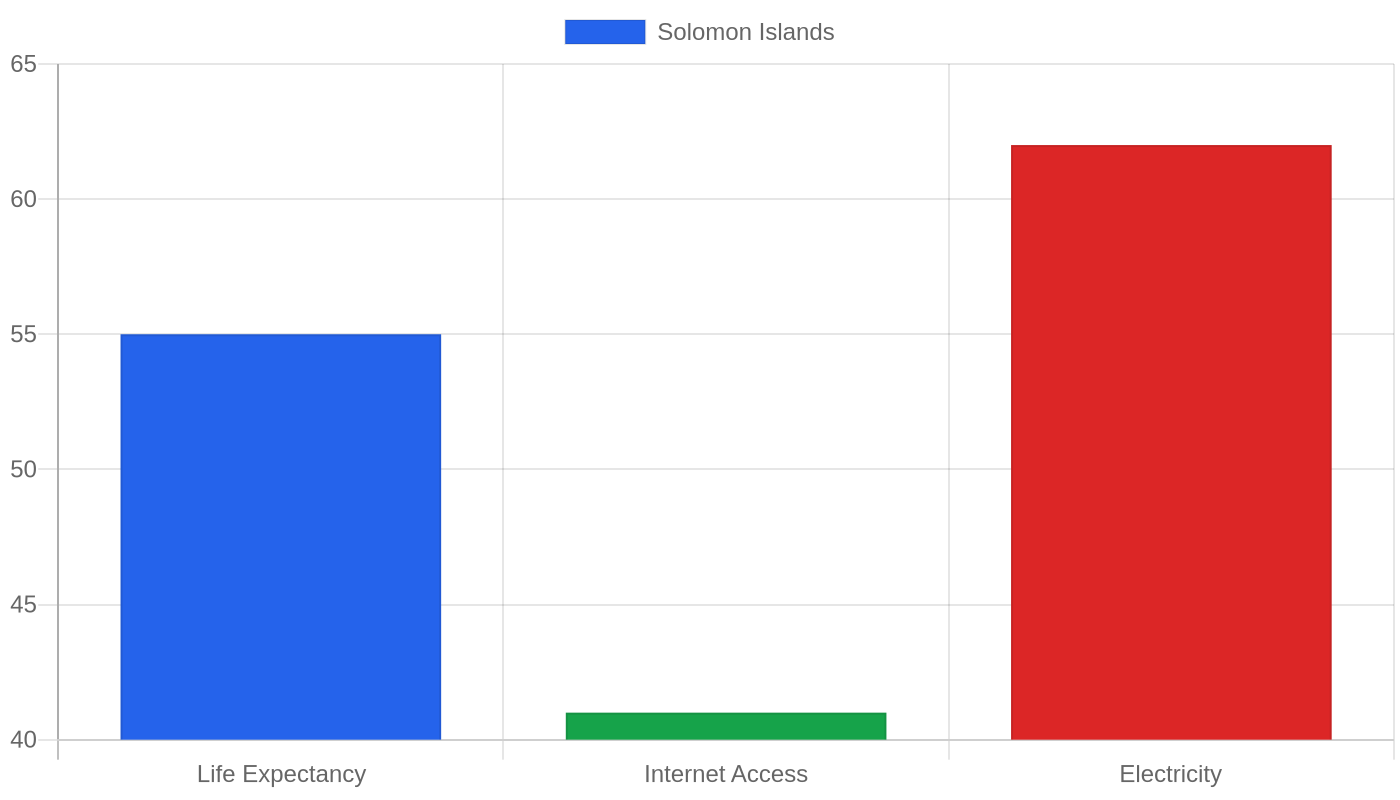
Data Transparency Gap: Current economic indicators such as GDP growth, inflation, and unemployment rates are not currently reported, highlighting a reliance on qualitative political stability over quantitative macroeconomic metrics in public discourse.
Security Context: Specific crime and safety indices are unavailable, suggesting that risk assessment for investors and residents must rely heavily on political stability and local community structures rather than standardized global safety scores.
The Architecture of Power
Solomon Islands presents a unique case study in governance where political stability is defined more by constitutional frameworks than by volatile market fluctuations. As a constitutional monarchy, the country maintains a deep historical link to the British Crown, with King Charles III serving as the ceremonial head of state. This role is executed locally by the Governor-General, who is chosen by the Parliament for a fixed five-year term, providing a layer of continuity amidst shifting political tides.
The heart of legislative power lies within a unicameral parliament consisting of 50 elected members. These representatives serve four-year terms, but the system includes a critical check on executive longevity: Parliament may be dissolved by a majority vote of its members before their term concludes. This mechanism ensures that the legislature remains accountable to its constituents and can trigger early elections if confidence in the government wanes.
For observers, this structure suggests a dynamic political environment where policy direction can shift rapidly based on parliamentary consensus, rather than being locked into long-term rigidities. The absence of detailed GDP or population data in current reports means that understanding the country requires looking at these institutional mechanics as the primary drivers of national direction.
The Invisible Economy
While traditional macroeconomic metrics like GDP growth, inflation CPI, and unemployment rates are listed as N/A, the economic narrative of Solomon Islands cannot be reduced to missing numbers. In many Pacific island nations, the formal economy often coexists with robust informal sectors that are not captured by standard World Bank aggregates.
The lack of reported GDP per capita (PPP) and GNI per capita figures does not imply an absence of economic activity, but rather a challenge in measurement due to the dispersed nature of the archipelago. Industries likely drive the daily cost of living, yet specific sectoral breakdowns are not provided in the current dataset. Similarly, the cost of living and housing markets operate on localized dynamics that may not align with broader regional averages without granular data.
Residents and businesses likely navigate expenses based on import dependencies and local production capabilities, creating a price structure that is highly sensitive to external shocks and supply chain logistics. Without explicit unemployment figures, labor market health must be inferred from the stability of key industries and the functioning of the parliamentary system that regulates them.
Therefore, the “economy” here is best understood as a resilient, adaptive system operating under a clear political mandate, even if the statistical footprint remains elusive to international trackers.
Business and Investment Landscape
For potential investors, the business climate in Solomon Islands is shaped less by corporate giants and more by the regulatory environment established by the state. The list of top companies is currently unpopulated, indicating that the private sector landscape may be dominated by small-to-medium enterprises or foreign-owned entities that do not appear in standard local rankings.
This absence of identifiable major domestic corporations suggests that investment opportunities might lie in infrastructure development, tourism, or resource management, sectors that typically require partnership with the government or international joint ventures. The political landscape, characterized by a stable parliamentary system, offers a predictable framework for legal operations, despite the lack of specific crime indices to quantify security risks.
Investors must therefore place a premium on due diligence regarding local partnerships and regulatory compliance, as the formal corporate hierarchy is not clearly delineated in available data. The safety index being marked as N/A further emphasizes that physical security assessments should be conducted on a case-by-case basis rather than relying on broad national statistics.
Consequently, the business environment appears to reward patience and local knowledge, with success hinging on navigating the nuances of the unicameral parliament’s legislative output.
Safety, Politics, and Daily Life
Quality of life in Solomon Islands is deeply intertwined with its political identity and social cohesion. With no specific crime index or safety index provided, residents and visitors must rely on general observations of the parliamentary system’s effectiveness in maintaining order. The constitutional monarchy model fosters a sense of national unity, with the Governor-General serving as a stabilizing figure above partisan politics.
However, the potential for early dissolution of Parliament indicates that political tensions can arise and be resolved quickly through democratic processes. This fluidity can contribute to a dynamic social atmosphere where civic engagement is high. The lack of happiness data or specific quality-of-life metrics means that personal well-being is likely tied to community strength and access to essential services rather than abstract indices.
In the absence of hard safety data, the reputation of the region for hospitality and communal living often fills the gap in assessing daily life. Ultimately, the political stability derived from the clear lines of succession and parliamentary authority provides a foundational sense of security for those living and working within the country.
What’s Happening Now
The current affairs landscape in Solomon Islands is defined by the ongoing operation of its constitutional framework rather than sudden economic shocks or policy revolutions. With King Charles III as head of state, the nation continues to balance its traditional ties with modern governance needs. The recent focus appears to be on the functionality of the 50-member parliament, which retains the power to self-dissolve, ensuring that the government remains responsive to electoral will.
There are no reported spikes in inflation or shifts in GDP growth, suggesting a period of relative macroeconomic quietude, though this silence also points to a lack of real-time data publication. The political discourse is likely centered on legislative priorities that support the main industries, even if those industries are not explicitly named in the current overview.
Business developments are probably incremental, focusing on maintaining the stability required for the constitutional monarchy to function smoothly. Observers should watch for any moves toward early parliamentary dissolution, as this would signal significant shifts in political alignment and potentially alter the regulatory landscape for businesses. The freshest indicator of change is thus political maneuvering within the unicameral body, which serves as the true barometer of national progress.
The Bottom Line
Solomon Islands offers a compelling look at how political structure can define a nation’s trajectory when economic data is scarce. It is a country where the rule of law and parliamentary accountability are the primary engines of stability. Investors and residents alike should prioritize understanding the constitutional mechanics and local community dynamics over chasing missing macroeconomic indicators.
For those seeking a stable, legally defined environment in the Pacific, it remains a distinctive option worth monitoring closely.
Sources & Methodology
This article is authored by Economic Pulse Net for informational and research purposes. Economic Pulse Net sources its data from multilateral institutions, national statistics bureaus, and proprietary databases. All data is believed to be current as of the date of publication.
Published: September 27, 2026 | Category: Research — Solomon Islands
Use these signals in your own platform
Economic Pulse publishes its live signal feed through a documented, read-only API. Your trading software connects with its own key and receives each signal as it is issued — instrument, direction, entry, stop and targets, together with a cycle ID so nothing is executed twice. The feed is independent of this website and cannot change it.
Signals are informational only and are not financial advice.