Economic Pulse Net | Sources: World Bank World Development Indicators, Government Sources | 2026
Key Takeaways
* Subtle Expansion: Mexico’s economy is projected to grow by just 0.56% in 2025, indicating a period of stagnation rather than robust expansion despite its large economic base.
Low Inflation Environment: With CPI inflation holding at approximately 3.8%, the country maintains price stability, which supports consumer purchasing power but reflects weak demand pressures.
Tight Labor Market: Unemployment sits at a remarkably low 2.67%, suggesting that while growth is slow, the labor market remains resilient and tight.
Corporate Landscape: The business environment is dominated by major players in telecommunications, aviation, and industrial conglomerates, with América Móvil and ALFA leading key sectors.
Economic Stagnation and Structural Resilience
Mexico’s economic trajectory for 2025 presents a complex picture of modest activity within a massive framework. According to World Bank data, the nation’s GDP growth is projected at a tepid 0.561683456144578%, signaling that the economy is barely expanding year-over-year. This sluggish growth contrasts sharply with the sheer scale of the economy, which stands at $1.83 trillion USD (specifically $1,832,641,364,775.52).
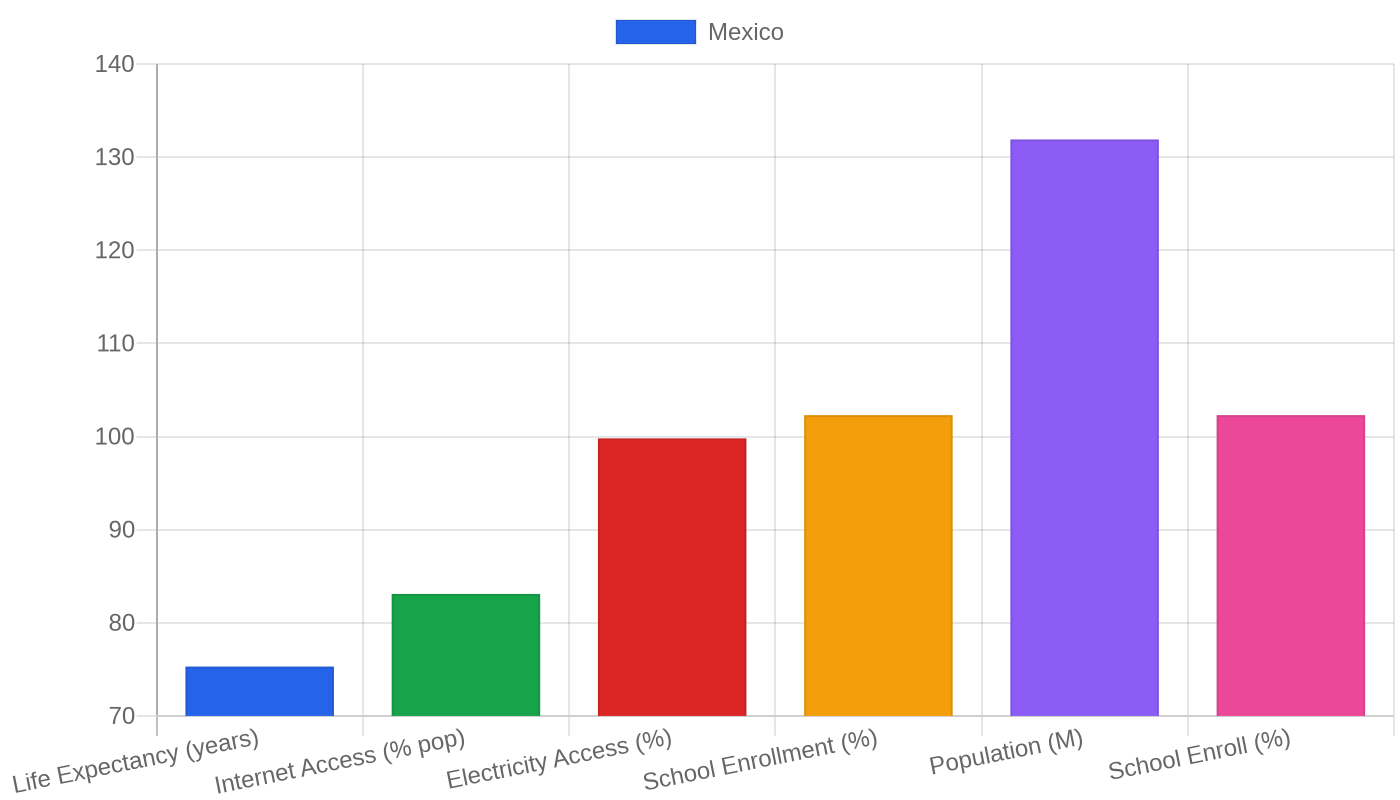
For context, this places Mexico among the larger global economies, yet the per capita metrics reveal the challenges of distributing wealth across a population of nearly 132 million people (131,946,900.0). While the GDP per capita in PPP terms is relatively healthy at $25,868.48, the GNI per capita is lower at $13,730.0, highlighting potential disparities in income distribution or external factor income. Despite the slow headline growth, the inflation rate has been well-controlled, sitting at 3.80668650726485%.
This suggests that monetary policy has successfully anchored expectations, preventing the hyperinflationary spikes seen in other emerging markets. However, such low inflation often accompanies weak domestic demand, meaning consumers are not spending aggressively enough to drive higher growth rates.
The unemployment rate of 2.673% further complicates the narrative; it is exceptionally low, implying that almost everyone who wants a job has one, yet this does not necessarily translate into high wage growth or economic dynamism.
Cost of Living and Daily Realities
The cost of living in Mexico varies significantly depending on whether one is located in major urban centers like Mexico City or more rural states, but the macroeconomic indicators provide a baseline for understanding affordability. With inflation capped near 3.8%, daily expenses for food, utilities, and transportation are likely stable compared to previous volatile years.
For expatriates and locals alike, the gap between nominal GDP per capita ($25,868 PPP) and GNI per capita ($13,730) suggests that while asset values or trade-based wealth may be higher, actual disposable income for the average citizen might feel tighter. Housing costs, therefore, become a critical determinant of quality of life; in cities where corporate headquarters for giants like ALFA and América Móvil are located, rent prices will reflect the premium of being close to economic hubs.
Conversely, in regions outside these central nodes, housing may be more affordable, though access to services might be limited. The low unemployment rate of 2.673% means that competition for entry-level jobs is fierce, potentially keeping wages flat even if the cost of living rises slightly due to imported goods or energy costs.
Without specific regional housing data, the general trend points to a market where affordability is manageable for those earning above the national median, but challenging for those reliant solely on local minimum wages.
Investment and Business Climate
Mexico’s corporate landscape is defined by powerful conglomerates and specialized service providers that dominate both domestic and international markets. At the forefront is América Móvil, a telecommunications giant that serves as a bellwether for digital infrastructure and connectivity across the region.
In the industrial sector, companies like ALFA and Alpek play crucial roles, with ALFA operating as a diversified conglomerate impacting steel, cement, and petrochemicals, while Alpek focuses specifically on oil and gas derivatives. The aviation sector also features prominently, with Aeroméxico Connect and Aeroméxico handling passenger transport, and AeroUnion and Aeromexpress managing logistics and cargo, underscoring the importance of supply chain efficiency in Mexico’s trade-dependent economy.
Basic materials remain vital, with Altos Hornos de México driving steel production essential for construction and manufacturing. Consumer goods are represented by entities like Ah Cacao Real Chocolate and Alpura, reflecting a strong domestic consumption culture focused on traditional and staple products. For investors, these companies offer exposure to established brands with significant market share, though the broader economic slowdown of 0.56% growth may limit immediate upside potential.
The business environment is thus characterized by mature industries rather than rapid startup proliferation, favoring established players with deep roots in the Mexican economy.
Safety, Politics, and Quality of Life
Navigating life in Mexico requires an understanding of both its political structure and its safety dynamics. Politically, the United Mexican States operates as a federal, representative, democratic, and republican system based on the 1917 Constitution. This framework establishes three distinct levels of government—the federal Union, state governments, and municipal governments—creating a complex but balanced system of checks and balances.
This decentralization allows for local autonomy but can also lead to varied enforcement of laws and policies across different regions. Regarding safety, available indices currently list Crime Index and Safety Index as N/A, meaning precise statistical comparisons are not possible at this moment. However, the absence of data does not imply safety; rather, it highlights the need for localized research when assessing personal security.
The political stability provided by the constitutional framework offers a degree of predictability for long-term residents and businesses, even if short-term policy shifts occur. Quality of life is heavily influenced by these political structures, as municipal governance directly impacts public services, infrastructure maintenance, and community safety initiatives.
Current Affairs and Policy Shifts
The current economic mood in Mexico is one of cautious observation as the country navigates a year of minimal growth. With GDP growth stuck at 0.56%, policymakers are likely facing pressure to stimulate demand without reigniting inflation, which is currently stable at 3.8%. The federal government must balance its budgetary responsibilities against the needs of a population of 132 million, ensuring that social programs do not strain public finances.
Meanwhile, the private sector, led by giants like América Móvil and ALFA, continues to operate with efficiency, adapting to the slow-growth environment by focusing on core competencies and cost control. The low unemployment rate of 2.673% suggests that the labor market is absorbing shocks well, but employers may be hesitant to expand hiring given the lack of broad economic momentum.
Recent news indicates that attention is turning toward structural reforms that could unlock productivity gains, particularly in energy and logistics, where companies like Alpek and AeroUnion operate. As we move through 2025, the focus remains on whether these incremental adjustments can pivot the economy from stagnation to sustainable expansion, all while maintaining the political integrity of the federal system established in 1917.
The Bottom Line
Mexico is a country of immense scale and historical depth, currently experiencing a phase of economic consolidation rather than explosive growth. Investors and observers should watch closely how the government leverages its federal structure to improve infrastructure and reduce friction in trade, particularly benefiting companies in aviation and basic materials. While the low unemployment rate is a positive indicator, the sluggish GDP growth warns against overly optimistic short-term projections.
This is a market best suited for long-term holders of established assets rather than speculative traders seeking quick returns.
Sources & Methodology
This article is authored by Economic Pulse Net for informational and research purposes. Economic Pulse Net sources its data from multilateral institutions, national statistics bureaus, and proprietary databases. All data is believed to be current as of the date of publication.
Published: September 27, 2026 | Category: Research — Mexico
Use these signals in your own platform
Economic Pulse publishes its live signal feed through a documented, read-only API. Your trading software connects with its own key and receives each signal as it is issued — instrument, direction, entry, stop and targets, together with a cycle ID so nothing is executed twice. The feed is independent of this website and cannot change it.
Signals are informational only and are not financial advice.