Economic Pulse Net | Sources: World Bank World Development Indicators, Government Sources | 2026
Key Takeaways
– Samoa’s political system represents one of the Pacific’s most enduring experiments in blending Westminster parliamentary democracy with indigenous customs and governance structures.
– The 1960 constitution, which took full effect upon independence from New Zealand in 1962, continues to shape the nation’s political and economic trajectory more than six decades later.
– The country’s economic narrative is currently defined by data gaps in key indicators, making qualitative assessment of its development path essential.
– Samoa’s governance model, referred to as the “Malo,” reflects a deliberate fusion of British parliamentary traditions with fa’a Samoa (the Samoan way), creating a unique institutional framework.
– As a small island nation, Samoa’s economic resilience depends heavily on its ability to navigate global shocks while maintaining social cohesion rooted in customary systems.
The Numbers Tell Only Part of the Story
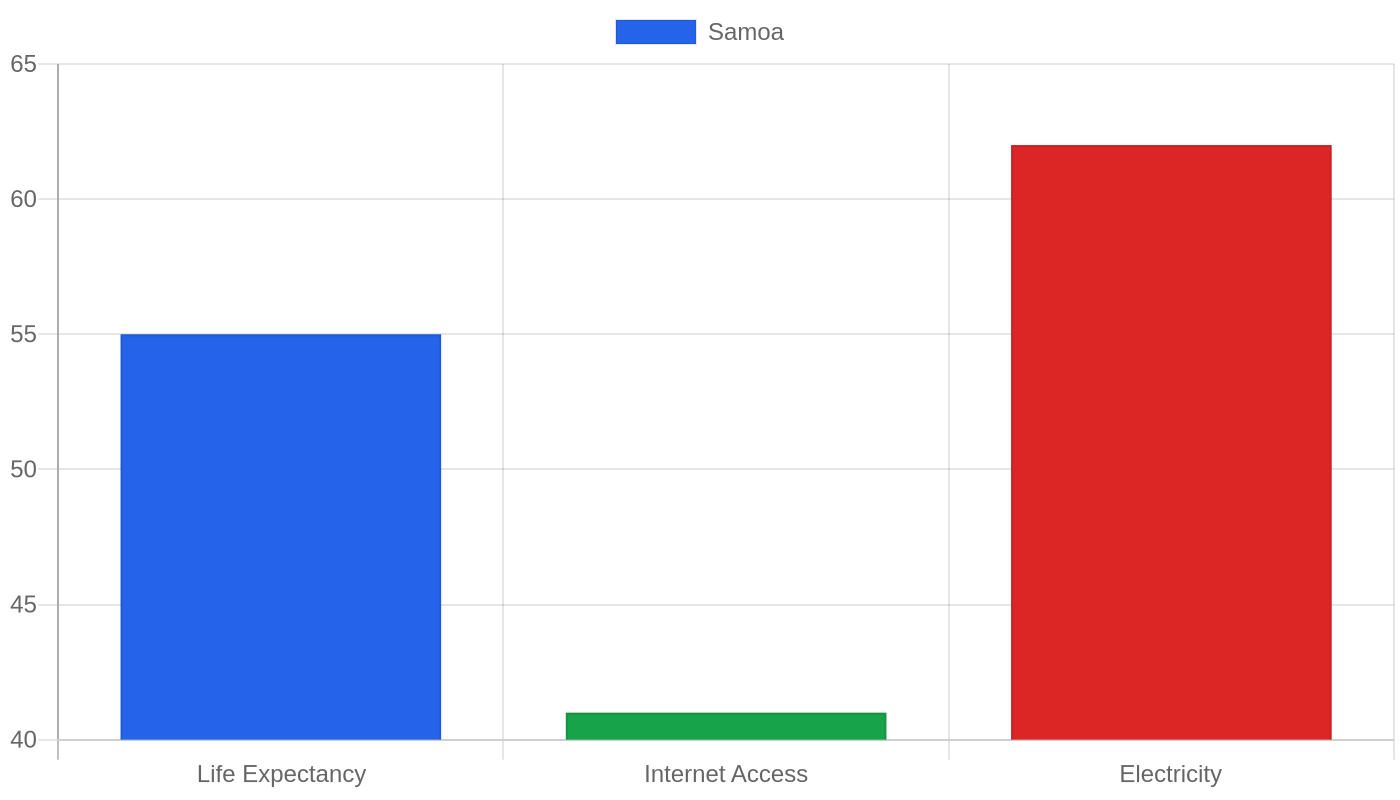
According to the World Bank, Samoa’s most recent macroeconomic indicators present a challenge for conventional economic analysis: GDP growth, inflation, unemployment, GDP in US dollars, GDP per capita (PPP), GNI per capita, and population figures are all currently unavailable in the latest dataset. This absence of hard numbers is itself telling for a country at Samoa’s stage of development.
Small island developing states in the Pacific frequently experience significant lags in data reporting, and Samoa is no exception. The lack of updated figures does not indicate economic stagnation; rather, it reflects the practical realities of statistical collection in a dispersed island nation with limited institutional capacity. For economists and investors alike, this means looking beyond the headline numbers to understand Samoa’s structural position.
The country’s economic foundations rest on traditional industries and remittance flows, which have historically provided stability even when formal data collection lags. Understanding Samoa’s economy requires patience and a willingness to work with incomplete information, much like navigating the country’s own geographic dispersion across its islands.
The Cost of Living: Between Tradition and Modernity
Housing and daily expenses in Samoa reflect the unique intersection of subsistence traditions and cash-based urban living. In Apia, the capital, housing costs have historically been shaped by customary land tenure systems, where approximately 80 percent of land is held under traditional ownership. This arrangement means that for many Samoans, housing is not purely a market commodity but a social asset tied to family and village structures.
Rent versus buy calculations in Samoa differ fundamentally from Western markets because land ownership is often communal rather than individual. Daily expenses for food and essentials are influenced by the country’s import dependence, with many goods requiring shipment from larger trading partners.
The cost of living in Samoa has generally been considered moderate compared to some other Pacific island nations, though this varies significantly between urban Apia and outer villages where subsistence agriculture supplements cash income. The absence of detailed CPI data in the current World Bank reporting makes precise comparisons difficult, but the structural dynamics are clear: Samoans balance participation in the cash economy with traditional support systems that provide a social safety net.
This dual economic reality means that cost of living pressures are experienced differently across the population, with those in formal employment in Apia facing different challenges than village-based families.
Investment and Business Climate: The Customary Constraint
The business environment in Samoa operates within a framework that prioritizes political stability and social cohesion over rapid economic liberalization. The “Malo” — as the national government is known — has historically maintained a cautious approach to foreign investment, seeking to protect customary land tenure and traditional social structures.
This creates a distinctive business climate where investors must navigate not only regulatory requirements but also deep-seated cultural expectations about community consultation and consensus. The absence of a list of top companies in the available data suggests a business landscape dominated by smaller enterprises and family-owned operations rather than large corporate entities.
Sectors with potential for growth include tourism, agriculture, and fisheries, though these industries face structural constraints related to scale and distance from major markets. The political system’s stability, maintained through the constitutional framework since 1960, provides a predictable environment for business, even if the pace of reform is slower than some investors might prefer.
For international businesses, Samoa offers access to a small but stable market, with the understanding that success requires genuine engagement with local customs and community structures. The country’s commitment to its constitutional model signals that economic development will continue to be pursued within a framework that prioritizes social and cultural preservation alongside economic growth.
Safety, Politics, and Quality of Life: The Malo’s Enduring Compact
Samoa’s political landscape is defined by a remarkable constitutional continuity that few post-colonial nations can match. The 1960 constitution, which came into force with independence from New Zealand in 1962, was deliberately constructed on the British pattern of parliamentary democracy, but with explicit modifications to accommodate Samoan customs.
This hybrid system has produced a political culture characterized by stability and consensus-building, with the “Malo” government serving as the central institution of national governance. The fusion of Westminster traditions with fa’a Samoa has created a governance model where formal democratic processes operate alongside customary chiefly authority.
This dual system has implications for quality of life: Samoans enjoy the benefits of democratic participation while maintaining social structures that provide community support and identity. Crime and safety indices are not currently available in the World Bank data, but Samoa has historically been considered one of the safer Pacific nations, with strong community ties serving as a deterrent to serious crime.
The political system’s resilience over more than six decades suggests a high level of social cohesion and institutional legitimacy. For residents, this translates into a quality of life that emphasizes community connection, cultural preservation, and a slower pace of life compared to more industrialized societies.
Current Affairs: Constitutional Stewardship in a Changing Pacific
Samoa currently finds itself at a moment of generational reflection, as the nation considers how its 1960 constitutional framework — the foundation of its modern identity — can address contemporary challenges. The political system established at independence was a deliberate compromise between British parliamentary practice and Samoan custom, and the balance between these elements remains a subject of ongoing national conversation.
As the Pacific region experiences increased geopolitical attention from larger powers, Samoa’s stable governance model represents a quiet form of strategic resilience. The “Malo” government continues to navigate the tension between preserving customary systems and responding to pressures for economic modernization and greater integration with global markets.
Climate change remains an existential concern for all Pacific island nations, and Samoa’s policy responses are being shaped within the framework of its constitutional system. The country’s approach to development, characterized by careful deliberation and consensus-building, stands in contrast to more aggressive reform agendas elsewhere in the region.
For observers of Pacific affairs, Samoa offers a case study in how small nations can maintain institutional continuity while adapting to changing circumstances. The current moment is less about dramatic policy shifts and more about the ongoing work of constitutional stewardship — ensuring that the 1960 settlement remains relevant for a new generation of Samoans facing unprecedented global challenges.
The Bottom Line
Samoa deserves attention from those interested in alternative models of post-colonial governance and sustainable development in small island states. The country’s constitutional continuity, maintained since 1960, offers a rare example of institutional stability in a region often characterized by political volatility.
While the absence of current economic data makes quantitative assessment difficult, Samoa’s qualitative strengths — political stability, social cohesion, and cultural preservation — provide a foundation for resilience. Investors, development practitioners, and students of governance should watch Samoa as a case study in how tradition and modernity can be deliberately and successfully balanced.
Sources & Methodology
This article is authored by Economic Pulse Net for informational and research purposes. Economic Pulse Net sources its data from multilateral institutions, national statistics bureaus, and proprietary databases. All data is believed to be current as of the date of publication.
Published: August 03, 2026 | Category: Research — Samoa
Use these signals in your own platform
Economic Pulse publishes its live signal feed through a documented, read-only API. Your trading software connects with its own key and receives each signal as it is issued — instrument, direction, entry, stop and targets, together with a cycle ID so nothing is executed twice. The feed is independent of this website and cannot change it.
Signals are informational only and are not financial advice.