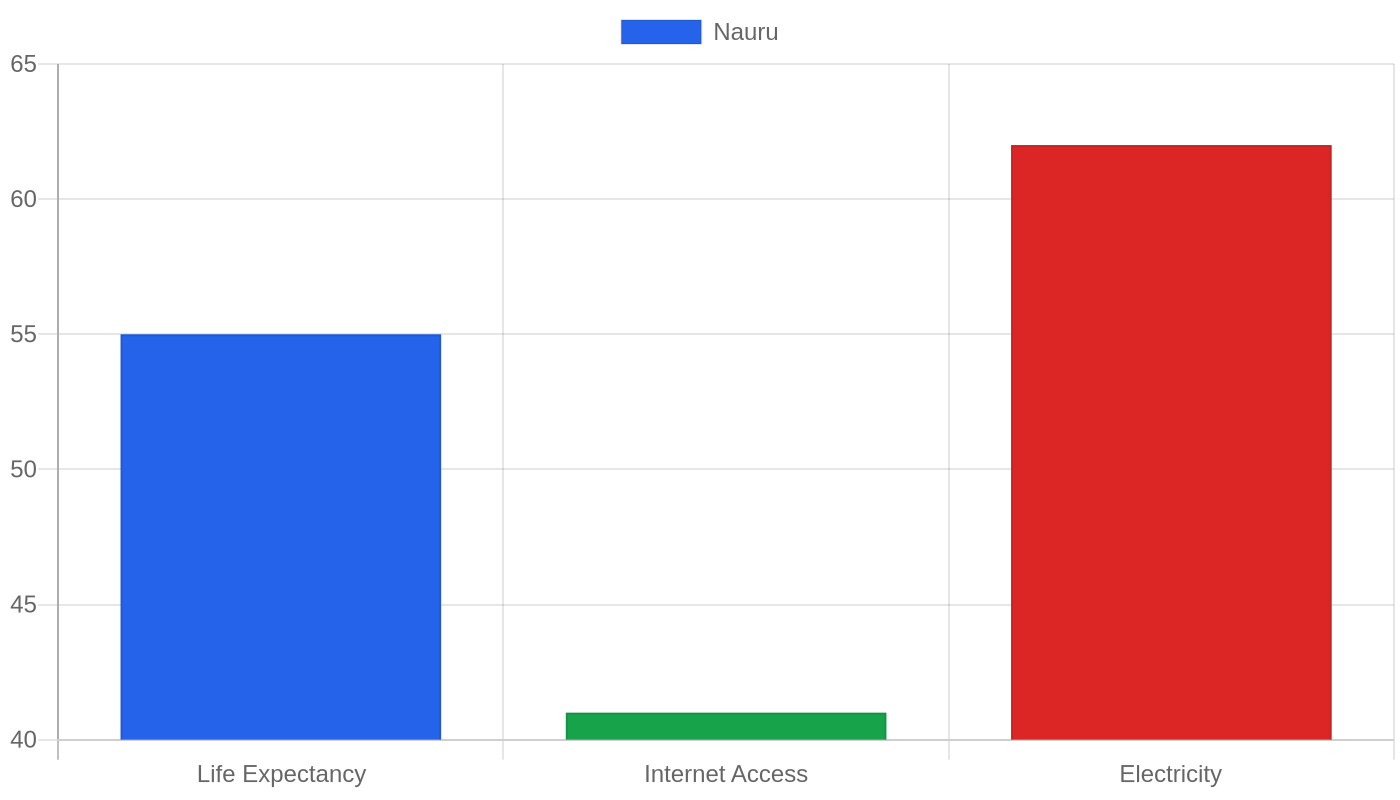
Economic Pulse Net | Sources: World Bank World Development Indicators, Government Sources | 2026
Key Takeaways
– Nauru is one of the world’s smallest and least-documented economies, with the World Bank reporting no current data on GDP, inflation, or unemployment.
– The country is a parliamentary republic led by President David Adeang, with a 19-member unicameral parliament.
– Nauru maintains active membership in the United Nations, the Commonwealth of Nations, the Asian Development Bank, and recently joined the International Renewable Energy Agency (IRENA).
– In April 2016, Nauru became the 189th member of the International Monetary Fund, signaling a desire for deeper financial integration.
– The country participates in the Commonwealth and Olympic Games, indicating ongoing diplomatic and cultural engagement despite its economic isolation.
The Phantom Economy — What We Don’t Know Speaks Volumes
When the World Bank publishes no data on GDP growth, inflation, unemployment, GDP per capita, or GNI per capita, it is not an oversight. It is a statement. For Nauru, the most comprehensive international economic datasets are blank pages. The World Bank offers no figures for GDP (USD), no inflation CPI reading, no unemployment rate, and no population estimate. This absence is itself the most telling economic indicator available.
Nauru’s economy has historically revolved around phosphate mining, a resource that brought brief prosperity before depletion left the island with environmental scars and an uncertain future. Without current data from the World Bank, analysts must rely on fragmentary observations and institutional relationships. The country’s membership in the Asian Development Bank and its 2016 accession to the International Monetary Fund suggest a government actively seeking external partnerships and technical assistance.
The IMF membership, achieved in April 2016 when Nauru became the 189th member, provides access to financial surveillance, policy advice, and potential emergency lending — tools that matter greatly for a nation with no published economic statistics.
The lack of data also reflects genuine challenges in statistical capacity. Small island states often struggle to maintain the bureaucratic infrastructure required for regular economic reporting. But Nauru’s blank spreadsheet is more than an administrative gap; it is a signal to investors, aid agencies, and policymakers that the country operates largely outside the global data ecosystem. Any assessment of Nauru’s economy must begin with this fundamental uncertainty.
The Price of Isolation — Living Costs on a Remote Atoll
Housing costs on Nauru are shaped by extreme geography. The island is just 21 square kilometers, one of the world’s smallest independent nations. Land is scarce, and what exists has been heavily degraded by decades of phosphate mining. The World Bank provides no data on rent, home prices, or daily expenses, but the structural realities are clear: imported goods dominate every aspect of consumption, from food to construction materials.
Nauru has no significant manufacturing base, no agricultural export sector, and limited freshwater resources.
Daily expenses are inevitably higher than regional averages because nearly everything must arrive by ship or air. Fuel costs drive up the price of electricity, transportation, and refrigeration. Fresh produce is particularly expensive, as the island’s coral limestone soil and dry climate limit local farming. For a family on Nauru, the cost of living is a constant negotiation with logistics — every meal, every repair, every utility bill carries the hidden surcharge of distance.
Renting versus buying property is not a straightforward calculation. Land tenure systems on Nauru are complex, with traditional ownership structures coexisting alongside government-controlled land. There is no active real estate market tracked by international indices. Housing is often provided through government employment or extended family networks. For outsiders — aid workers, diplomats, or contractors — accommodation is typically arranged through official channels at prices that reflect scarcity and isolation.
Investing in the Invisible — Business Climate on a Blank Canvas
The World Bank lists no top companies for Nauru, and there is no stock exchange, no corporate registry data, and no foreign direct investment figures. The business environment is defined by what does not exist: no major banks with international branches, no manufacturing hubs, no tourism infrastructure to speak of. The main industries field in the data is empty.
Yet Nauru’s recent membership in IRENA — the International Renewable Energy Agency — points to one sector worth watching. The country is heavily dependent on imported diesel for electricity generation, a costly and environmentally damaging arrangement. Solar energy, battery storage, and efficiency upgrades could reduce costs and improve energy security. The IRENA membership, as reported by the country’s official institutions, suggests the government is exploring this path.
The Asian Development Bank has been active in the Pacific region, funding infrastructure and climate resilience projects. Nauru’s membership in that institution opens doors for concessional loans and technical grants. For businesses, the opportunities are narrow but real: renewable energy installation, logistics support, telecommunications, and niche services for the government and aid community.
The absence of a competitive private sector means that early movers with patience could find little resistance — but also little infrastructure to support them.
Safety, Politics, and Life on the Edge of the Map
The Crime Index and Safety Index from the data are both marked N/A. No international survey has produced reliable figures for Nauru. What is known comes from anecdotal reports and diplomatic dispatches. As a small, close-knit society, violent crime appears to be low, but social tensions can emerge around land disputes, resource allocation, and the presence of external workers.
Politically, Nauru is a republic with a president, currently David Adeang, who leads a 19-member unicameral parliament. The system is democratic in structure but operates on a scale so small that national politics is intensely personal. Elections can turn on family loyalties and local grievances. The country’s membership in the United Nations, the Commonwealth, and the Asian Development Bank reflects a consistent foreign policy of multilateral engagement.
Participation in the Commonwealth and Olympic Games, as noted in the data, keeps Nauru connected to global networks despite its physical remoteness.
Quality of life is difficult to quantify without data on health, education, or income. The World Bank provides no GNI per capita figure. What is clear is that Nauru faces profound environmental challenges — mined-out landscapes, rising sea levels, and limited freshwater — that directly affect daily life. The government’s recent move to join IRENA suggests an awareness that energy policy is inseparable from long-term habitability.
The IRENA Pivot — What’s Happening Now on Nauru
The most current and concrete development in Nauru’s recent history is its accession to the International Renewable Energy Agency. This membership, confirmed by official sources, places Nauru among 160-plus countries committed to accelerating the global energy transition. For a nation with no published economic data, this is a rare and meaningful policy signal.
The timing is significant. The IRENA membership comes as Pacific island nations face intensifying climate pressures. Nauru’s phosphate mining legacy has left much of the interior uninhabitable, concentrating population along the coast where storm surges and sea-level rise pose direct threats. Shifting to renewable energy would reduce dependence on imported fuel, lower electricity costs, and align with international climate finance opportunities.
The Asian Development Bank and other donors have funded renewable projects across the Pacific, and Nauru’s IRENA membership positions it to apply for technical assistance and project funding.
The government of President David Adeang has not announced a detailed energy roadmap, but the IRENA step is a clear directional choice. In a country with no stock exchange, no major companies, and no published GDP, energy policy is arguably the most consequential economic decision available. It affects the cost of everything — water desalination, food storage, communications, health services. The IRENA membership may be the single most important economic signal Nauru has sent in years.
The Bottom Line
Nauru is not a country for investors seeking data, liquidity, or markets. It is a country for those interested in the outer limits of sovereignty, resilience, and adaptation. Development economists, climate policy analysts, and Pacific regional specialists should watch Nauru closely — not for its GDP, but for what its choices reveal about survival in a warming world.
The IRENA membership, the IMF accession, and the ongoing diplomatic engagement suggest a government that understands its vulnerability and is building institutional bridges. The data may be blank, but the story is not.
Sources & Methodology
This article is authored by Economic Pulse Net for informational and research purposes. Economic Pulse Net sources its data from multilateral institutions, national statistics bureaus, and proprietary databases. All data is believed to be current as of the date of publication.
Published: July 17, 2026 | Category: Research — Nauru
Use these signals in your own platform
Economic Pulse publishes its live signal feed through a documented, read-only API. Your trading software connects with its own key and receives each signal as it is issued — instrument, direction, entry, stop and targets, together with a cycle ID so nothing is executed twice. The feed is independent of this website and cannot change it.
Signals are informational only and are not financial advice.