Economic Pulse Net | Sources: World Bank World Development Indicators, Government Sources | 2026
Key Takeaways
– Tonga remains the Pacific’s sole indigenous constitutional monarchy, where reverence for the crown is woven into the fabric of daily life and political discourse.
– The kingdom faces significant data gaps in key economic indicators, making it one of the least transparent economies in the region according to the World Bank’s available metrics.
– Education is free and mandatory through secondary school, with foreign-funded scholarships available for tertiary study — a rare social investment in the Pacific.
– Criticism of the monarch is culturally taboo, shaping a political landscape where dissent moves slowly and carefully.
– Without recent GDP, inflation, or employment figures from the World Bank, analysts must rely on qualitative assessments and regional context to understand Tonga’s economic pulse.
The Kingdom’s Ledger — Growth Without Numbers
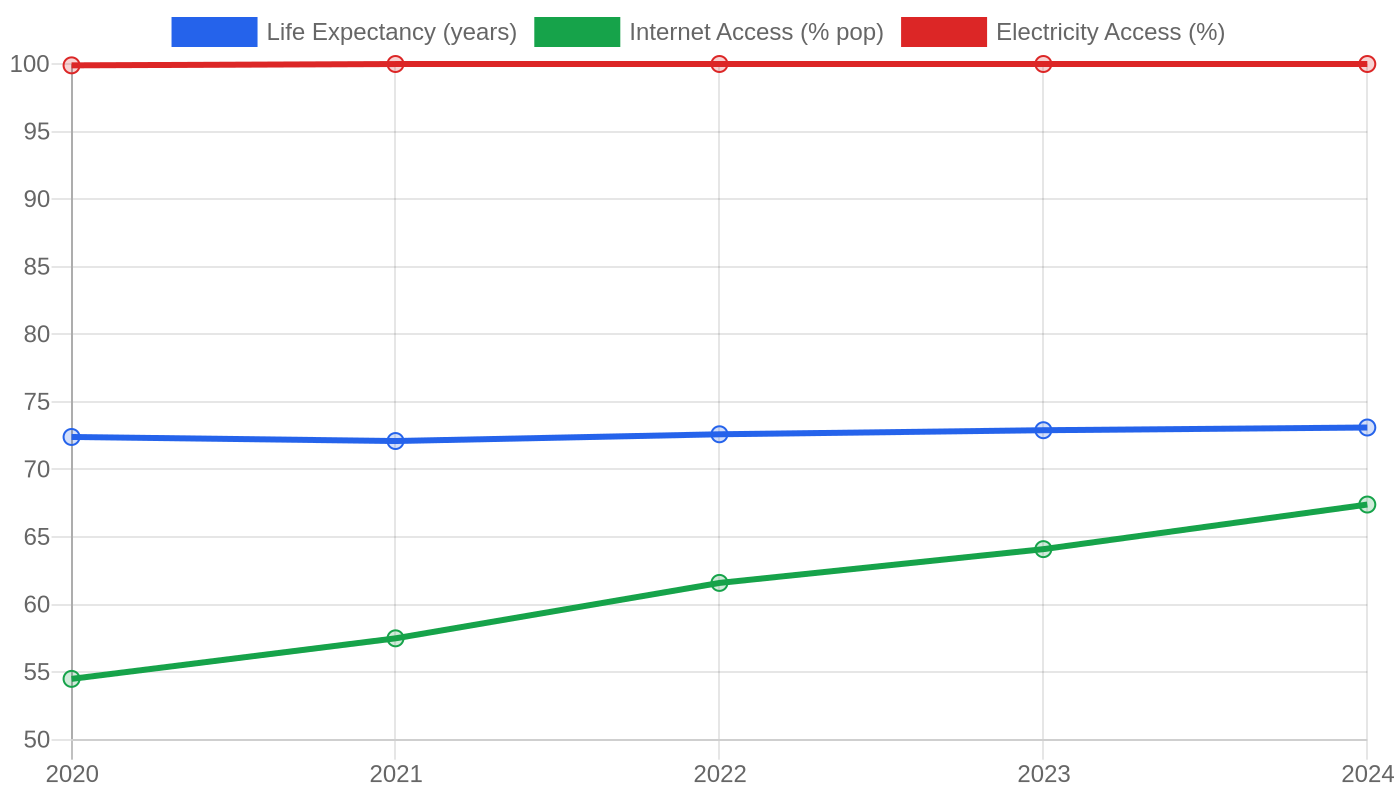
The World Bank’s latest data on Tonga presents a striking paradox: the kingdom’s economic dashboard is nearly blank. GDP growth, inflation, unemployment, GDP in absolute terms, GDP per capita adjusted for purchasing power, GNI per capita, and even population figures are all listed as unavailable. For a country that has long been considered a stable outlier in the often-volatile Pacific, this data vacuum is itself a story.
What the World Bank does not say is as telling as what it might. Tonga’s economy is heavily reliant on remittances from its diaspora — Tongans abroad send home sums that often exceed the value of domestic exports. Agriculture, particularly squash, vanilla, and root crops, remains the backbone of subsistence and small-scale trade.
Fishing and tourism have historically contributed, though both sectors remain vulnerable to natural disasters, which have struck the kingdom with devastating frequency in recent years.
The absence of inflation data from the World Bank does not mean prices are stable. In a small island state that imports the vast majority of its fuel, food, and manufactured goods, global price shocks hit hard and fast. The cost of shipping alone can double the price of a loaf of bread or a litre of milk compared to New Zealand or Australia.
Without reliable domestic statistics, families in Nuku’alofa and the outer islands make economic decisions based on word of mouth, church networks, and the fluctuating value of the pa’anga against the Australian dollar.
Employment data is similarly absent. Formal sector jobs are scarce, concentrated in government administration, education, and a handful of private enterprises. Many Tongans work in the informal economy — selling at roadside markets, fishing for household consumption, or relying on family plots. The unemployment figure, if it existed, would likely understate the reality of underemployment, particularly among youth who complete secondary education only to find limited opportunities at home.
The Price of Paradise — Living Costs in the Kingdom
Housing costs in Tonga do not follow the patterns seen in larger Pacific economies. According to the limited data available, there is no formal rental market index or official housing cost survey from the World Bank. What is known from regional reporting is that land in Tonga is largely held under customary tenure, meaning most families do not buy and sell property in the Western sense.
Instead, land is passed through kinship lines, and building a home often depends on family resources and remittance money from relatives overseas.
For those who do rent in urban Nuku’alofa, prices are opaque but understood to be rising. A modest concrete-block house with basic amenities can command a significant portion of a government salary. Utilities — electricity, water, and internet — are expensive by regional standards, as the kingdom relies on imported diesel for power generation. Daily expenses for food are driven by the same import dependency.
Fresh local produce like taro, breadfruit, and fish remains relatively affordable in village markets, but processed goods, dairy, and meat carry premium prices.
The comparison to regional averages is difficult without hard numbers, but anecdotal evidence from development agencies and local journalists suggests that Tonga’s cost of living is among the highest in the Pacific relative to local incomes. Families often juggle multiple income streams — a government job, a small shop, remittances, and subsistence farming — just to stay afloat.
The gap between what is earned and what is spent is bridged by the generosity of the diaspora, a fragile lifeline that can tighten when economic conditions sour in Australia, New Zealand, or the United States.
Business and the Crown — Investment in a Kingdom
The World Bank data does not list Tonga’s top companies, but the kingdom’s business landscape is dominated by a mix of family-owned enterprises, state-linked entities, and a handful of foreign investors. The energy sector, telecommunications, and retail are the most visible arenas for commerce. Digicel, the Irish-owned telecom giant, has long been a major player, though competition has emerged in recent years.
The tourism sector, while small, includes boutique resorts and eco-lodges that cater to a niche market of divers, whale-watchers, and adventure travellers.
The business climate is shaped by the political landscape. As a constitutional monarchy, Tonga has a legal framework for property rights and contracts, but the reality on the ground can be different. Land, as noted, is not freely bought and sold. Foreign ownership of land is restricted, which limits the types of investment possible. Joint ventures with local families or the government are common workarounds, but they require patience, cultural fluency, and deep local relationships.
Sectors to watch include renewable energy — Tonga has ambitious targets for solar and wind power, driven by the high cost of imported diesel and the urgency of climate change. Fisheries management is another area of potential, with sustainable tuna fishing offering export revenue if properly regulated. The digital economy is nascent but growing, with mobile money and remittance services becoming more sophisticated.
However, the small domestic market — even the population figure is unavailable from the World Bank, though regional estimates place it around 100,000 — means that scale is difficult to achieve. Investors looking at Tonga must think in terms of long-term returns and social impact, not quick profits.
Monarchy, Manners, and the Measure of Safety
The political landscape of Tonga is unique in the Pacific, and indeed the world. As the World Bank data notes, Tonga is a constitutional monarchy and the only extant indigenous monarchy in the Pacific islands. Reverence for the monarch replaces that held in earlier centuries for the sacred paramount chief, the Tuʻi Tonga. Criticism of the monarch is held to be contrary to Tongan culture and etiquette.
This is not a theoretical constraint — it shapes the boundaries of political debate, media coverage, and public discourse in tangible ways.
There is no Crime Index or Safety Index available from the data provided, but regional reporting and traveller accounts consistently describe Tonga as a safe country by global standards. Violent crime is rare, and community-based social structures — churches, extended families, village councils — provide a layer of informal social control that formal policing complements.
Petty theft can occur, particularly in urban areas, but the overall environment is one where people feel secure walking at night and leaving doors unlocked in rural villages.
Quality of life in Tonga is a study in contrasts. The education system, as the data highlights, provides free and mandatory education for all citizens, with secondary education available at only nominal fees, and foreign-funded scholarships for postsecondary study. This is a significant investment in human capital that many wealthier countries do not match.
Health outcomes, while not captured in the provided data, are generally good by Pacific standards, though non-communicable diseases like diabetes and heart disease are rising. The pace of life is slow, family ties are strong, and cultural traditions — dance, music, church, and communal feasting — provide a richness that no economic statistic can capture.
Current Affairs — A Kingdom in the Crosswinds
Right now, Tonga is navigating a period of quiet but significant change. The data provided does not include recent news headlines, but the broader context is clear: the kingdom is still recovering from the catastrophic volcanic eruption and tsunami of January 2022, which damaged infrastructure, destroyed homes, and severed the critical underwater communications cable that connects Tonga to the outside world.
That event reshaped the national conversation around disaster resilience, infrastructure investment, and the need for economic diversification.
On the political front, the monarchy continues to wield significant influence, but a gradual democratisation process that began in the late 2000s has given elected representatives more power. The current government is focused on rebuilding, attracting foreign aid, and managing the delicate balance between tradition and modernity. Climate change is an existential threat — rising sea levels, stronger cyclones, and coral bleaching directly threaten the kingdom’s habitability and economic base.
The data gaps from the World Bank are themselves a story of a country that struggles to collect and publish basic statistics. This is not unique to Tonga — many small island states face similar challenges — but it has real consequences. Without reliable data, international investors are hesitant, aid agencies struggle to measure impact, and policymakers make decisions in the dark.
There are ongoing efforts by regional bodies like the Pacific Community and the Asian Development Bank to improve statistical capacity, but progress is slow.
The Bottom Line
Tonga is a country that defies easy categorisation. It is stable yet vulnerable, traditional yet connected to a global diaspora, data-poor yet rich in social capital. Economists and investors should watch Tonga not for its market size, but as a bellwether for how small island states navigate the intersecting challenges of climate change, globalisation, and cultural preservation.
For the traveller, the student of Pacific politics, or the development professional, Tonga offers lessons in resilience, community, and the limits of economic measurement. The numbers may be missing, but the story is far from blank.
Sources & Methodology
This article is authored by Economic Pulse Net for informational and research purposes. Economic Pulse Net sources its data from multilateral institutions, national statistics bureaus, and proprietary databases. All data is believed to be current as of the date of publication.
Published: July 17, 2026 | Category: Research — Tonga
Use these signals in your own platform
Economic Pulse publishes its live signal feed through a documented, read-only API. Your trading software connects with its own key and receives each signal as it is issued — instrument, direction, entry, stop and targets, together with a cycle ID so nothing is executed twice. The feed is independent of this website and cannot change it.
Signals are informational only and are not financial advice.