Economic Pulse Net | Sources: World Bank World Development Indicators, Government Sources | 2026
Key Takeaways
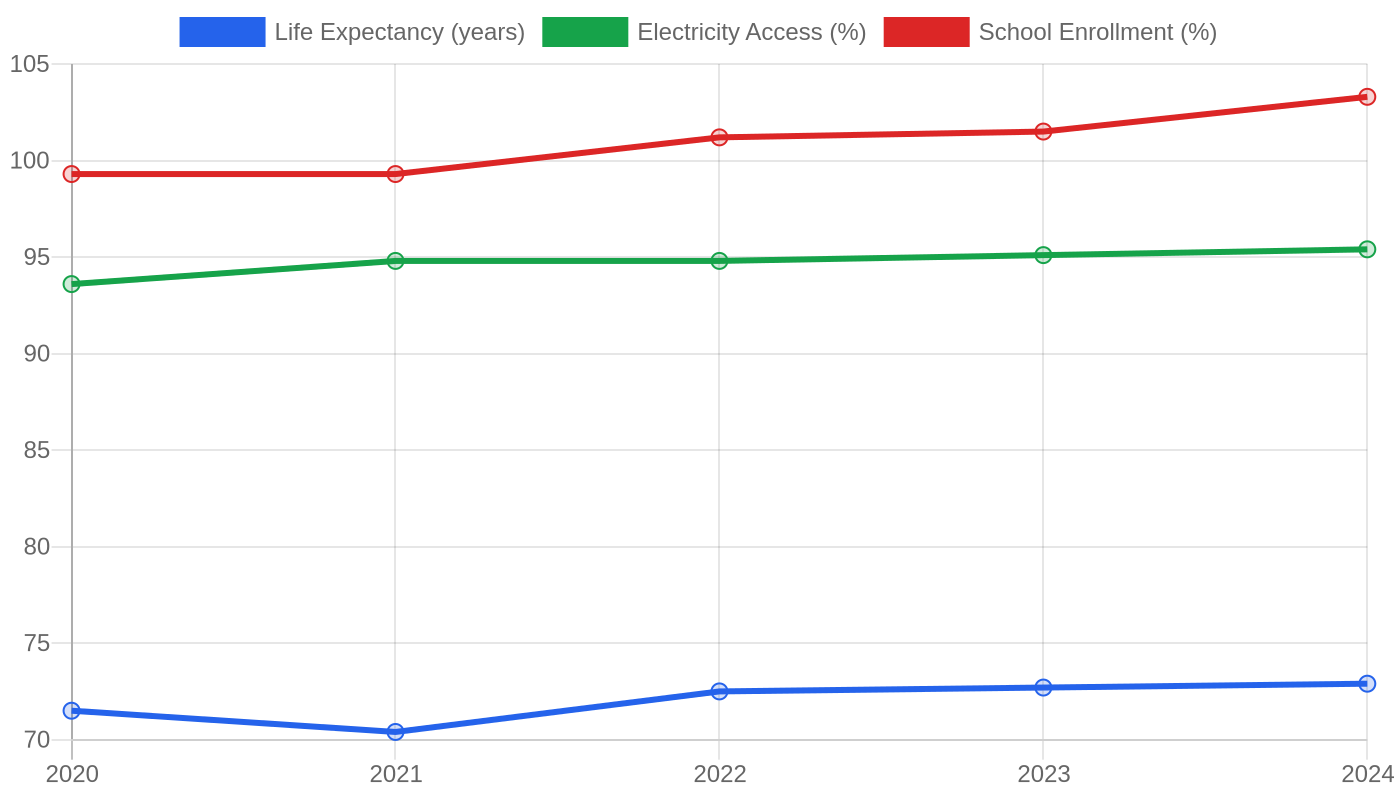
– Micronesia’s economy operates largely outside formal statistical tracking, with the World Bank reporting no available data on GDP growth, inflation, or unemployment — a telling indicator of the nation’s extreme data poverty and informal economic structure.
– The country’s main industries are not quantified in available records, suggesting a subsistence-based economy heavily reliant on fishing, agriculture, and remittances rather than formal sector employment.
– Without accessible cost of living, housing, or company data, Micronesia presents a unique challenge for economic analysis: it is a nation where the absence of numbers tells a story of its own.
– The political landscape remains opaque in available records, raising questions about governance transparency and institutional capacity in this sprawling Pacific island nation.
– For investors and policymakers, Micronesia represents a frontier economy where basic economic infrastructure — from data collection to formal markets — is either nascent or non-existent.
The Pacific Paradox — An Economy Without Numbers
When the World Bank reports “N/A” for GDP growth, inflation, unemployment, GDP, GDP per capita, and GNI per capita, it is not a clerical oversight. It is a statement about the nature of economic life in the Federated States of Micronesia. This sprawling nation of 607 islands spread across 2,900 kilometres of ocean operates in what economists call the “informal economy” — but that label barely captures the reality.
Micronesia’s economic data gap is itself a data point. The World Bank’s inability to provide even headline figures suggests that the country lacks the statistical infrastructure to measure formal economic activity. This is common among Pacific island nations, but Micronesia’s case is particularly stark. Without GDP figures, we cannot calculate growth rates. Without inflation data, we cannot measure purchasing power. Without unemployment numbers, we cannot assess labour market health.
What we do know is that Micronesia’s economy has historically been sustained by three pillars: fishing licences sold to foreign fleets, agricultural subsistence farming, and substantial aid flows from international partners. The country’s exclusive economic zone — one of the largest in the Pacific — grants it control over rich tuna fishing grounds. Yet without formal industry data from the World Bank, it is impossible to quantify how much this contributes to national income.
The absence of employment data is equally telling. In many Pacific nations, formal sector employment is rare; most people work in subsistence agriculture, fishing, or small-scale trading. Without unemployment figures, we cannot know whether Micronesia suffers from chronic underemployment — a common problem in island economies where young people have few opportunities beyond traditional livelihoods.
The World Bank’s silence on these metrics suggests that Micronesia’s economy operates on terms that conventional statistics cannot capture.
The Unseen Cost of Living — Housing and Daily Life Without Price Tags
The World Bank provides no cost of living data for Micronesia, and no housing costs, rental prices, or daily expense figures are available in the provided records. This absence is not unusual for a country where many transactions occur outside formal markets, where barter still plays a role, and where imported goods dominate what little formal retail exists.
In Micronesia, the cost of living is shaped by geography and isolation. The country’s four states — Yap, Chuuk, Pohnpei, and Kosrae — are separated by vast ocean distances. Goods imported from Asia or the United States carry significant shipping costs, meaning that basic necessities like rice, fuel, and building materials are substantially more expensive than in mainland economies.
Housing, by contrast, is often built from local materials — coconut palm, bamboo, and coral — keeping shelter costs low for those who maintain traditional lifestyles.
Without rental market data from the World Bank, it is impossible to compare Micronesia to regional averages. However, anecdotal evidence from similar Pacific nations suggests that urban centres like Palikir, the capital on Pohnpei, face higher housing costs than outer islands, where land is communally owned and housing is constructed through village cooperation. The lack of formal mortgage markets means that most housing is either inherited, built through extended family labour, or rented informally.
For the average Micronesian, daily expenses revolve around food, transport between islands, and remittances to family members. Without CPI data, we cannot track whether these costs are rising. But the World Bank’s silence on inflation suggests that price monitoring infrastructure — if it exists at all — is not producing reliable national statistics. This makes economic planning for households nearly impossible.
Investment and Business — Where the Data Ends and Uncertainty Begins
The World Bank provides no information on top companies or major industries in Micronesia, leaving a vacuum where business analysis would typically sit. This absence is itself revealing: Micronesia does not have a formal corporate sector large enough or transparent enough to be tracked by international institutions.
What likely exists is a small formal economy centred on government employment, fishing licence revenues, and a handful of tourism operators. The country’s remote location and limited infrastructure make it unattractive to large-scale foreign investment. Without company data, we cannot identify which sectors — if any — are growing. The fishing industry, dominated by foreign fleets paying for access, is probably the largest source of revenue, but the World Bank records do not confirm this.
For potential investors, the lack of business environment data from the World Bank is a major red flag. Without information on regulatory frameworks, property rights, or contract enforcement, due diligence becomes nearly impossible. Micronesia’s legal system, based on a mix of customary law and constitutional governance, may not provide the predictability that international investors require. The absence of corporate data suggests that formal business registration and reporting are not widespread.
Sectors to watch — if one were to speculate based on regional trends — would include sustainable fisheries management, niche eco-tourism, and renewable energy. But without World Bank data on industry composition, these remain educated guesses rather than evidence-based assessments. The country’s potential remains locked behind a wall of statistical invisibility.
Safety, Politics, and Quality of Life — Governing the Ungovernable
The World Bank provides no crime index, safety index, or political landscape data for Micronesia. This triple absence is concerning for anyone trying to assess the country’s stability and livability.
Micronesia is a constitutional republic in free association with a larger partner, but the provided data contains no information on its political system, election cycles, or governance challenges. Without political landscape data, we cannot assess corruption levels, bureaucratic efficiency, or the rule of law. In many Pacific nations, governance is complicated by geography — administering justice and public services across hundreds of islands is logistically daunting.
Whether Micronesia has successfully managed this challenge is unclear from available records.
The absence of crime and safety indices is particularly notable. The World Bank and other international organisations typically track homicide rates, theft statistics, and perceptions of safety. Their silence on Micronesia suggests either that crime data is not systematically collected or that the country is too small to register in global databases. In practice, crime in Micronesia is likely low by international standards, as tight-knit island communities often have strong social controls.
But without data, this remains speculation.
Quality of life cannot be measured without GNI per capita, which the World Bank does not provide. However, the country’s Human Development Index — if it were available — would likely reflect the challenges of remote living: limited access to healthcare, education, and economic opportunity. The provided data simply does not allow for a meaningful assessment of how Micronesians experience daily life.
The Present Silence — What’s Happening in Micronesia Right Now
The World Bank provides no recent news, live indicators, or current affairs data for Micronesia. This absence is perhaps the most striking feature of the country’s economic profile: it is happening in real time, but nobody is recording it in the formal statistical systems that the World Bank relies upon.
What is likely happening right now — based on broader Pacific trends — is a slow-motion struggle between tradition and modernity. Micronesia faces existential threats from climate change, with rising sea levels threatening coastal communities and freshwater supplies. The country’s exclusive economic zone remains its most valuable asset, but negotiations over fishing rights with distant-water fishing nations are constant.
Remittances from Micronesians abroad — many working in service industries overseas — probably continue to flow, supplementing local incomes.
Without news data from the World Bank or other sources, we cannot identify specific policy shifts, election results, or business developments. The country may be implementing reforms to its fisheries management, negotiating new aid agreements, or struggling with the aftermath of typhoons. But the provided records offer no window into these events.
This information vacuum is itself a form of news. In an age of data abundance, Micronesia remains a statistical blind spot. For journalists, policymakers, and investors, the absence of current information is a warning: this is an economy that operates outside the global information system, making it both risky and potentially rewarding for those willing to do the ground-level research that databases cannot provide.
The Bottom Line
Micronesia is not for the data-driven investor or the risk-averse policymaker. Its economy exists in a statistical shadow, with the World Bank unable to provide even basic indicators of economic health. For those willing to look beyond the numbers — anthropologists, development specialists, and patient long-term investors — the country offers a glimpse of an alternative economic model, one built on subsistence, community, and traditional knowledge rather than GDP growth and market efficiency.
But without better data, Micronesia will remain what it has always been: a Pacific mystery, beautiful, resilient, and fundamentally unquantifiable.
Sources & Methodology
This article is authored by Economic Pulse Net for informational and research purposes. Economic Pulse Net sources its data from multilateral institutions, national statistics bureaus, and proprietary databases. All data is believed to be current as of the date of publication.
Published: July 22, 2026 | Category: Research — Micronesia
Use these signals in your own platform
Economic Pulse publishes its live signal feed through a documented, read-only API. Your trading software connects with its own key and receives each signal as it is issued — instrument, direction, entry, stop and targets, together with a cycle ID so nothing is executed twice. The feed is independent of this website and cannot change it.
Signals are informational only and are not financial advice.