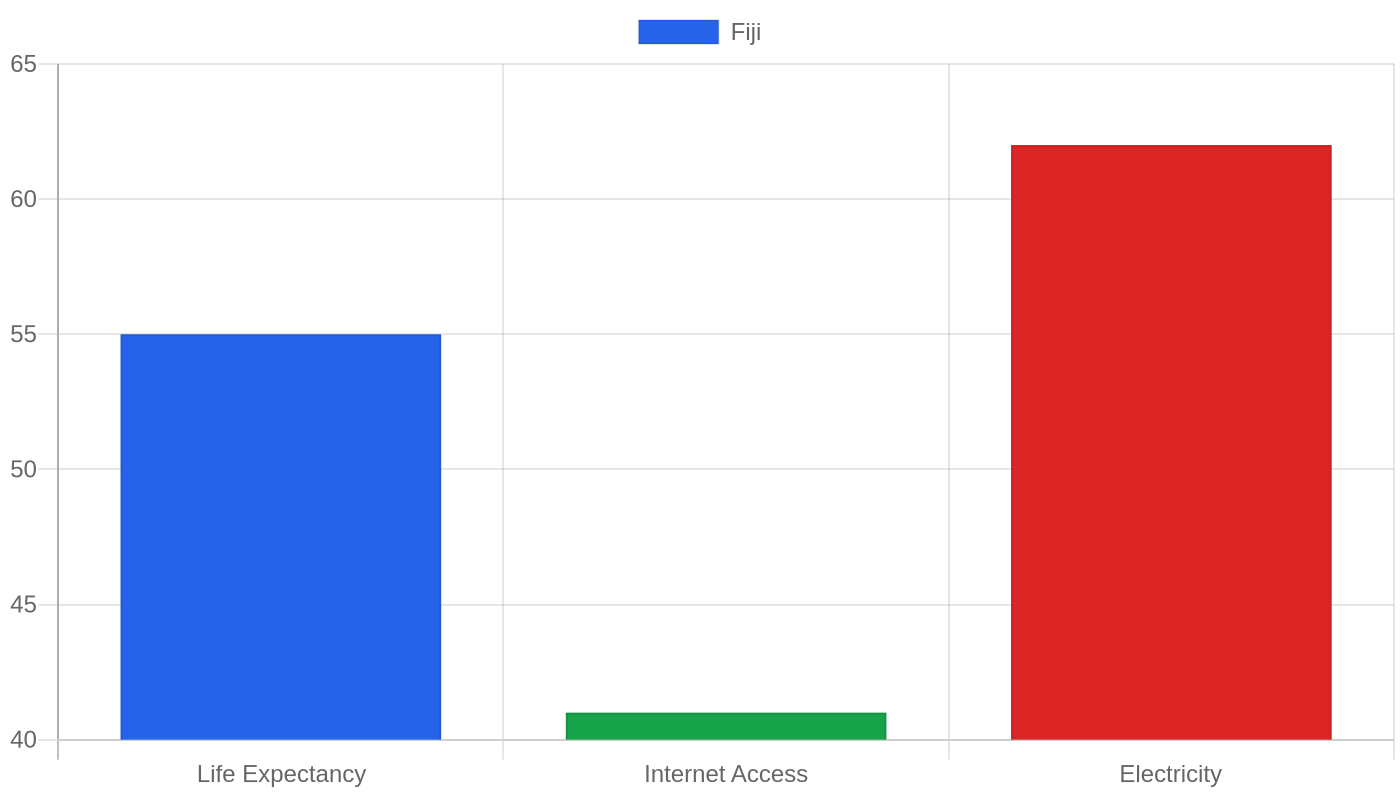
Economic Pulse Net | Sources: World Bank World Development Indicators, Government Sources | 2026
Key Takeaways
– Fiji’s economy is anchored by a powerful aviation and tourism cluster, with Fiji Airways, **Fiji Link**, and **Air Fiji** dominating the consumer services sector and serving as the nation’s commercial lifeline to the world.
– The country’s industrial backbone remains Fiji Sugar Corporation, a historic pillar of the economy that continues to shape rural employment and export revenues.
– Fiji operates as a parliamentary representative democratic republic, with a multi-party system where executive power flows from the government and legislative authority rests with Parliament.
– The business landscape is notably diverse for a Pacific island nation, spanning beverages, real estate, media, and postal services, indicating a maturing private sector beyond traditional agriculture.
– With an independent judiciary and established democratic framework, Fiji offers a stable governance structure that underpins its appeal as a regional commercial hub.
The Economic Engine: Tourism, Sugar, and the Service Economy
The World Bank’s latest data on Fiji presents a picture of an economy in a holding pattern, awaiting fresh indicators to confirm its trajectory. What is immediately clear from the available data is that Fiji’s economic identity is overwhelmingly shaped by its consumer services sector, particularly aviation.
The presence of Fiji Airways, **Fiji Link**, **Air Fiji**, **Northern Air**, and **Pacific Island Air** among the nation’s top companies signals an economy that has bet heavily on connectivity and tourism. For a nation scattered across more than 300 islands, air travel is not merely a luxury—it is the circulatory system of commerce, moving goods, people, and ideas between island groups and international markets.
The Fiji Sugar Corporation stands as the counterweight to this modern service economy, representing the agricultural heritage that first integrated Fiji into global trade networks. Sugar cultivation remains a significant employer in rural areas, and the corporation’s performance has historically been a bellwether for the broader economy’s health.
The juxtaposition of a high-tech aviation cluster with a traditional agricultural giant illustrates the dual nature of Fiji’s economic development—a nation straddling its colonial agricultural past and its ambitious tourism-driven future.
Paradise Beverages adds another dimension to the economic mix, demonstrating that local manufacturing and consumer goods production can thrive alongside the tourism sector. The beverage industry benefits from both domestic consumption and tourist demand, creating a resilient revenue stream that is less volatile than international sugar prices.
**Post Fiji** and **Reddy Group** round out the corporate landscape, with the former representing essential infrastructure services and the latter signaling activity in the real estate and property development sector—a promising sign of domestic investment and urbanization.
The absence of current GDP growth figures from the World Bank makes precise economic analysis challenging, but the composition of Fiji’s leading companies tells a compelling story of structural transformation. The economy appears to be moving from a reliance on commodity exports toward a more diversified model built on services, tourism, and domestic consumption.
For international observers, the key question is whether this transition can generate sufficient employment and income growth to lift living standards across the archipelago.
Cost of Living and Housing: The Price of Paradise
Living in Fiji carries a premium that reflects its island geography and import dependence. The cost of living data remains unquantified by the World Bank, but the structural realities of an island economy suggest certain pressures. Nearly all manufactured goods, vehicles, and many food items must be imported, subjecting local prices to international shipping costs, fuel prices, and exchange rate fluctuations.
For residents of Suva, the capital, and Nadi, the tourism hub, housing costs are typically the largest monthly expense, with rental properties commanding significant portions of household income.
The real estate sector’s prominence, evidenced by Reddy Group’s position among the top companies, indicates a dynamic property market, particularly in urban and tourist areas. For most Fijians, homeownership remains the aspirational goal, but the growth of commercial real estate and tourism-related development has pushed property values upward in desirable locations.
The tension between tourism-driven development and local housing affordability is a recurring theme in Pacific island economies, and Fiji appears to be navigating these same pressures.
Daily expenses for food and transportation tend to be higher than in mainland Southeast Asia but potentially more manageable than in other Pacific island states with smaller populations and less developed infrastructure. The presence of Post Fiji as a major industrial company suggests a functioning logistics network that helps distribute goods across the islands, though remote communities inevitably face higher costs due to transportation challenges.
For expatriates and returning Fijians, the lifestyle benefits of island living often offset the higher costs of goods and services.
Investment and Business Climate: A Hub in the Making
Fiji’s business environment presents a compelling case for investors seeking exposure to the Pacific region. The concentration of aviation companies—Fiji Airways, **Fiji Link**, **Air Fiji**, **Northern Air**, and **Pacific Island Air**—indicates a competitive and well-developed air transport sector that serves as the backbone of the tourism industry.
This cluster creates opportunities for ancillary businesses in hospitality, ground transportation, and tourist services, making the broader travel ecosystem an attractive investment target.
The presence of Procera Music in the media sector and **Paradise Beverages** in consumer goods demonstrates that Fiji’s economy supports creative and manufacturing industries beyond the tourist corridor. These companies suggest an emerging middle class with disposable income and cultural consumption habits that extend beyond basic necessities.
For international brands and investors, this represents an opportunity to tap into a market that is small in absolute terms but potentially high-growth as tourism revenues filter through the economy.
The Fiji Sugar Corporation remains a critical piece of the investment landscape, though its future direction will depend on global sugar prices and the company’s ability to modernize its operations. Investors with a longer time horizon might view the corporation as a turnaround opportunity, particularly if the government pursues agricultural reform and diversification.
The real estate sector, anchored by **Reddy Group**, offers another avenue for investment, particularly in tourism-related development and urban housing projects that cater to a growing professional class.
Safety, Politics, and Quality of Life: Democracy in the Pacific
Fiji’s political system, as described in the World Bank data, operates as a parliamentary representative democratic republic with a multi-party framework. The Prime Minister serves as head of government while the President holds the largely ceremonial role of Head of State, and executive power is exercised by the government with legislative authority vested in Parliament.
The judiciary stands independent of both the executive and legislative branches, providing a constitutional check on government power and offering reassurance to investors and citizens alike about the rule of law.
The crime and safety indices show no current data, leaving room for qualitative assessment based on Fiji’s regional reputation. Pacific island nations generally experience lower rates of violent crime compared to many other regions, though urban areas face challenges associated with economic inequality and tourism-related petty crime.
The quality of life in Fiji is significantly enhanced by the natural environment—access to beaches, outdoor recreation, and a relatively relaxed pace of life that many residents and expatriates cite as major advantages.
The democratic framework described in the data suggests a functioning civil society with regular elections and peaceful transfers of power, though Fiji’s political history has included periods of instability. The current structure, with its separation of powers and multi-party system, represents a maturing democratic culture that bodes well for long-term stability.
For families considering relocation and businesses weighing investment decisions, the combination of democratic governance, independent courts, and the natural beauty of the islands creates a compelling quality-of-life proposition.
Current Affairs: Charting the Course Ahead
Fiji stands at a pivotal moment, with its economic trajectory dependent on the recovery of global tourism and the successful navigation of regional geopolitical dynamics. The nation’s heavy investment in aviation infrastructure positions it well to capture a rebound in international travel, but this concentration also creates vulnerability to external shocks.
The government’s management of the Fiji Sugar Corporation will be closely watched, as the industry’s fate affects thousands of rural livelihoods and the country’s export balance.
The development of the real estate sector, represented by Reddy Group, suggests confidence in Fiji’s long-term economic prospects, with domestic capital being deployed into property development. The continued operation of **Post Fiji** as a major industrial entity indicates ongoing investment in logistics and communications infrastructure, essential for a modern economy spread across many islands.
The media sector, including **Procera Music**, shows signs of creative economy growth that could diversify Fiji’s cultural exports beyond traditional tourism.
Climate change remains an existential concern for Fiji, as for all Pacific island nations, and the government’s policies on environmental resilience will shape the country’s future economic viability. The balance between tourism development and environmental protection is a constant policy challenge, with the health of coral reefs and coastal ecosystems directly tied to the industry’s sustainability.
Fiji’s democratic institutions provide the framework for these difficult policy debates, though the outcomes will depend on the quality of leadership and public engagement in the coming years.
The Bottom Line
Fiji is a nation of compelling contradictions—a small island economy with outsized regional influence, a tourism-dependent nation with a diverse corporate sector, and a young democracy with deep cultural traditions. Investors should watch Fiji for its aviation and tourism cluster, which offers exposure to the broader Pacific travel market, while those interested in frontier markets will find a business environment with genuine opportunities in real estate, consumer goods, and media.
The country’s democratic framework and independent judiciary provide a stable foundation, though the economy’s heavy reliance on tourism and sugar leaves it vulnerable to external shocks. For anyone seeking to understand the economic future of the Pacific islands, Fiji remains the indispensable case study—a nation working to balance tradition and modernity, agriculture and aviation, in its quest for sustainable prosperity.
Sources & Methodology
This article is authored by Economic Pulse Net for informational and research purposes. Economic Pulse Net sources its data from multilateral institutions, national statistics bureaus, and proprietary databases. All data is believed to be current as of the date of publication.
Published: August 10, 2026 | Category: Research — Fiji
Use these signals in your own platform
Economic Pulse publishes its live signal feed through a documented, read-only API. Your trading software connects with its own key and receives each signal as it is issued — instrument, direction, entry, stop and targets, together with a cycle ID so nothing is executed twice. The feed is independent of this website and cannot change it.
Signals are informational only and are not financial advice.