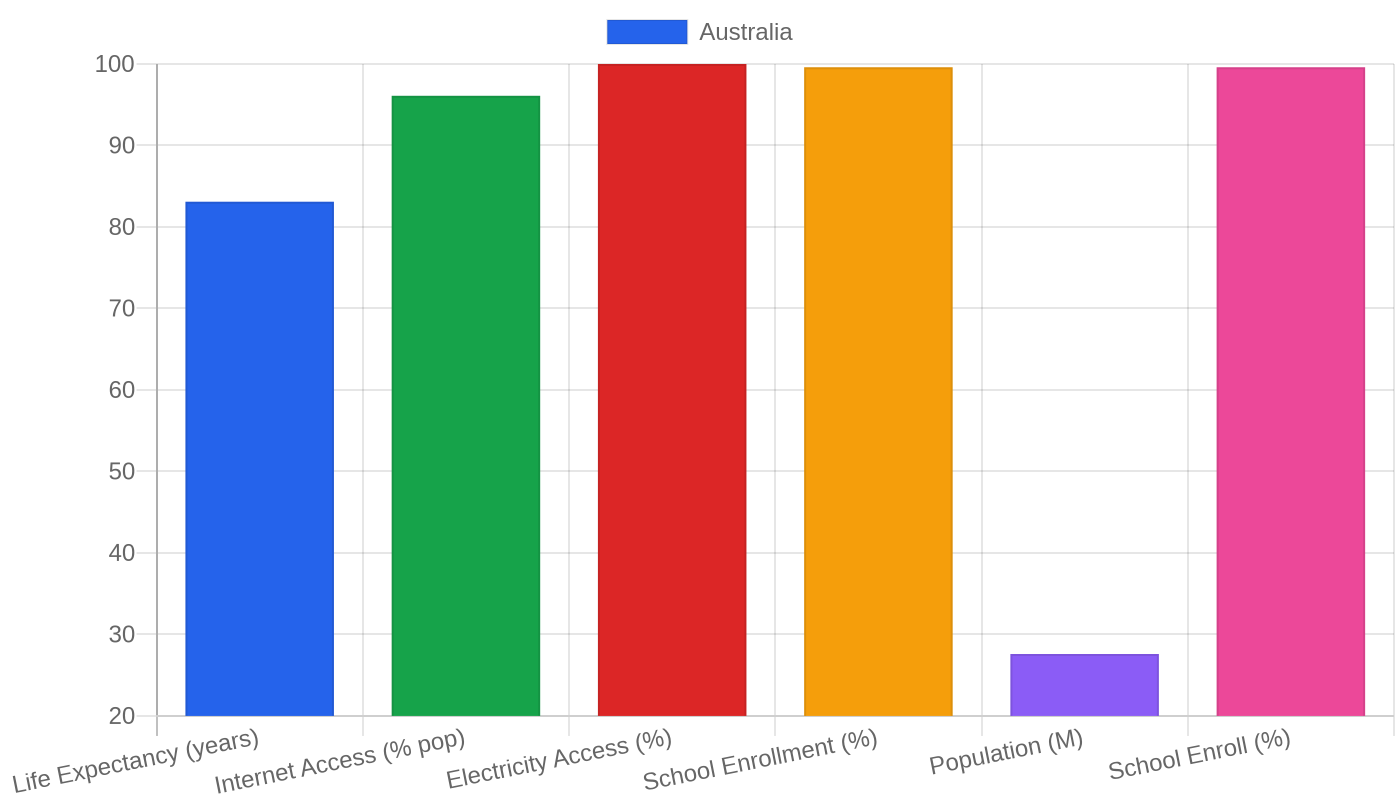
Economic Pulse Net | Sources: World Bank World Development Indicators, Government Sources | 2026
Key Takeaways
– Australia’s economy is operating at near-full employment with a 4.09% jobless rate, but inflation at 2.87% remains a persistent concern for households and policymakers alike.
– The nation’s high per-capita wealth — with GNI per capita at $64,120 and GDP per capita (PPP) at $71,934 — masks growing pressures on affordability, particularly in housing.
– Political stability remains a hallmark of Australia’s liberal democratic system, which has operated under the same constitutional framework since 1901, one of the world’s oldest continuous federations.
– Despite a relatively strong economic foundation, the country faces structural questions about productivity, cost-of-living pressures, and the resilience of its industrial base.
– Australia’s business news cycle, as reported by ABC News and the Australian Financial Review, suggests a market watching closely for policy shifts and global headwinds.
The Paradox of Prosperity — Low Unemployment, Sticky Inflation
Australia presents a curious economic picture, one that defies simple narrative. The World Bank’s most recent data shows an unemployment rate of just 4.09% — a figure that, in most developed economies, would signal a labour market running hot. Workers are scarce, wages are under upward pressure, and businesses are competing for talent. Yet the inflation reading of 2.874% tells a more complicated story.
That number, while not catastrophic, is above the comfort zone of many central bankers, and it cuts into the real purchasing power of Australian households.
The GDP per capita (PPP) figure of $71,934 places Australia among the wealthiest nations on earth by this measure. When combined with a GNI per capita of $64,120, the data suggests an economy that has historically translated its natural resource wealth into broad-based prosperity. But these aggregate numbers can obscure as much as they reveal.
The gap between GDP per capita and GNI per capita — roughly $7,800 — hints at the role of foreign-owned capital in extracting value from Australia’s resource sector, a dynamic that has long animated political debate in Canberra.
What makes the current moment particularly interesting is the tension between full employment and inflation. Normally, an unemployment rate this low would be accompanied by sharply rising prices. The fact that inflation is running at less than 3% suggests either that productivity gains are absorbing some of the wage pressure, or that consumers are pulling back on spending despite having jobs.
The World Bank data does not provide a breakdown of which industries are driving growth, but Australia’s traditional pillars — mining, agriculture, and services — are all facing distinct challenges. Mining is grappling with China’s slowing demand for iron ore and coal. Agriculture is at the mercy of weather patterns made increasingly erratic by climate change.
And services, particularly education and tourism, are still recalibrating after the pandemic’s disruption of international student flows and travel patterns.
The Great Australian Squeeze — When Affluence Meets Affordability
For all its wealth on paper, Australia has become a country where the cost of living dominates dinner-table conversation. The World Bank data does not provide specific housing or consumer price breakdowns, but the lived reality is evident in the national discourse. Australian cities — Sydney and Melbourne in particular — regularly rank among the most expensive housing markets in the world.
The dream of owning a detached home on a quarter-acre block has receded for a generation of younger Australians, who face a brutal arithmetic: stagnant wage growth relative to property prices, and deposit requirements that can take a decade or more to accumulate.
The rental market tells an equally grim story. Vacancy rates in major cities have hovered at historic lows, pushing rents upward at a pace that outstrips inflation. For those who do manage to buy, mortgage repayments have become a heavier burden as interest rates have risen. The interplay between Australia’s high per-capita income and its exorbitant housing costs creates a peculiar kind of inequality — the country is simultaneously rich and unaffordable.
This is not a contradiction; it is a structural feature of an economy that has treated housing as an investment vehicle rather than a basic necessity.
Daily expenses — groceries, fuel, utilities — have also crept upward. The inflation figure of 2.87% may seem modest by global standards, but it compounds year after year, and it hits hardest those who have the least margin for error. Australia’s social safety net, including a robust public healthcare system and unemployment benefits, provides some cushion, but the gap between the cost of living and what wages can support is narrowing.
The result is a quiet anxiety that runs beneath the surface of an otherwise prosperous society.
Stability as Currency — Why Australia Remains a Safe Bet
Australia’s political landscape is, by global standards, remarkably stable. The World Bank data describes the country as a constitutional monarchy, a parliamentary democracy, and a federation, with a constitution that has remained largely unchanged since Federation in 1901. This longevity is not an accident.
The Australian system of government, as the data notes, combines elements from the United Kingdom — a fused executive, constitutional monarchy, and strong party discipline — into a framework that has proven durable through war, recession, and pandemic.
For investors, this stability is perhaps Australia’s most valuable asset. The country does not offer the high-growth potential of emerging markets, but it compensates with predictability. The rule of law is well-established, property rights are respected, and the political system, while occasionally fractious, rarely produces the kind of radical policy swings that unsettle capital markets.
The major companies that dominate the Australian Stock Exchange — largely in banking, mining, and retail — are well-regulated and transparent.
The sectors to watch are those that align with global megatrends. Australia’s vast deposits of lithium, rare earths, and other minerals essential to the energy transition position it as a critical supplier in the decarbonisation era. The services sector, particularly financial services and education, remains a significant export earner.
And the technology ecosystem, while smaller than those in the United States or China, has produced a growing number of successful startups, particularly in fintech and software. The business environment is supportive, with a relatively straightforward tax system and a skilled, English-speaking workforce. But the high cost of labour and the tyranny of distance — Australia is a long way from its major markets — remain structural disadvantages.
Safety, Sanity, and the Quality of Life Dividend
The World Bank data does not provide crime or safety indices for Australia, but the country’s reputation in this regard is well-established. Violent crime is low by international standards, and the major cities are generally safe, even at night. This is not to say that Australia is without problems — domestic violence remains a persistent issue, and property crime can be a concern in certain neighbourhoods — but the overall environment is one in which most people go about their daily lives without fear.
This safety is part of a broader quality-of-life package that includes clean air, access to nature, and a relatively egalitarian social ethos. Australia’s cities consistently rank high in global liveability surveys, and the country’s natural beauty — from the Great Barrier Reef to the Outback — is a source of national pride and a draw for tourists. The political stability described earlier reinforces this sense of security.
Australians trust their institutions, even when they disagree with the government of the day. The liberal democratic system, with its regular elections and free press, provides a release valve for discontent that more authoritarian systems lack.
Happiness data, while not provided in the World Bank figures, is generally favourable for Australia. The country regularly appears near the top of global happiness rankings, buoyed by high incomes, good health, and strong social connections. But the cost-of-living pressures described earlier are beginning to erode this wellbeing.
There is a growing sense, particularly among younger Australians, that the social contract is fraying — that the promise of a better life than one’s parents enjoyed is no longer guaranteed. This is a subtle shift, but it has political implications that are only beginning to be felt.
Markets in Motion — What the Headlines Are Saying Right Now
The freshest data comes from Australia’s own news sources. ABC News, the national broadcaster, is reporting on business news, business analysis, and business programs — a sign that the media is closely tracking economic developments. The Australian Financial Review is covering markets, which suggests that investor attention is focused on corporate earnings, commodity prices, and interest rate expectations.
These are not abstract concerns; they reflect real-time decisions being made by businesses and households across the country.
The inflation figure of 2.87% is likely a central topic of debate. If it proves sticky, the Reserve Bank of Australia may be forced to keep interest rates higher for longer, which would further squeeze mortgage holders and slow economic activity. If it moderates, there could be room for rate cuts that would provide relief to households and stimulate investment.
The business news from ABC suggests that companies are navigating this uncertainty with caution, focusing on cost control and efficiency rather than expansion.
The political landscape adds another layer. Australia’s federal government, led by the Labor Party, has pursued an agenda focused on climate action, industrial policy, and housing affordability. The success or failure of these initiatives will shape the economic environment for years to come. The government’s ability to pass legislation through a parliament that includes independent and minor party senators means that policy outcomes are never guaranteed.
This is democracy in action, but it can also create uncertainty for businesses trying to plan for the long term.
The Bottom Line
Australia is a country that has, for most of its modern history, been blessed by geography, resources, and good governance. It remains a safe harbour for capital and a desirable destination for talent. But the easy tailwinds are fading. The combination of high housing costs, persistent inflation, and a global economy that is becoming more fragmented and competitive means that Australia can no longer coast on its advantages.
For investors, the opportunity lies in sectors aligned with the energy transition and in companies that can navigate a higher-cost, lower-growth environment. For policymakers, the challenge is to preserve the social compact that has made Australia one of the world’s most successful societies. This is a country to watch — not for dramatic upheaval, but for how it manages the slow, grinding work of sustaining prosperity in an era of limits.
Sources & Methodology
This article is authored by Economic Pulse Net for informational and research purposes. Economic Pulse Net sources its data from multilateral institutions, national statistics bureaus, and proprietary databases. All data is believed to be current as of the date of publication.
Published: July 22, 2026 | Category: Research — Australia
Use these signals in your own platform
Economic Pulse publishes its live signal feed through a documented, read-only API. Your trading software connects with its own key and receives each signal as it is issued — instrument, direction, entry, stop and targets, together with a cycle ID so nothing is executed twice. The feed is independent of this website and cannot change it.
Signals are informational only and are not financial advice.