Economic Pulse Net | Sources: World Bank World Development Indicators, Government Sources | 2026
🇺🇸 United States 2025: The Giant’s Steady Pulse in a Complex Global Era
Key Takeaways
- The U.S. economy is expanding at a moderate pace of 2.16% in 2025, signaling resilience despite global uncertainties.
- Inflation remains slightly elevated at nearly 3%, while unemployment sits at a relatively low 4.2%, indicating a tight labor market.
- With a GDP of approximately $30.77 trillion, the United States maintains its position as the world’s largest economy by nominal value.
- Per capita wealth remains exceptionally high, with GDP per capita (PPP) exceeding $90,000, underscoring the nation’s deep economic capacity.
The Engine Room: Growth, Inflation, and the Labor Market
The macroeconomic landscape of the United States in 2025 is defined by a delicate balance between sustained growth and persistent price pressures.
According to the World Bank, the nation’s Gross Domestic Product (GDP) is projected to grow by 2.16138195623856% this year.
This figure suggests that the American economy is not in a recessionary phase but is instead expanding at a moderate, steady pace that supports overall stability.
However, this growth comes with a caveat: inflation, measured by the Consumer Price Index (CPI), stands at 2.94952520485207%.
While this is lower than the peak inflation rates seen in recent years, it remains above the traditional 2% target often sought by monetary authorities.
This level of inflation implies that the cost of goods and services is still rising, which can erode purchasing power for households if wage growth does not keep pace.
On the employment front, the unemployment rate has settled at 4.198%.
This relatively low figure indicates a robust labor market where most people who seek work are able to find it.
Such low unemployment often puts upward pressure on wages, which can further fuel inflation but also boosts consumer spending, creating a virtuous cycle of economic activity.
The total GDP of the United States is valued at $30,769,700,000,000.0, reaffirming its status as the global economic heavyweight.
When adjusted for purchasing power parity, the GDP per capita reaches $90,026.5163005744, highlighting the immense individual economic capacity within the country.
These metrics collectively paint a picture of an economy that is large, productive, and currently navigating the transition from high-inflation recovery to a more normalized growth environment.
The Price of Living: Affordability and Daily Expenses
Living in the United States in 2025 presents a complex financial landscape for residents, driven by the interplay of high wages and persistent inflation.
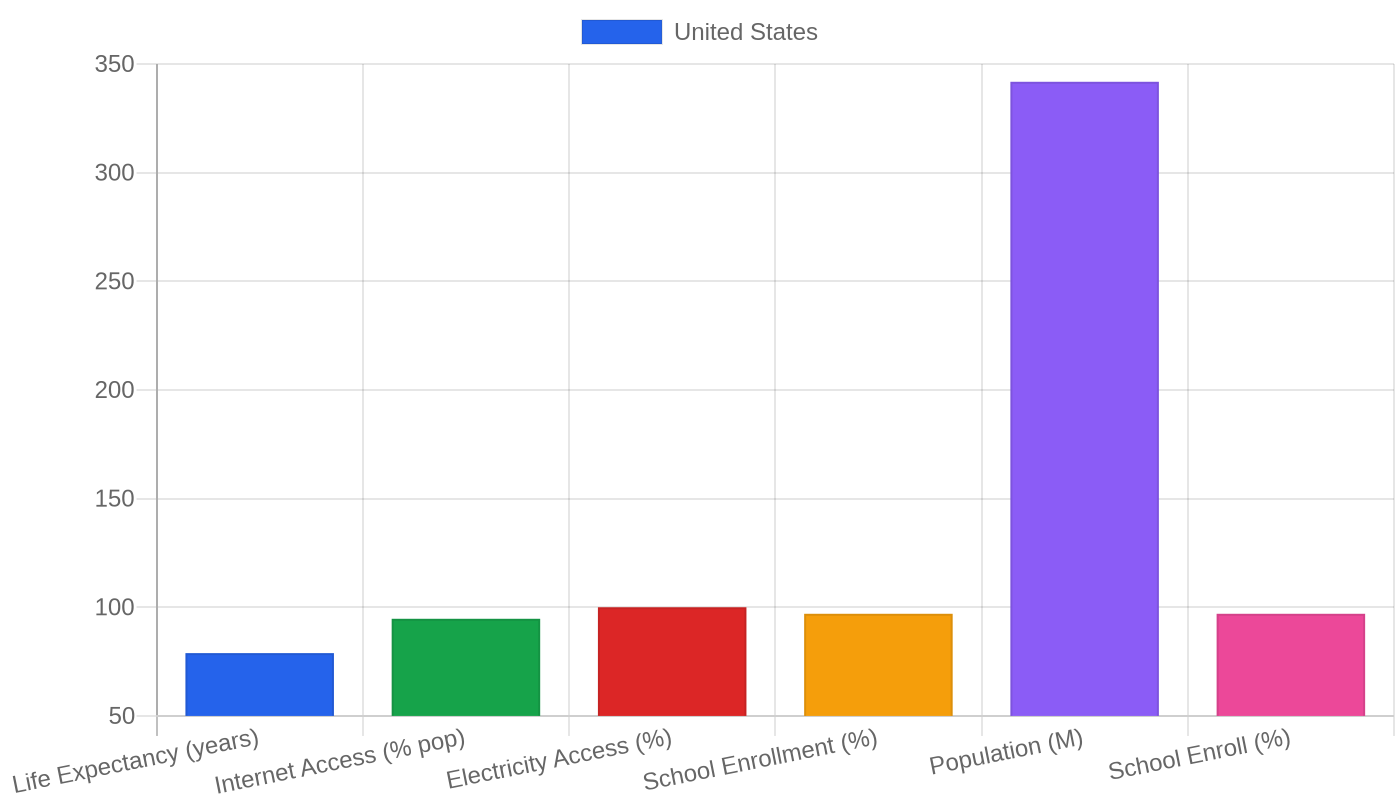
With a Gross National Income (GNI) per capita of $88,810.0, the average American household enjoys a high level of disposable income compared to global standards.
However, the nearly 3% inflation rate means that the cost of daily essentials—such as food, energy, and transportation—is continuing to climb, requiring households to budget carefully to maintain their standard of living.
While specific data on housing costs and rent versus buy dynamics is not provided in the current dataset, the high per capita income suggests that many Americans are in a position to invest in property, though the rising cost of living may constrain entry-level buyers.
The population of 341,784,857.0 creates a vast domestic market, which helps to stabilize prices through economies of scale in retail and manufacturing.
For consumers, the key challenge is managing the gap between income growth and price increases.
In a low-unemployment environment, workers may have more leverage to negotiate higher salaries, potentially offsetting the impact of inflation on their real income.
Nevertheless, the sustained inflation rate of 2.95% serves as a reminder that the era of cheap goods and services has not fully returned.
Residents must remain vigilant in their financial planning, ensuring that savings and investments outpace the gradual erosion of purchasing power.
The overall cost of living remains high by international standards, but the high GNI per capita provides a significant buffer for most households.
Business Climate and Corporate Power
The United States remains a global magnet for business activity, supported by its massive domestic market and technological leadership.
Although specific lists of top companies and main industries are not detailed in the provided data, the sheer scale of the $30.77 trillion GDP implies a diverse and powerful industrial base.
The low unemployment rate of 4.2% suggests that businesses are actively hiring, indicating confidence in future demand and operational stability.
This tight labor market, however, may present challenges for employers, who must compete for scarce talent, potentially driving up labor costs.
The high GDP per capita (PPP) of over $90,000 suggests that the American workforce is highly productive, which is attractive to foreign and domestic investors seeking efficiency and scale.
While detailed sector-specific data is absent, the general economic indicators point to a resilient business environment capable of absorbing global shocks.
The federal structure of the country, with 50 states, allows for diverse regulatory environments that can cater to different types of business models.
Companies operating in the U.S. benefit from a large, affluent consumer base, which provides a stable foundation for revenue growth.
The business climate is further supported by the nation’s status as the world’s oldest surviving federation, offering a long-term political and legal stability that is rare in the global economy.
This stability, combined with high per capita income, makes the U.S. a primary destination for capital investment and innovation.
Political Stability and Quality of Life
The United States operates as a federal republic consisting of 50 states and a federal capital district, Washington, D.C.
This political structure is underpinned by the Constitution of the United States, which serves as the supreme law of the land.
The presidential system of federal government has been adopted, in whole or in part, by many newly independent states worldwide, highlighting its influence and perceived stability.
While specific crime and safety indices are listed as “N/A” in the provided data, the political framework suggests a society governed by established legal institutions.
The nation’s status as the world’s oldest surviving federation implies a long history of democratic governance and institutional continuity.
This political stability is a crucial factor for both residents and investors, as it provides a predictable environment for long-term planning.
The quality of life in the U.S. is reflected in its high GNI per capita, which allows for significant public and private spending on healthcare, education, and infrastructure.
Although the data does not provide specific happiness or safety metrics, the economic indicators suggest a high standard of living for the majority of the population.
The political landscape is complex, with sovereignty asserted over five unincorporated territories and several uninhabited island possessions, adding layers to its federal structure.
Overall, the combination of economic strength and political longevity creates a unique environment where quality of life is supported by both individual prosperity and institutional resilience.
Current Affairs: Navigating the 2025 Economic Landscape
The current economic narrative for the United States in 2025 is centered on the challenge of sustaining growth while taming inflation.
The World Bank’s projection of 2.16% GDP growth suggests that policymakers are successfully avoiding a hard landing, but the nearly 3% inflation rate indicates that the fight against price increases is not over.
This ongoing battle has significant implications for interest rates and borrowing costs, which directly affect housing markets and business investment.
The low unemployment rate of 4.2% is a double-edged sword; while it supports consumer confidence, it also limits the central bank’s ability to stimulate the economy further without risking higher inflation.
As the year progresses, the focus will likely remain on whether inflation can be brought down to the 2% target without triggering a recession.
The large population of over 341 million people provides a vast labor pool, which is crucial for maintaining productivity and growth.
Investors and businesses are closely watching these indicators to gauge the future trajectory of the economy.
The stability of the federal government and its constitutional framework provides a bedrock of confidence, even as economic conditions fluctuate.
The coming months will be critical in determining whether the U.S. can achieve a “soft landing,” where inflation cools and growth remains steady.
The interplay between these factors will define the economic experience for Americans and the global market in the near term.
The Bottom Line
The United States in 2025 presents a compelling case for those interested in stable, high-growth markets.
With a GDP exceeding $30 trillion and per capita income among the highest in the world, the nation offers unparalleled scale and opportunity.
The current economic indicators—moderate growth, low unemployment, and manageable inflation—suggest a resilient economy that is well-positioned for long-term investment and residence.
However, the persistent inflation rate requires careful monitoring, as it could impact real returns and purchasing power.
For global investors, business leaders, and prospective residents, the U.S. remains a cornerstone of the world economy, offering a blend of political stability and economic dynamism that is hard to replicate elsewhere.
Sources & Methodology
This article is authored by Economic Pulse Net for informational and research purposes.
Economic Pulse Net sources its data from multilateral institutions, national statistics bureaus, and proprietary databases.
All data is believed to be current as of the date of publication. Published: September 03, 2026 |
Category: Research — United States
Use these signals in your own platform
Economic Pulse publishes its live signal feed through a documented, read-only API. Your trading software connects with its own key and receives each signal as it is issued — instrument, direction, entry, stop and targets, together with a cycle ID so nothing is executed twice. The feed is independent of this website and cannot change it.
Signals are informational only and are not financial advice.