Economic Pulse Net | Sources: World Bank World Development Indicators, Government Sources | 2026
Key Takeaways
– Panama’s economy is defined by its role as a global transit hub, with a political system built on presidential representation and a multi-party democracy that has remained stable for decades.
– The country’s corporate landscape is dominated by aviation and financial services, with Copa Airlines and its parent Copa Holdings leading a robust consumer services sector.
– Banco Latinoamericano de Comercio Exterior (Bladex) anchors the financial sector, providing a unique regional banking model that extends beyond national borders.
– Panama’s service-based economy faces the classic challenge of diversification, as its historical reliance on the Canal and logistics continues to evolve.
– The political framework operates on a clear separation of powers, with an independent judiciary providing institutional checks and balances.
The Canal Effect: Reading Panama’s Economic DNA
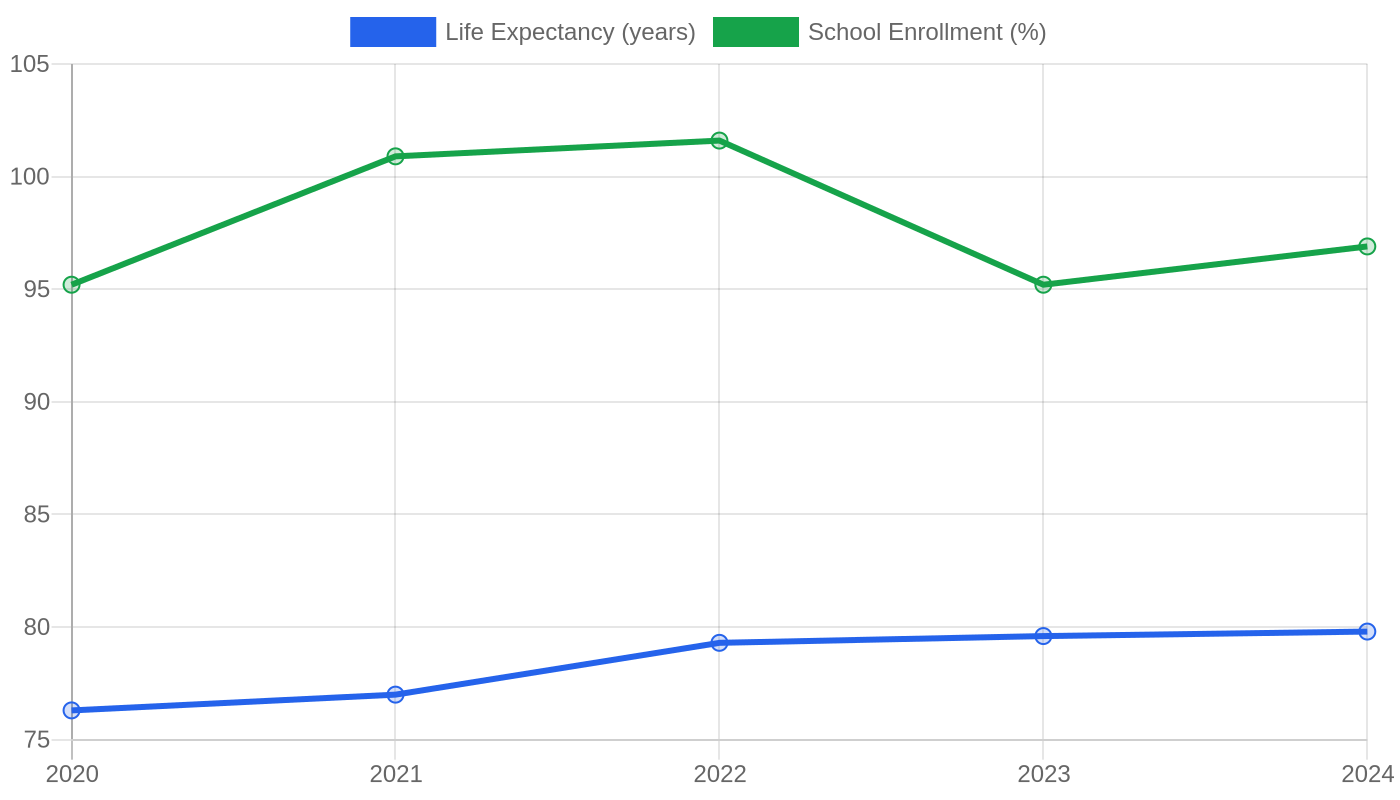
Panama’s economic story is written in the movement of goods and people. While the World Bank’s latest figures do not provide a current GDP growth rate, inflation reading, or unemployment numbers, the structural picture that emerges from the available data tells a compelling story of a services-driven economy with an outsized regional footprint.
The country’s industrial base is concentrated in two key areas: consumer services and industrials, specifically aviation and logistics. This is not a manufacturing economy, nor is it commodity-dependent in the traditional sense. Instead, Panama has built its prosperity on its geography, leveraging its position as the narrowest point between two oceans to become the hemisphere’s great connector.
Aeroperlas, Air Panamá Internacional, Air Panama, and Alas Chiricanas represent the domestic and regional aviation ecosystem, while Copa Airlines and Copa Holdings have transformed Panama City into a true aviation hub. The presence of Air Services Cargo and DHL Aero Expreso underscores the logistics backbone that keeps goods moving through the region.
The financial sector adds another layer of sophistication. Balboa Bank and Trust and Banco Latinoamericano de Comercio Exterior — better known as Bladex — demonstrate that Panama has successfully built a banking industry that serves both domestic needs and regional trade finance. This is an economy that has learned to sell services, not just goods, and that distinction matters enormously for its growth trajectory.
The Price of Paradise: What Life Costs in a Transit Nation
Without current cost-of-living data from the World Bank, we must look at the structural indicators that shape daily life in Panama. The country’s status as a regional hub for banking, aviation, and logistics means that Panama City functions as a business destination, and that carries implications for housing and daily expenses.
In economies dominated by services and international commerce, urban centers typically see a two-tier cost structure: one for the professional class tied to the corporate sector, and another for service workers who support those industries. Panama’s heavy concentration of financial and aviation companies suggests that its capital city operates with the price pressures common to global business hubs.
The presence of multiple international airlines and cargo operations means a constant flow of business travelers, expatriate professionals, and regional headquarters staff, all of whom put upward pressure on housing in desirable neighborhoods. For the average Panamanian, the calculus of rent versus ownership in such an environment often depends on access to credit, which the country’s robust banking sector is well-positioned to provide.
Where Capital Flows: The Business Climate in a Banking Nation
Panama’s top companies list reads like a who’s who of regional connectivity. Copa Holdings, the parent company of Copa Airlines, represents one of Latin America’s most successful aviation stories, connecting smaller cities across the hemisphere through its Panama City hub. This is not just a national airline; it is a continental distribution network.
The financial sector, anchored by Bladex, offers something unique: a bank established by central banks from across Latin America to finance regional trade. This gives Panama a financial infrastructure that is genuinely international in scope, attracting capital flows that other countries of similar size could only dream of.
For investors, Panama offers a business environment built on the rule of law, with a judiciary that operates independently of both the executive and the legislature. That institutional stability is a genuine asset in a region where it cannot be taken for granted. The multi-party system ensures political competition, while the presidential framework provides clear executive accountability.
The aviation cluster deserves particular attention. With Copa, DHL Aero Expreso, and multiple domestic carriers, Panama has developed an aviation ecosystem that supports everything from cargo logistics to tourism and business travel. This is a sector with significant barriers to entry, which means established players benefit from sustained competitive advantages.
Stability and Its Discontents: Politics and Public Safety in Panama
Panama operates as a presidential representative democratic republic, with a multi-party system and a clear separation of powers. The President serves as both head of state and head of government, executive power rests with the administration, and legislative authority is shared between the government and the National Assembly.
This institutional framework has provided Panama with political continuity, but it also creates the familiar tensions of presidential systems. The balance between executive ambition and legislative oversight is a constant negotiation, and the independent judiciary serves as the ultimate arbiter.
The available data does not include crime or safety indices, which makes it difficult to offer specific assessments of public security. However, the country’s deep integration with international commerce — the constant flow of air cargo, business travelers, and regional banking activity — suggests a functioning society with the institutional capacity to manage the challenges typical of a middle-income country.
Panama’s quality of life is intrinsically tied to its economic model. The service sector provides white-collar employment, the aviation industry supports a wide range of skilled and semi-skilled jobs, and the financial sector offers professional careers that keep talent within the country. The question is whether this model can continue to deliver rising living standards for all Panamanians, not just those directly employed by the flagship industries.
The Road Ahead: Panama’s Next Act
The story of Panama in 2026 is one of consolidation and adaptation. The aviation sector, led by Copa Holdings, continues to be the crown jewel of the economy, while the financial industry maintains its regional significance. The logistics and cargo operations that move goods through the country remain essential infrastructure for global trade.
But the country faces structural questions that will define its next decade. Can it diversify beyond its traditional strengths? Will the service economy generate enough employment for a growing population? And can the political system manage the inevitable pressures that come with being a small country with an outsized regional role?
The absence of current World Bank data on GDP growth, inflation, and unemployment leaves gaps in our understanding of Panama’s present moment. What is clear is that the country’s fundamental economic architecture remains intact: a services-driven economy anchored by aviation, logistics, and banking, operating under a stable political framework with an independent judiciary.
The Bottom Line
Panama is a country that has turned geography into destiny, building a service economy that connects hemispheres and moves capital across borders. For investors, it offers exposure to Latin American trade and aviation through well-established corporate champions. For business travelers, it is the hemisphere’s great crossroads. For observers of political economy, it demonstrates how a small nation can build outsized influence through smart policy and institutional stability.
The lack of fresh macroeconomic data makes precise forecasting difficult, but the structural story of Panama — a logistics superpower with a banking sector to match — remains as compelling as ever.
Sources & Methodology
This article is authored by Economic Pulse Net for informational and research purposes. Economic Pulse Net sources its data from multilateral institutions, national statistics bureaus, and proprietary databases. All data is believed to be current as of the date of publication.
Published: August 12, 2026 | Category: Research — Panama
Use these signals in your own platform
Economic Pulse publishes its live signal feed through a documented, read-only API. Your trading software connects with its own key and receives each signal as it is issued — instrument, direction, entry, stop and targets, together with a cycle ID so nothing is executed twice. The feed is independent of this website and cannot change it.
Signals are informational only and are not financial advice.