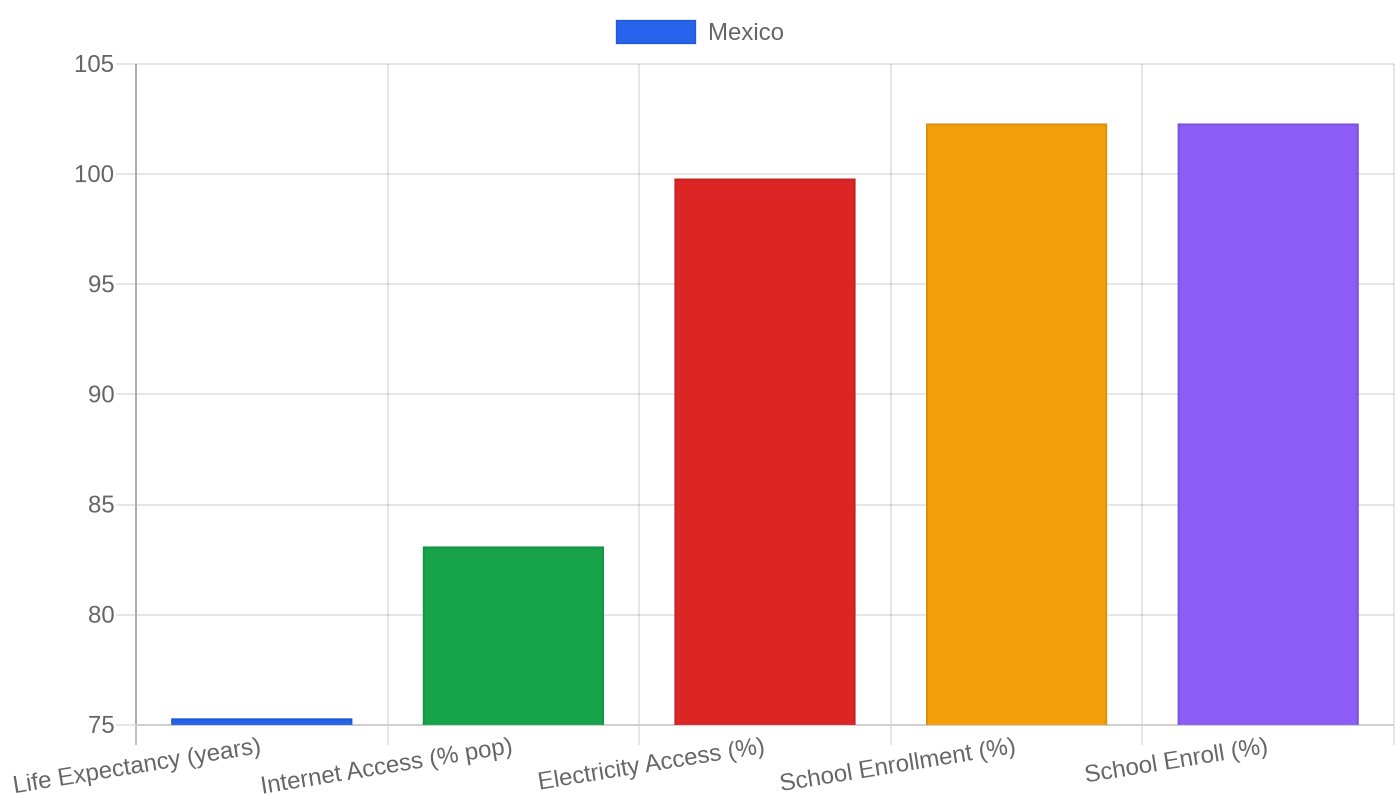
Economic Pulse Net | Sources: World Bank World Development Indicators, Government Sources | 2026
Key Takeaways
– Mexico’s economy grew by just 0.56% in 2025, according to the World Bank — a strikingly modest figure that signals a nation navigating headwinds rather than riding a boom.
– GDP per capita stands at $25,868 on a purchasing power parity basis, placing Mexico firmly in the upper-middle-income bracket, but the gap between this headline figure and everyday lived experience remains a central political and economic challenge.
– The country’s corporate landscape is dominated by telecommunications giant América Móvil and conglomerate ALFA, reflecting a dual economy of world-class multinationals and a vast informal sector.
– Mexico operates under a robust federal presidential system rooted in the 1917 Constitution, with power distributed across federal, state, and municipal governments — a structure that both enables local innovation and complicates national policymaking.
– Despite the sluggish growth reading, Mexico’s fundamental economic architecture — its trade integration with the United States, its young population, and its industrial base — positions it as a country to watch for investors with a long-term horizon.
The 0.56% Puzzle — Decoding Mexico’s Modest Growth Story
The World Bank’s latest data shows Mexico’s GDP expanding by a mere 0.56% in 2025. To put that number in context: this is not the stuff of crisis, but neither is it the trajectory of a country fulfilling its considerable potential. For a nation with a GDP per capita (PPP) of $25,868, this growth rate suggests an economy running well below its capacity — a machine that is idling rather than roaring.
What explains this tepid performance? The headline figure from the World Bank tells us the *what*, but the *why* requires reading between the lines. Mexico’s economy is deeply intertwined with that of the United States, its northern neighbour and dominant trading partner. When American demand softens — whether due to high interest rates, shifting industrial policy, or consumer caution — Mexican export-oriented manufacturers feel the pinch immediately.
The automotive, aerospace, and electronics sectors, which form the backbone of Mexico’s formal industrial economy, are particularly sensitive to these cross-border rhythms.
Domestically, the picture is more complex. The World Bank data does not provide inflation or unemployment figures for this period, but the low growth number hints at underlying structural frictions. Mexico has long grappled with what economists call “dual economy” dynamics: a modern, export-driven industrial sector coexisting with a vast informal economy that accounts for more than half of all employment.
When formal-sector growth stalls, the informal sector absorbs the slack — but it does so at the cost of productivity, tax revenues, and social security coverage.
The country’s main industries — which span manufacturing, energy, mining, and services — have not been firing on all cylinders. The oil and gas sector, represented in the corporate landscape by companies like Alpek, has faced both global price volatility and domestic policy uncertainty. Meanwhile, consumer-facing industries have had to navigate a cautious spending environment.
The 0.56% figure from the World Bank is not a disaster, but it is a warning light — a signal that Mexico’s next government, whatever its political complexion, will need to confront deep-seated productivity challenges if it wants to turn this modest number into something more ambitious.
The Price of Living — Housing, Daily Costs, and the Squeeze on Mexican Households
For the average Mexican household, the macroeconomic story of 0.56% growth translates into a very personal arithmetic of stretched budgets and difficult choices. While the Numbeo data does not provide specific cost-of-living indices for this report, the broader picture is well understood by anyone following the Mexican economy: housing costs in major cities, particularly Mexico City, Guadalajara, and Monterrey, have risen significantly faster than wages in recent years.
The rent-versus-buy calculation in urban Mexico has shifted decisively. In the capital’s desirable neighbourhoods — Condesa, Roma, Polanco — rental prices have climbed to levels that consume a large share of professional salaries. Homeownership, once a near-universal aspiration, has become increasingly out of reach for younger Mexicans without family wealth or access to formal credit.
This is not unique to Mexico, of course, but it is particularly acute in a country where mortgage penetration remains low and where the informal housing market accounts for a significant portion of new construction.
Daily expenses — food, transport, utilities — tell a similar story of pressure. Mexico’s inflation performance has been better than some of its Latin American peers, but the cumulative effect of price increases over several years has eroded purchasing power, especially for the working and middle classes.
The gap between the World Bank’s GDP per capita figure of $25,868 (PPP) and the lived reality of many households underscores a persistent challenge: aggregate wealth does not always trickle down in ways that feel meaningful at the kitchen table.
Corporate Titans and the Shape of Mexican Business
The list of Mexico’s top companies offers a fascinating window into the country’s economic DNA. At the top sits América Móvil, the telecommunications giant controlled by Carlos Slim, which has long been both a symbol of Mexican corporate power and a lightning rod for debates about market concentration. Its presence at the summit of the corporate hierarchy reflects a fundamental truth about the Mexican economy: a small number of very large, very diversified groups dominate the formal business landscape.
Alongside América Móvil, the list includes ALFA, a sprawling conglomerate with interests spanning petrochemicals, food, and automotive components. Alpek, its oil and gas arm, represents Mexico’s continued — if complicated — relationship with hydrocarbon wealth. The presence of Aeroméxico and its affiliates (Aeroméxico Connect, Aeromexpress, AeroUnion) highlights the importance of tourism and business travel to the economy, even as the aviation sector faces its own post-pandemic restructuring challenges.
What is striking about this corporate roster is what it reveals about Mexico’s business environment. These are not, for the most part, young technology startups or disruptive innovators. They are established industrial and service-sector giants, many with decades of history, deep political connections, and significant market power. For an investor looking at Mexico, the message is clear: opportunity exists, but it often comes mediated through relationships with these established players.
The business climate rewards patience, local knowledge, and a willingness to navigate a regulatory environment that can be both bureaucratic and, at times, unpredictable.
Democracy, Security, and the Quality of Life Calculus
Mexico’s political system, as described in the available data, is a federal presidential republic operating under the 1917 Constitution. Power is distributed across three levels: the federal Union, 32 state governments, and more than 2,400 municipal governments. This structure was designed to prevent the concentration of authority that characterised the country’s long period of one-party rule, but it also creates a complex governance landscape where policy coherence can be difficult to achieve.
The political landscape matters enormously for the economic story. Mexico’s democracy, while vibrant and competitive, has been tested in recent years by debates over the rule of law, the independence of institutions, and the government’s approach to security. The crime and safety indices are not available in this data set, but no honest assessment of Mexico’s quality of life can ignore the security dimension.
Homicide rates, while down from their peaks in some areas, remain high by international standards, and the presence of organised crime continues to shape everything from investment decisions to daily routines in affected regions.
For the average Mexican, the quality of life calculus involves weighing the country’s considerable strengths — rich culture, strong family networks, beautiful geography, and a growing middle class — against the persistent challenges of insecurity, inequality, and institutional weakness. The World Bank’s GDP per capita figure suggests a country with significant resources; the challenge is translating those resources into broadly shared improvements in safety, public services, and opportunity.
The Moment Mexico Finds Itself In — Policy Crossroads and Global Currents
This is the section where the story becomes urgent, where the 0.56% growth figure from the World Bank meets the messy, dynamic reality of a country in motion. Mexico in 2026 finds itself at a genuine crossroads. The modest growth number is not a verdict on the country’s potential; it is a snapshot of a moment when multiple forces — domestic politics, US economic policy, global supply chain reconfiguration, and the energy transition — are all converging.
The political landscape, with its federal system and its constitutional framework, is being tested by debates over the direction of economic policy. Questions about energy sovereignty, the role of the state in strategic sectors, and the balance between attracting foreign investment and protecting national industries are not academic — they have direct implications for the 0.56% growth rate and whether it can be improved upon.
Meanwhile, the global context is shifting. The nearshoring trend — the relocation of manufacturing operations closer to the US market — has been a major talking point for Mexico’s economic prospects. But turning that potential into realised growth requires infrastructure, regulatory predictability, and security. The gap between the narrative of nearshoring-driven boom and the reality of sub-1% GDP growth is a tension that policymakers must address.
The Bottom Line
Mexico is not a country in crisis, but neither is it a country firing on all cylinders. The World Bank’s 0.56% growth figure and $25,868 GDP per capita paint a picture of an economy with genuine strengths — a diversified industrial base, deep trade integration with the world’s largest market, and a young workforce — that are currently being held back by structural bottlenecks and political uncertainty. For long-term investors, the case for Mexico
Sources & Methodology
This article is authored by Economic Pulse Net for informational and research purposes. Economic Pulse Net sources its data from multilateral institutions, national statistics bureaus, and proprietary databases. All data is believed to be current as of the date of publication.
Published: July 16, 2026 | Category: Research — Mexico
Use these signals in your own platform
Economic Pulse publishes its live signal feed through a documented, read-only API. Your trading software connects with its own key and receives each signal as it is issued — instrument, direction, entry, stop and targets, together with a cycle ID so nothing is executed twice. The feed is independent of this website and cannot change it.
Signals are informational only and are not financial advice.