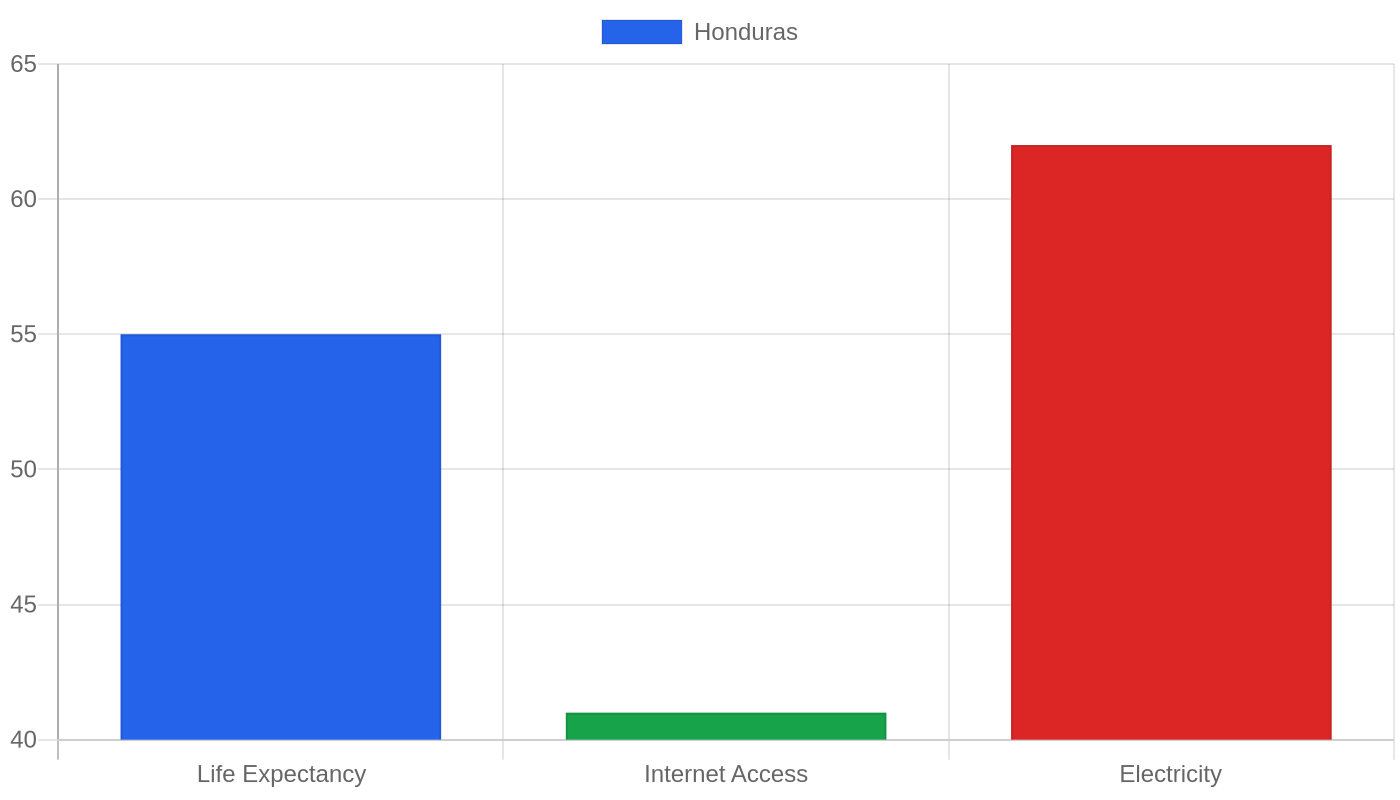
Economic Pulse Net | Sources: World Bank World Development Indicators, Government Sources | 2026
Key Takeaways
– A functioning democracy with institutional stability: Honduras operates as a presidential representative democratic republic, with a clear separation of powers between the executive, legislative, and judicial branches — a framework that provides a predictable foundation for business and governance.
– A state-driven energy sector: The Empresa Nacional de Energía Eléctrica remains a cornerstone of the national economy, signalling that utilities and infrastructure development are central to the country’s economic trajectory.
– An aviation-heavy corporate landscape: The majority of Honduras’s top companies are in consumer services, particularly airlines, suggesting a nation deeply connected by air travel and positioned as a regional transit point.
– Telecommunications and fuel distribution anchor the private sector: With Hondutel and Gasolineras Uno among the leading firms, the economy shows strength in essential services and energy distribution.
– A country to watch for infrastructure and connectivity plays: From InterAirports managing key facilities to a robust airline sector, Honduras is quietly building out its logistical backbone.
Macroeconomic Overview — The Numbers Behind the Narrative
The World Bank’s latest data on Honduras presents a familiar challenge for analysts: headline figures for GDP growth, inflation, unemployment, and GDP per capita remain unpublished for the most recent period. Yet the absence of fresh statistics does not diminish the importance of understanding where this Central American nation stands.
Honduras’s economic identity is shaped by its position as a bridge between the Caribbean and the Pacific trade routes, and by the industries that have taken root within its borders.
What we can observe with clarity is the composition of the country’s corporate elite. The dominance of consumer services firms — particularly airlines like AeroCaribe de Honduras, AeroHonduras, Aerolíneas Sosa, Atlantic Airlines, EasySky, and Isleña Airlines — tells a compelling story. This is a nation where domestic air travel is not a luxury but a necessity.
The mountainous terrain and dispersed population centres have made aviation an essential component of the national economy, creating a competitive market with at least six carriers operating within the country’s borders.
The presence of Empresa Nacional de Energía Eléctrica among the top companies highlights the critical role of state enterprise in the energy sector. For a developing economy, reliable electricity generation and distribution are foundational to every other industry. The prominence of this utility suggests that energy policy and investment will remain defining factors in Honduras’s economic future.
Meanwhile, the presence of Hondutel in telecommunications and Gasolineras Uno in fuel distribution completes a picture of an economy anchored in essential services — energy, connectivity, and mobility.
When inflation and GDP data do become available, analysts will watch closely for signs of how these core sectors are performing. The airline industry’s health, in particular, serves as a bellwether for consumer confidence and business activity. If these carriers are expanding routes and fleets, it signals economic momentum. If they are consolidating, it suggests headwinds.
For now, the structure of the economy speaks to resilience — these are industries that serve fundamental needs, not discretionary spending.
Cost of Living — The Price of Connection
Without recent World Bank data on consumer prices, housing costs, or wage levels, painting a precise picture of daily expenses in Honduras requires inference from the country’s economic structure. What we can reasonably deduce is that the cost of living is shaped by the same geography that has made aviation so central to the national economy.
In a country where moving goods and people across internal borders often requires air travel, transportation costs necessarily ripple through the price of everything else.
The prominence of Gasolineras Uno among the nation’s largest companies suggests that fuel prices are a significant factor in household budgets. In economies where a substantial portion of the population relies on road transport for both commuting and commerce, fuel costs are not merely an expense — they are a primary driver of inflation and household financial strain.
The same logic applies to energy costs, with Empresa Nacional de Energía Eléctrica’s performance directly affecting what families pay for electricity.
For housing, the absence of specific data on rent versus purchase prices leaves room only for general observation. In many Central American economies, homeownership rates are traditionally high, with families building homes incrementally over generations. The rental market tends to be concentrated in urban centres where employment opportunities draw workers.
As Honduras continues to develop its infrastructure, particularly through the work of InterAirports and the expansion of air travel, secondary cities may see increased housing demand — a dynamic worth watching in the coming years.
Investment & Business Climate — The Skies Are the Limit
For investors looking at Honduras, the corporate landscape offers a clear message: this is a country where infrastructure and essential services present the most compelling opportunities. The sheer number of airlines operating domestically — six of the top ten companies — indicates a competitive market that has found ways to thrive. EasySky, Isleña Airlines, Atlantic Airlines, and their competitors are not merely surviving; they are among the most significant enterprises in the nation.
The presence of InterAirports in the industrials sector points to the importance of aviation infrastructure as a growth area. Airport management and development are capital-intensive businesses that require long-term vision and stable regulatory environments. The fact that this company ranks among Honduras’s largest suggests that the country is investing seriously in its role as a regional transport hub.
Beyond aviation, the energy sector demands attention. Empresa Nacional de Energía Eléctrica’s position as a top company underscores the strategic importance of electricity generation and distribution. For international investors, partnerships in energy infrastructure — whether in generation capacity, grid modernisation, or renewable sources — represent significant opportunities.
Similarly, Hondutel’s presence in telecommunications signals a market for connectivity investments as the country continues to integrate into the digital economy.
The business environment, framed by the presidential representative democratic republic structure, offers a degree of institutional predictability that investors value. With executive power exercised by the government, legislative authority vested in the National Congress, and an independent judiciary, there are clear checks and balances in place. This framework, while not without challenges, provides the rule of law that businesses require for long-term planning and capital commitment.
Safety, Politics & Quality of Life — Democracy in Practice
Honduras’s political system is defined by its constitutional structure: a presidential representative democratic republic where the President serves as both head of state and head of government. This dual role concentrates significant authority in the executive branch, but the system’s designers built in counterweights. Legislative power rests with the National Congress, and the judiciary operates independently of both.
This tripartite structure is designed to prevent the concentration of power and maintain democratic accountability.
The practical functioning of this system matters for quality of life in tangible ways. When the judiciary operates independently, citizens and businesses can seek redress for grievances without fear of political interference. When the National Congress functions effectively, it provides a forum for debate and legislation that reflects the will of the people. These institutional foundations are essential for social stability and economic development.
Crime and safety indices for Honduras are not currently available in the World Bank dataset, leaving a gap in our understanding of daily life for ordinary citizens. However, the structure of the economy — with its emphasis on essential services and transportation — suggests a society focused on practical concerns: keeping the lights on, staying connected, and moving people and goods efficiently. These are the priorities of a nation getting on with the business of development.
Current Affairs — An Aviation Nation Takes Flight
The most striking feature of Honduras’s current economic moment is the remarkable density of its domestic aviation sector. Six airlines — AeroCaribe de Honduras, AeroHonduras, Aerolíneas Sosa, Atlantic Airlines, EasySky, and Isleña Airlines — rank among the country’s top companies. This is an extraordinary concentration for a nation of Honduras’s size, and it speaks to both the geography of the country and the entrepreneurial spirit of its business community.
The continued operation and growth of these carriers suggests resilient domestic demand for air travel. In many developing economies, domestic airlines struggle to maintain profitability against road transport and, increasingly, high-speed rail. Honduras’s reliance on aviation reflects the practical realities of its terrain and the absence of extensive rail networks. For travellers, this means that air travel is not a premium service but a necessity of daily life and commerce.
The presence of Empresa Nacional de Energía Eléctrica among the corporate leaders indicates ongoing attention to the country’s power infrastructure. Reliable electricity is the backbone of modern economies, and its provision remains a priority. Similarly, Hondutel’s position in telecommunications points to efforts to keep Honduras connected in an increasingly digital world.
Gasolineras Uno’s prominence in fuel distribution completes the picture of a nation ensuring its essential systems are functioning.
For observers watching Honduras, the key indicators to monitor are the expansion plans of its airlines, the investment programme of its energy utility, and the modernisation of its telecommunications network. These three sectors — aviation, energy, and connectivity — will determine the country’s economic trajectory in the years ahead.
The Bottom Line
Honduras is a nation building its future through essential infrastructure — aviation, energy, and telecommunications — and its corporate landscape reflects these priorities. For investors in infrastructure, transportation, and utilities, the country offers opportunities grounded in fundamental economic needs rather than speculative trends. The stable democratic framework, with its independent judiciary and separation of powers, provides the institutional foundation that long-term investment requires.
For anyone watching Central American development, Honduras deserves attention as a country where the essentials of modern economy are being constructed with determination and entrepreneurial energy.
Sources & Methodology
This article is authored by Economic Pulse Net for informational and research purposes. Economic Pulse Net sources its data from multilateral institutions, national statistics bureaus, and proprietary databases. All data is believed to be current as of the date of publication.
Published: August 01, 2026 | Category: Research — Honduras
Use these signals in your own platform
Economic Pulse publishes its live signal feed through a documented, read-only API. Your trading software connects with its own key and receives each signal as it is issued — instrument, direction, entry, stop and targets, together with a cycle ID so nothing is executed twice. The feed is independent of this website and cannot change it.
Signals are informational only and are not financial advice.