Economic Pulse Net | Sources: World Bank World Development Indicators, Government Sources | 2026
Key Takeaways
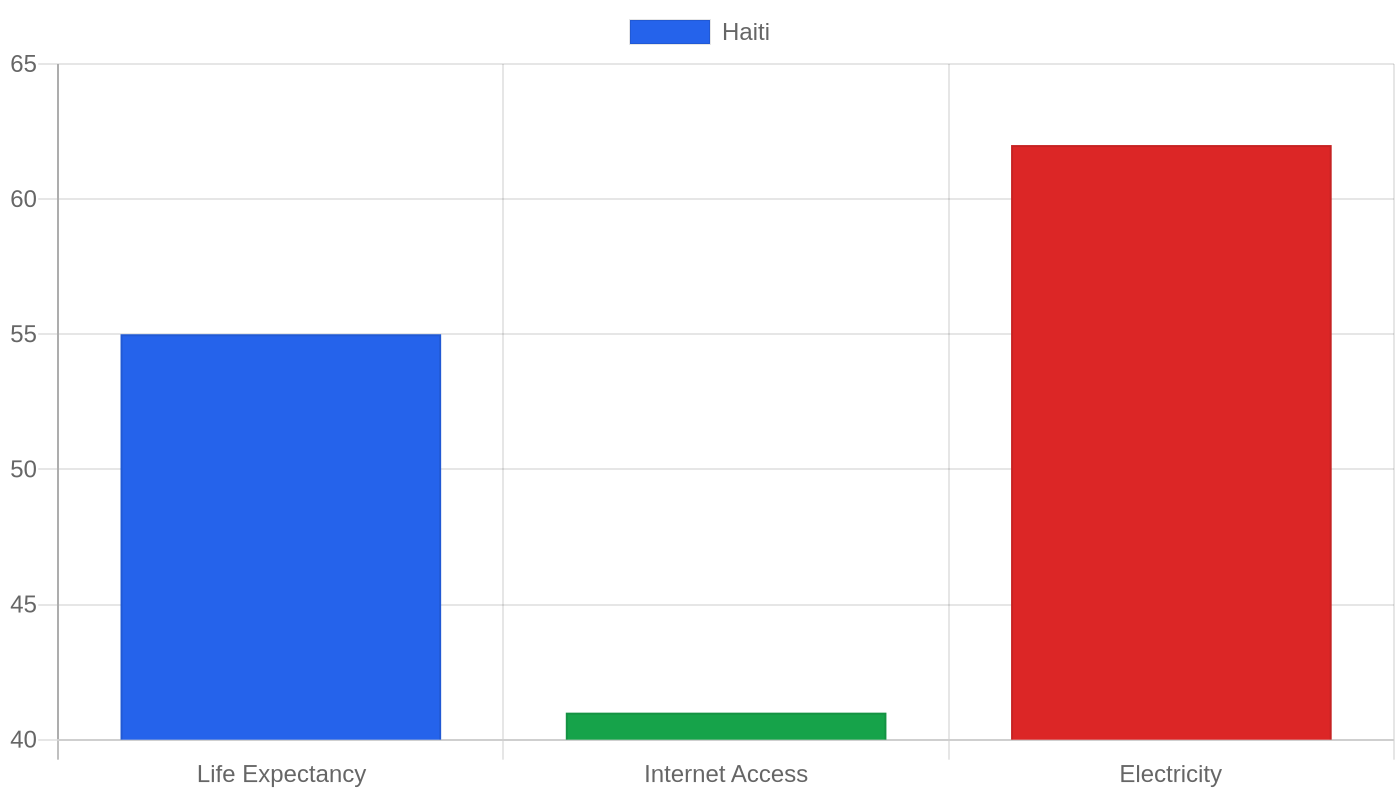
– Haiti’s economic data remains largely unavailable from the World Bank, reflecting the profound institutional breakdown that has made basic statistical collection nearly impossible.
– The country’s financial sector is dominated by a handful of banks and consumer goods companies, suggesting a narrow economic base with limited diversification.
– Political instability is entrenched in Haiti’s semi-presidential system, where presidents are elected every five years but cannot serve consecutive terms, creating frequent leadership turnover.
– The absence of reliable data on inflation, unemployment, and GDP growth is itself a telling indicator of the depth of Haiti’s governance crisis.
– Despite the chaos, a core group of domestic companies continues to operate, pointing to pockets of resilience within the private sector.
The Ghost Economy — Where Data Goes to Die
When the World Bank cannot provide GDP growth figures, inflation rates, or unemployment numbers for a country, it is not merely a statistical gap. It is a statement. Haiti’s economic data vacuum speaks louder than any spreadsheet could. The absence of numbers tells the story of a state that has lost its capacity to measure, let alone manage, its own economy. Without GDP per capita or GNI per capita figures, analysts are left to piece together a portrait from fragments.
What we do know from the World Bank’s silence is that Haiti’s economy operates largely outside formal channels. The main industries that might once have anchored growth — agriculture, textiles, assembly manufacturing — have been battered by decades of political turmoil, natural disasters, and infrastructural collapse.
The lack of even a population estimate from the World Bank is particularly striking; it suggests that the most basic demographic data, essential for any economic planning, is either unavailable or unreliable.
The inflation picture is equally opaque. Without a Consumer Price Index from the World Bank, there is no official measure of how quickly the cost of living is rising. Yet anecdotal evidence from international organizations and local media points to severe price pressures, particularly on food and fuel. The Haitian gourde has experienced dramatic volatility in recent years, and the absence of formal data does not mean Haitians are not feeling the pinch — it means the pain is not being recorded.
Unemployment figures are missing as well, but in a country where the informal sector is estimated to absorb the vast majority of workers, official unemployment rates have always been misleading. The real story is underemployment, subsistence labor, and the daily struggle to generate income in an economy where the state provides little support and fewer opportunities.
The Price of Survival — Housing and Daily Life in a Cash Economy
Housing costs in Haiti are a brutal reality for most citizens, though precise figures are unavailable from the data provided. In Port-au-Prince, the capital, rents have historically consumed a large share of household income, particularly in areas that are considered safer or closer to commercial activity. The cost of construction materials, many of which must be imported, drives up both purchase prices and rental rates.
For the majority of Haitians, homeownership is a distant dream. The housing market is characterized by informal settlements, where families build what they can with whatever materials are available. The divide between those who can afford formal housing and those who cannot is stark, and it mirrors the broader inequality that defines Haitian society. Rent versus buy is not a meaningful choice for most — renting is the only option, and even that is often a stretch.
Daily expenses for food, transportation, and basic goods have risen sharply, though the data provided does not include specific cost-of-living indices. What is clear is that Haiti imports a significant portion of its food, making it highly vulnerable to global price shocks and currency depreciation. The cost of a meal in Port-au-Prince is far higher relative to income than in most Caribbean neighbors, a fact that drives chronic malnutrition and food insecurity across the country.
Corporate Survivors — Who Is Still Doing Business in Haiti?
The list of top companies provided reveals a striking concentration in two sectors: financial services and consumer goods. The Bank of the Republic of Haiti, Banque de l’Union Haïtienne, Capital Bank, and Fonkoze represent the backbone of the formal financial system. Fonkoze is particularly noteworthy as a microfinance institution that has focused on serving rural and low-income clients, demonstrating that even in a broken economy, there is demand for financial inclusion.
On the consumer goods side, Brasserie de la Couronne and Brasserie Nationale d’Haïti dominate the beverage market, while Comme Il Faut is a well-known cigarette brand. These companies have survived because they serve basic, recurring consumer needs — beer, soft drinks, tobacco — that persist even in times of crisis. The GB Group, listed as a conglomerate, suggests some degree of economic diversification, though the data does not specify its holdings.
Balistrad and Caribintair, both in consumer services, round out the corporate landscape. The presence of these companies indicates that some business activity continues, but the narrow base is a red flag. Haiti’s economy is not generating new industries or attracting significant foreign direct investment. These are legacy companies, many of them family-owned, that have weathered storms through sheer endurance rather than dynamic growth.
The business climate, based on the available data, is defined by risk. Without reliable electricity, functioning ports, or basic security, operating a formal business in Haiti requires extraordinary resilience. The fact that these companies exist at all is a testament to entrepreneurial grit, but it is not a model for broad-based economic development.
Politics, Violence, and the Daily Gamble of Life in Haiti
Haiti’s political system, as described in the data, is a semi-presidential republic with a multiparty structure. The president is head of state, elected every five years, and cannot serve consecutive terms. The prime minister, appointed by the president from the majority party in the National Assembly, serves as head of government. On paper, this sounds like a functioning democracy.
In practice, the system has produced chronic instability, with frequent changes in leadership, contested elections, and periods of extended rule by decree.
The crime and safety indices are listed as unavailable, but that absence is itself misleading. Haiti has long been ranked among the most dangerous countries in the world by organizations that do track such data. Gang violence, kidnappings, and armed robberies are endemic in Port-au-Prince and have spread to other regions. The state’s inability to provide security is perhaps the single greatest barrier to economic recovery.
Quality of life in Haiti is shaped by this insecurity. The data provided does not include happiness or well-being indices, but it is safe to say that the combination of political dysfunction, economic collapse, and widespread violence produces a daily existence that is precarious for the vast majority of citizens. Those with means have left; those without remain trapped in a system that offers little hope of improvement.
The Present Tense — Haiti in the Here and Now
Right now, Haiti is in a state of acute crisis that defies easy summary. The political landscape remains volatile, with the presidency and prime ministership subject to the same instability that has plagued the country for years. The data provided notes that a president cannot serve two consecutive terms, a rule that has contributed to a revolving door of leadership and a lack of long-term policy continuity.
The economic situation on the ground is dire. Without current inflation figures from the World Bank, it is impossible to quantify the erosion of purchasing power, but reports from humanitarian organizations consistently describe a population struggling to afford basic necessities. The cost of food, fuel, and transportation has risen dramatically, and the informal economy that sustains most Haitians is under immense strain.
The corporate sector, as represented by the companies listed, continues to function but is operating in survival mode. Banks face challenges with liquidity and security, while consumer goods companies deal with disrupted supply chains and reduced consumer spending. The absence of any technology, manufacturing, or export-oriented companies from the top list is telling — Haiti is not attracting the kind of investment that could transform its economy.
International attention has focused on Haiti’s security crisis, with calls for foreign intervention to address gang violence. But the data provided does not include any recent news about reforms, elections, or policy shifts. What is clear is that Haiti is stuck in a loop: political instability fuels economic decline, which in turn exacerbates violence and insecurity, making recovery even more distant.
The Bottom Line
Haiti is not a country for conventional investors or risk-averse businesses. It is a case study in state failure and economic collapse, where the absence of data is more revealing than any statistic could be. For development economists, humanitarian organizations, and students of political economy, Haiti offers a stark lesson in what happens when institutions break down and no one rebuilds them.
The country’s resilience is real, but it is a resilience born of necessity, not strength — and it is running out of time.
Sources & Methodology
This article is authored by Economic Pulse Net for informational and research purposes. Economic Pulse Net sources its data from multilateral institutions, national statistics bureaus, and proprietary databases. All data is believed to be current as of the date of publication.
Published: July 20, 2026 | Category: Research — Haiti
Use these signals in your own platform
Economic Pulse publishes its live signal feed through a documented, read-only API. Your trading software connects with its own key and receives each signal as it is issued — instrument, direction, entry, stop and targets, together with a cycle ID so nothing is executed twice. The feed is independent of this website and cannot change it.
Signals are informational only and are not financial advice.