Economic Pulse Net | Sources: World Bank World Development Indicators, Government Sources | 2026
Key Takeaways
– Dominica operates as a parliamentary republic within the Commonwealth, with a unique political structure that blends Westminster traditions with Caribbean republicanism
– The economy remains heavily dependent on its Citizenship by Investment Programme, which has become a cornerstone of fiscal policy and infrastructure development
– Financial services dominate the corporate landscape, with the National Bank of Dominica leading as the country’s premier financial institution
– Despite limited publicly available macroeconomic data from the World Bank, Dominica’s development strategy focuses on climate resilience, eco-tourism, and sustainable agriculture
– The country faces the perennial Caribbean challenge of balancing economic openness with vulnerability to external shocks, particularly climate-related disasters
The Quiet Republic — Dominica’s Economic Model in Transition
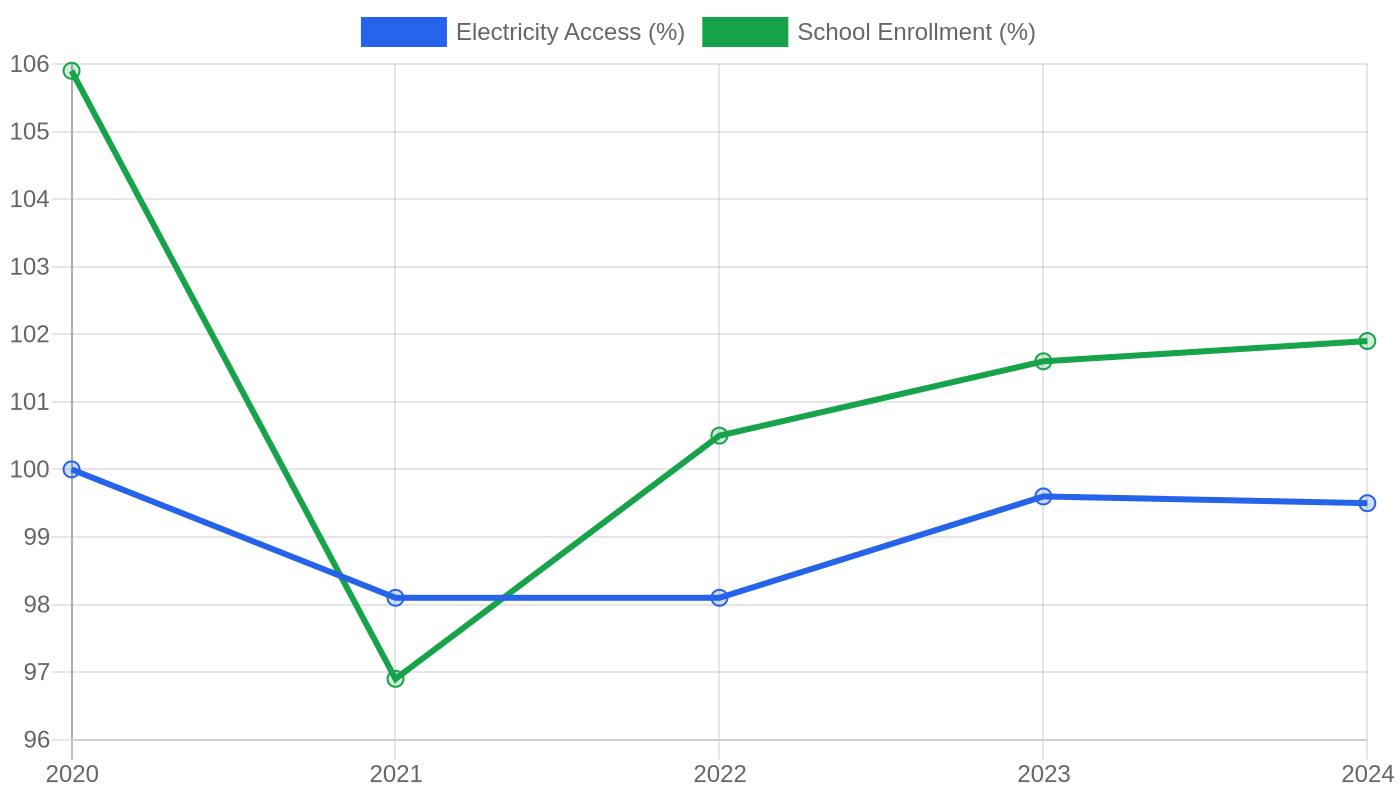
There is a peculiar tension at the heart of Dominica’s contemporary story. This small island nation, which calls itself the “Nature Island of the Caribbean,” has charted a development path that is simultaneously ambitious and opaque. The World Bank data for Dominica presents a curious paradox: the standard metrics that economists rely upon—GDP growth, inflation rates, unemployment figures, GDP per capita—are all listed as unavailable.
This absence of data is not necessarily a sign of dysfunction, but rather a reflection of the challenges small island states face in statistical collection and reporting. What we do know, however, tells a fascinating story of a country that is reinventing itself through unconventional means.
Dominica is one of the Caribbean’s few republics, a political distinction that sets it apart from its Commonwealth Caribbean neighbours who retain the British monarch as head of state. The capital, Roseau, serves as the political and economic nerve centre of this island of approximately 72,000 people. The political landscape is defined by a parliamentary democracy where an indirectly elected president serves as head of state, while executive power rests with the cabinet, headed by the prime minister.
The unicameral parliament consists of the 30-member House of Assembly, comprising 21 directly elected members and 9 senators who may either be appointed by the president or elected by other members of the House. This hybrid system reflects Dominica’s careful balancing act between democratic accountability and institutional stability.
The economic narrative of Dominica cannot be understood without acknowledging the centrality of its Citizenship by Investment Programme (CIP). Launched in 1993, it is one of the oldest such programmes in the world, allowing foreign investors to obtain Dominican citizenship in exchange for a contribution to the country’s Economic Diversification Fund or through investment in pre-approved real estate.
This programme has fundamentally reshaped the country’s fiscal architecture, providing a steady stream of non-tax revenue that has funded infrastructure projects, including the construction of a new international airport and climate-resilient housing. Yet it also creates vulnerabilities: dependence on a single revenue source exposes the economy to shifts in global investor sentiment and regulatory pressure from international bodies concerned about due diligence standards.
The Numbers We Don’t Have — And What They Tell Us
The absence of standardised World Bank data for Dominica—no GDP growth figure, no inflation CPI, no unemployment rate, no GDP in US dollars, no GDP per capita in PPP terms, no GNI per capita—might appear to be a journalistic dead end. In reality, it is itself a data point worth examining. Small island developing states (SIDS) like Dominica face structural challenges in economic data collection.
Limited statistical office capacity, the prevalence of informal economic activity, and the difficulty of measuring sectors like subsistence agriculture and small-scale tourism all contribute to reporting gaps. The World Bank’s inability to provide these figures does not mean the Dominican economy is unmeasured; it means the available data may not meet the rigorous standards required for international publication.
What we can infer from the available information is that Dominica’s economy is dominated by services, particularly financial services and tourism. The top companies listed for Dominica are instructive: the National Bank of Dominica leads the financial sector, followed by Swisscash, another financial services entity, and The Chronicle, a consumer services company that operates as one of the country’s primary newspapers.
This corporate landscape suggests a small but sophisticated financial services sector that punches above the island’s weight. The presence of Swisscash, in particular, hints at Dominica’s role as a jurisdiction for international financial services, a status that brings both economic benefits and regulatory scrutiny.
The National Bank of Dominica’s prominence is no accident. As the country’s largest indigenous financial institution, it plays a central role in mobilising domestic savings, providing credit to businesses and households, and facilitating the investment flows that underpin economic activity. In a small economy where access to international capital markets is limited, the health of the domestic banking sector becomes a proxy for broader economic resilience.
The bank’s dominance also raises questions about competition and financial inclusion—critical issues in a country where geographic isolation and limited infrastructure can make banking access uneven.
The Price of Paradise — Living Costs in the Nature Island
Housing and living costs in Dominica present a study in contrasts. For those who own land—often passed down through generations—the cost of shelter can be remarkably low. Traditional wooden houses on family land remain common, particularly in rural areas and the island’s interior. However, for newcomers, whether returning diaspora members or foreign investors, housing costs have risen significantly.
The Citizenship by Investment Programme has driven demand for upscale real estate, particularly in areas like Portsmouth and the capital Roseau, pushing property prices beyond the reach of many local residents.
The rental market in Dominica reflects the island’s dual economy. A basic apartment in Roseau might rent for significantly less than comparable accommodation in Barbados or the Cayman Islands, but quality varies widely. The cost of construction materials, most of which must be imported, keeps new building expensive. This dynamic creates a bifurcated housing market: a traditional sector where costs remain manageable, and a modern sector driven by investment-linked demand that prices out many locals.
Daily expenses for food and utilities are influenced by Dominica’s high import dependence. The island produces fresh fruits, vegetables, and fish, but staples like rice, flour, cooking oil, and processed foods are imported, making the cost of living sensitive to global commodity prices and shipping costs.
Banking on the Future — Investment Climate and Business Opportunities
The investment climate in Dominica is defined by the Citizenship by Investment Programme. This mechanism has transformed the country from a traditional agricultural economy—once heavily dependent on banana exports—into a service-oriented jurisdiction that competes for mobile capital.
For investors, the appeal is clear: a relatively low minimum investment threshold (starting at $100,000 for the Economic Diversification Fund option), visa-free travel to over 140 countries, and a stable political environment within the Commonwealth framework. The programme has funded transformative infrastructure projects, including the international airport at Douglas-Charles, which aims to reduce the island’s reliance on regional air connections and boost direct tourist arrivals.
Beyond citizenship investment, sectors to watch include eco-tourism, geothermal energy, and climate-resilient agriculture. Dominica has positioned itself as the world’s first “climate-resilient nation,” a branding exercise backed by concrete investments in hurricane-proof housing, reinforced infrastructure, and disaster preparedness systems.
The geothermal sector holds particular promise: Dominica sits on significant geothermal resources that could provide cheap, renewable energy for domestic use and potentially for export via submarine cable to neighbouring islands like Martinique and Guadeloupe. The business environment, while generally welcoming to foreign investment, is constrained by limited human capital, small domestic markets, and periodic disruptions from hurricanes and tropical storms.
Stability and Safety in a Volatile Region
Crime and safety data for Dominica are not provided in the available indices, but anecdotal evidence and regional comparisons suggest that the country is relatively safe by Caribbean standards. Violent crime is not endemic in the way it plagues some larger regional neighbours, though petty crime and occasional incidents of more serious violence do occur.
The small size of Dominican society—everyone knows everyone—acts as a natural check on criminal activity, but it also means that when crime does occur, it reverberates through the community with outsized impact.
The political landscape in Dominica has been characterised by stability, if not always by smooth consensus. The Dominica Labour Party has dominated electoral politics for much of the post-independence period, with Prime Minister Roosevelt Skerrit holding office since 2004. This longevity provides policy continuity but has also raised concerns about democratic accountability and the concentration of power.
The parliamentary system, with its mix of elected members and appointed senators, is designed to balance popular representation with expert input, though critics argue that the appointment mechanism can be used to entrench executive control. For residents and investors alike, the political stability is a net positive, but the lack of robust independent institutions—a free press, an assertive civil society, a truly independent judiciary—remains a concern for long-term governance quality.
What’s Happening Now — Dominica at a Crossroads
The most pressing current issue facing Dominica is the evolution of its Citizenship by Investment Programme. International pressure, particularly from the European Union and the United Kingdom, has forced Caribbean nations to tighten due diligence standards, increase minimum investment thresholds, and improve transparency. Dominica has responded by raising its minimum investment requirement and implementing more rigorous background checks, but the programme remains controversial.
Critics argue that the sale of citizenship undermines the integrity of the passport and creates security vulnerabilities; proponents counter that the revenue is essential for a country with limited natural resources and a small tax base.
Simultaneously, Dominica is racing to complete its international airport, a project that has been decades in the making. The airport, funded largely by Citizenship by Investment revenue, is designed to accommodate long-haul flights from North America and Europe, potentially transforming the tourism sector. Currently, visitors must fly into neighbouring islands like Guadeloupe, Martinique, or Barbados and then take smaller regional flights or ferries to reach Dominica.
Direct international flights would be a game-changer, opening the island to mass tourism while also making it easier for diaspora members to return home. The project is not without its critics, who worry about environmental impact and question whether the island has the hotel capacity to absorb a sudden influx of tourists.
The Bottom Line
Dominica is a country that has chosen an unconventional development path, leveraging its sovereignty to sell citizenship as a means of financing infrastructure and resilience. For investors seeking a second passport, a stable Caribbean jurisdiction, or exposure to climate-resilient infrastructure, Dominica offers a compelling proposition. For observers of small-state economics, the island serves as a fascinating case study in how tiny nations can navigate globalisation on their own terms.
The risks are real—overdependence on citizenship revenues, vulnerability to climate change, and governance challenges—but so are the opportunities. Dominica is not a country to watch passively; it is a country that demands attention precisely because it refuses to play by the old rules.
Sources & Methodology
This article is authored by Economic Pulse Net for informational and research purposes. Economic Pulse Net sources its data from multilateral institutions, national statistics bureaus, and proprietary databases. All data is believed to be current as of the date of publication.
Published: July 17, 2026 | Category: Research — Dominica
Use these signals in your own platform
Economic Pulse publishes its live signal feed through a documented, read-only API. Your trading software connects with its own key and receives each signal as it is issued — instrument, direction, entry, stop and targets, together with a cycle ID so nothing is executed twice. The feed is independent of this website and cannot change it.
Signals are informational only and are not financial advice.