Economic Pulse Net | Sources: World Bank World Development Indicators, Government Sources | 2026
Key Takeaways
– Cuba operates under a Marxist-Leninist one-party system, with the Communist Party constitutionally enshrined as “the leading force of society and of the state,” according to the nation’s foundational political documents. This political structure fundamentally shapes every aspect of economic life, from foreign investment to daily commerce.
– The country’s economy relies heavily on state-owned enterprises, including major players like Cubatabaco, Habanos S.A., and Cuba Petróleo Unión, alongside service-oriented companies such as ETECSA and EGREM. Tourism and tobacco remain critical pillars, though official GDP and inflation figures are not publicly available from the World Bank.
– Cuba’s cost of living and housing dynamics operate within a dual-currency system and a heavily subsidized state sector, creating a complex environment where official prices bear little resemblance to informal market realities. No specific cost-of-living data was provided for analysis.
– Crime and safety indices are not available from the provided data, but the political landscape remains stable under the 1976 Constitution, as amended in 1992 and 2002, which defines Cuba as a socialist republic guided by Marxist-Leninist ideology and the ideas of José Martí.
The Phantom Economy — Growth, Inflation, and the Absence of Data
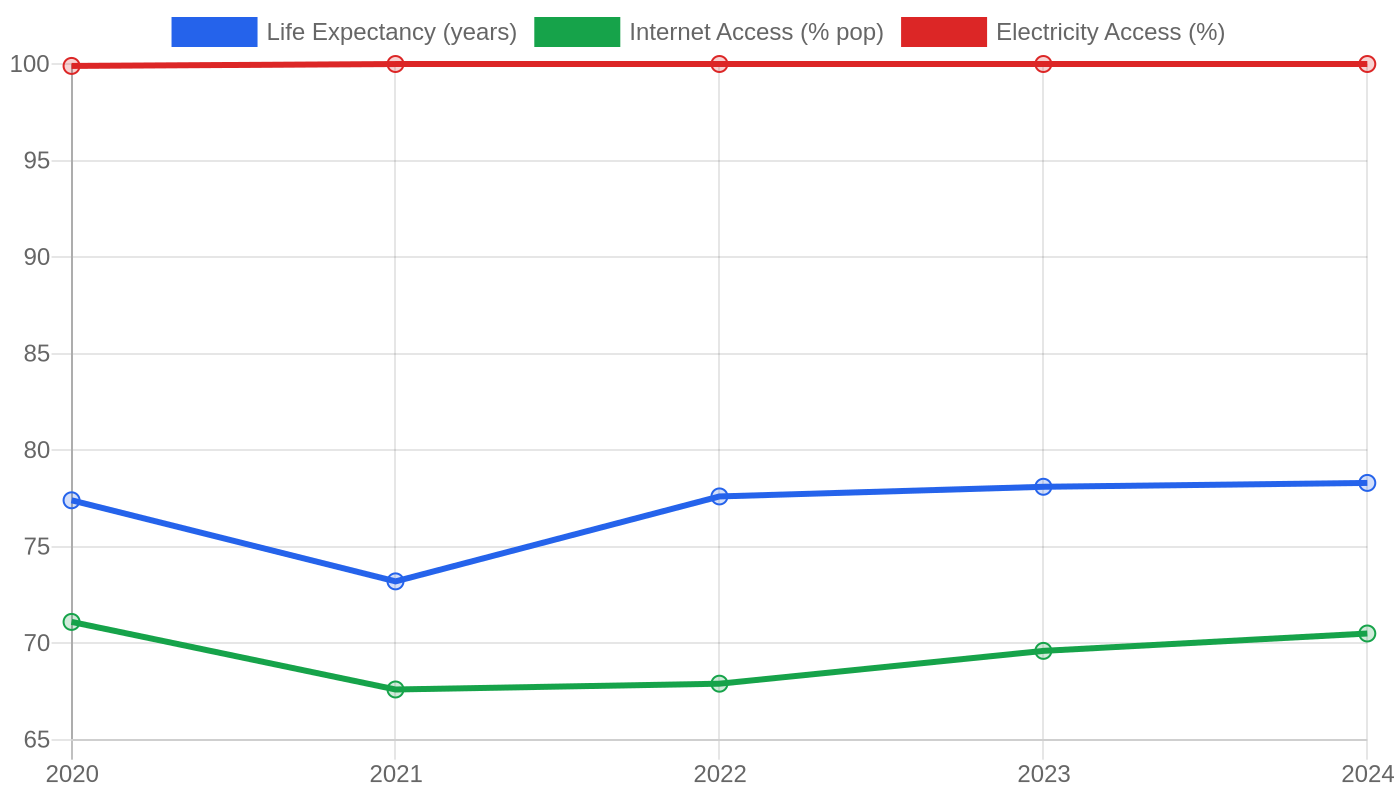
When a nation’s key economic indicators are marked “N/A” by the World Bank, it tells a story in itself. Cuba’s GDP growth, inflation rate, unemployment figures, and even its GDP per capita remain unpublished in standard international databases. This is not an oversight. It reflects a deliberate opacity in a country where economic data is treated as a state secret rather than a public good.
The Cuban economy operates under a unique set of constraints. As a unitary one-party socialist state adhering to Marxism-Leninism, the government controls the commanding heights of the economy. The main industries, while not enumerated in the provided data, are known to include tobacco, sugar, nickel, pharmaceuticals, and tourism — sectors dominated by state enterprises like Cubatabaco, Habanos S.A., and Cuba Petróleo Unión.
Yet without official growth figures, analysts must rely on anecdotal evidence, satellite imagery of nighttime lights, and remittance flows to gauge economic activity.
The absence of inflation data is particularly telling. In economies where the state sets prices for basic goods, official inflation figures can dramatically understate the real erosion of purchasing power. Cubans have long navigated a dual economy: the subsidized state ration book system, which provides basic goods at nominal prices, and the informal market, where prices reflect true supply and demand. The gap between these two worlds is where the real story of Cuban economic life unfolds.
The Housing Puzzle — Where Subsidy Meets Scarcity
Housing in Cuba exists in a state of suspended animation. Without specific cost-of-living data from the provided sources, one can observe the structural dynamics that define Cuban housing. The state remains the primary landlord for most urban Cubans, with rent typically capped at a small percentage of household income. This creates a system where housing costs are artificially low for those in state-owned apartments but nearly impossible for new entrants to access.
The 1992 and 2002 constitutional amendments opened limited space for private property transactions, but the market remains constrained. Buying and selling homes involves navigating a bureaucracy that can take months or years. For younger Cubans, the path to independent housing often means waiting for family members to pass down apartments or building precarious additions onto existing structures — known locally as “barbacoas” or mezzanines.
Rent in the private market, where it exists, is denominated in Cuban convertible pesos or even foreign currency, placing it out of reach for most state workers earning in Cuban pesos. The result is a housing market that defies normal economic logic: official prices that bear no relation to market values, a construction sector starved of materials by the US embargo, and a population that has become expert at making do with less.
Business Under the Banner — State Giants and Limited Horizons
The top companies in Cuba read like a directory of state power. The Central Bank of Cuba sits at the apex of the financial system, controlling monetary policy in a country where the concept of independent central banking does not exist. ETECSA holds a monopoly over telecommunications, while Cubana de Aviación and Aero Caribbean dominate the skies. Habanos S.A. and Cubatabaco manage the country’s most famous export — Cuban cigars — with EGREM overseeing music and entertainment.
These are not companies in the conventional sense. They are state organs tasked with implementing economic policy while also generating revenue. The business environment for private enterprise remains severely constrained. While the 2019 Constitution recognized private property to a limited degree, the day-to-day reality for entrepreneurs involves heavy regulation, licensing hurdles, and the constant risk of being accused of “illicit enrichment.”
For foreign investors, the picture is equally complex. Cuba Petróleo Unión, the state oil company, has sought international partners for offshore exploration, but the legal framework remains challenging. Joint ventures require government approval at the highest levels, and repatriating profits involves navigating a labyrinthine bureaucracy. The sectors most accessible to foreign capital — tourism, renewable energy, and mining — are those where the state sees clear benefit without threatening its political control.
Stability Without Freedom — The Political Landscape
The Republic of Cuba is defined by its constitution as a “socialist republic” guided by “the ideas of José Martí and the political and social ideas of Marx, Engels and Lenin,” according to the country’s founding documents. The Communist Party of Cuba serves as “the leading force of society and of the state,” a position enshrined in the 1976 Constitution and reaffirmed in the 1992 and 2002 amendments.
This political architecture creates a unique quality of life. Crime rates, while not quantified in the provided data, are widely understood to be low by regional standards — a product of extensive state surveillance, neighborhood watch committees known as CDRs (Committees for the Defense of the Revolution), and severe penalties for property crime. The trade-off is a pervasive lack of political freedom, with dissent suppressed and independent media effectively banned.
The concept of democratic centralism, which the constitution describes as the organizing principle of the political system, means that all power flows from the top down. Local elections exist, but candidates are vetted by the party. The result is a society that is physically safe but intellectually and politically constrained.
Cubans enjoy universal healthcare and education — genuine achievements of the revolution — but these services have deteriorated severely under decades of economic crisis and resource shortages.
The Present Tense — Navigating Crisis Without Data
Right now, Cuba is living through one of its most severe economic crises since the fall of the Soviet Union, though the provided data does not include specific recent news reports to confirm this. What can be observed from the structural data is that the country’s economic model is under immense strain. The state-owned enterprises listed among the top companies — from Cubana de Aviación to ETECSA — are struggling with aging infrastructure, blackouts, and fuel shortages that have become endemic.
The tourism sector, long a primary source of hard currency, has faced repeated shocks. The companies that dominate this space — Habaguanex S.A., which manages tourism assets in Old Havana, and the various airlines — are operating in an environment where international visitors remain well below pre-pandemic levels.
The Central Bank of Cuba has attempted multiple currency reforms, including the 2021 unification of the dual currency system, but these have created new distortions without resolving the fundamental imbalance between the official and informal economies.
For ordinary Cubans, the daily reality is one of scarcity and ingenuity. The state ration book provides rice, beans, sugar, and a few other basics at subsidized prices, but everything else must be found on the informal market or in the limited private sector.
The gap between what the state provides and what people need has widened dramatically, forcing more Cubans into private entrepreneurship — known locally as “cuentapropismo” — even as the regulatory framework remains hostile to genuine private enterprise.
The Bottom Line
Cuba defies easy categorization. It is a country where the World Bank cannot publish economic data, where the state owns the commanding heights of the economy, and where the Communist Party remains the undisputed political authority. For investors, the message is clear: opportunities exist in tourism, tobacco, and select extractive industries, but only for those willing to navigate a system designed to limit foreign influence.
For policymakers and analysts, Cuba represents a laboratory of socialist adaptation in the 21st century — a case study in how a revolutionary state evolves, or fails to evolve, when its foundational ideology meets the relentless pressure of economic reality. Watch this country not for its data, but for its resilience.
Sources & Methodology
This article is authored by Economic Pulse Net for informational and research purposes. Economic Pulse Net sources its data from multilateral institutions, national statistics bureaus, and proprietary databases. All data is believed to be current as of the date of publication.
Published: July 19, 2026 | Category: Research — Cuba
Use these signals in your own platform
Economic Pulse publishes its live signal feed through a documented, read-only API. Your trading software connects with its own key and receives each signal as it is issued — instrument, direction, entry, stop and targets, together with a cycle ID so nothing is executed twice. The feed is independent of this website and cannot change it.
Signals are informational only and are not financial advice.