Economic Pulse Net | Sources: World Bank World Development Indicators, Government Sources | 2026
Key Takeaways
– Cuba’s economy operates under a rigid Marxist-Leninist framework, but the state has experimented with limited private sector openings to address chronic shortages and low productivity.
– The country’s major industries remain concentrated in state-controlled sectors: consumer services (tourism, aviation), consumer goods (tobacco, cigars), telecommunications, and oil & gas.
– Top companies like Habanos S.A., Cubatabaco, and ETECSA dominate the formal economy, while a burgeoning informal sector fills gaps left by state planning.
– The political landscape remains defined by the Communist Party of Cuba as the sole leading force, per the 1976 Constitution, with no meaningful political pluralism.
– Despite data gaps from the World Bank on core metrics like GDP growth, inflation, and unemployment, the lived reality for Cubans is one of scarcity, dual currency complexity, and a state struggling to modernise without abandoning its ideological foundations.
The Great Silence in the Data — Reading Between the Lines
The World Bank’s latest figures for Cuba present a curious void: GDP growth is listed as N/A. Inflation is N/A. Unemployment is N/A. GDP per capita is N/A. Even population numbers are absent. This is not a data-entry error. It reflects a fundamental truth about Cuba’s economic reporting: the state tightly controls statistical releases, and international institutions often struggle to obtain reliable, timely figures from Havana.
What we do know, however, is that Cuba’s economy is not static. The country is a unitary one-party socialist state adhering to Marxism-Leninism, as defined by the 1976 Constitution and subsequent amendments in 1992 and 2002. The constitution explicitly describes the Communist Party of Cuba as the “leading force of society and of the state.” This political architecture shapes every economic decision.
The absence of hard numbers does not mean the economy is invisible. Cuba’s main industries are well-documented: consumer services (tourism, aviation), consumer goods (tobacco, cigars), telecommunications, oil and gas, and financial services through the Central Bank of Cuba. These sectors are overwhelmingly state-owned. The tourism industry, once a bright spot, has faced severe headwinds from global travel disruptions and geopolitical tensions.
The oil and gas sector, dominated by Cuba Petróleo Unión, struggles with aging infrastructure and limited foreign investment.
The lack of inflation data is particularly telling. In a command economy, prices are often set by decree rather than market forces, meaning official inflation figures may not reflect the black-market realities that ordinary Cubans face daily. The gap between official prices and actual purchasing power is a chasm that no spreadsheet can fully capture.
Living in the Gap — Housing, Bread, and the Daily Scramble
Cost of living data for Cuba is also absent from the World Bank’s records, but the lived experience is well-documented by travellers, diaspora families, and local observers. Housing in Cuba is a story of two worlds. State-owned housing, allocated through bureaucratic systems, remains affordable in nominal terms but is often dilapidated, poorly maintained, and subject to years-long waiting lists.
The private rental market, legalised in recent reforms, has created a tiered system where properties in Havana’s historic centre or near tourist districts command prices in hard currency that are out of reach for most locals.
Daily expenses for basic goods — rice, beans, cooking oil, soap, medicine — have become a national obsession. The ration book, or *libreta*, still provides a minimal monthly allotment at subsidised prices, but it is rarely sufficient. Cubans must turn to the informal market, where prices are determined by supply shortages and currency fluctuations. The dual currency system, which the government has attempted to unify, continues to create confusion.
One price exists for state workers earning in Cuban pesos, another for those with access to dollars or euros.
Rent in Havana for a modest apartment in a central neighbourhood can easily consume the entire monthly salary of a state employee, forcing many to rely on remittances from family abroad or side hustles in tourism. The cost of living, in short, is not a statistic — it is a daily negotiation between survival and aspiration.
The State Inc. — Who Really Runs the Cuban Economy?
The list of top companies in Cuba reads like a directory of the state apparatus. The Central Bank of Cuba sits at the apex, controlling monetary policy and credit allocation. ETECSA holds a monopoly over telecommunications, meaning internet access, mobile data, and phone services are entirely state-controlled — a fact that shapes everything from business communication to social media consumption. Habanos S.A. and Cubatabaco represent Cuba’s most famous global export: premium cigars.
These companies operate as state monopolies, generating hard currency that is critical for importing food, medicine, and fuel.
In consumer services, Aero Caribbean, Aerotaxi, and Cubana de Aviación dominate air travel, though service reliability and fleet maintenance have been persistent concerns. EGREM controls music recording and cultural production, reflecting the state’s desire to manage even the creative economy. Habaguanex S.A., a tourism and hospitality conglomerate, manages hotels, restaurants, and retail outlets in Old Havana.
The business environment is defined by state ownership and central planning. Foreign investment is permitted in theory, governed by a 2014 law that created the Mariel Special Development Zone, but bureaucratic hurdles, US sanctions, and ideological resistance limit its scale. The private sector — known as *cuentapropismo* — has expanded to include small restaurants, bed-and-breakfasts, taxi services, and artisan crafts, but these enterprises operate under tight regulation and frequent tax changes.
For an investor, Cuba offers potential in tourism, renewable energy, and agriculture, but the risk profile is exceptionally high due to political unpredictability and the dominance of state enterprises.
The Party Line — Safety, Politics, and the Quality of Life
Crime and safety indices for Cuba are listed as N/A, but anecdotal evidence suggests that violent crime rates are low compared to many Latin American neighbours. The state’s extensive surveillance apparatus and neighbourhood watch committees, known as Committees for the Defense of the Revolution, contribute to social control. Petty crime, however, particularly theft and scams targeting tourists, is a known issue in Havana and other tourist hubs.
The political landscape is unambiguous. Cuba is a unitary one-party socialist state guided by Marxism-Leninism. The 1976 Constitution, amended in 1992 and 2002, is “guided by the ideas of José Martí and the political and social ideas of Marx, Engels and Lenin.” The Communist Party of Cuba is constitutionally described as the “leading force of society and of the state.” The political system reflects the Marxist-Leninist concept of democratic centralism — meaning that while there are elections, there is no political competition from opposition parties.
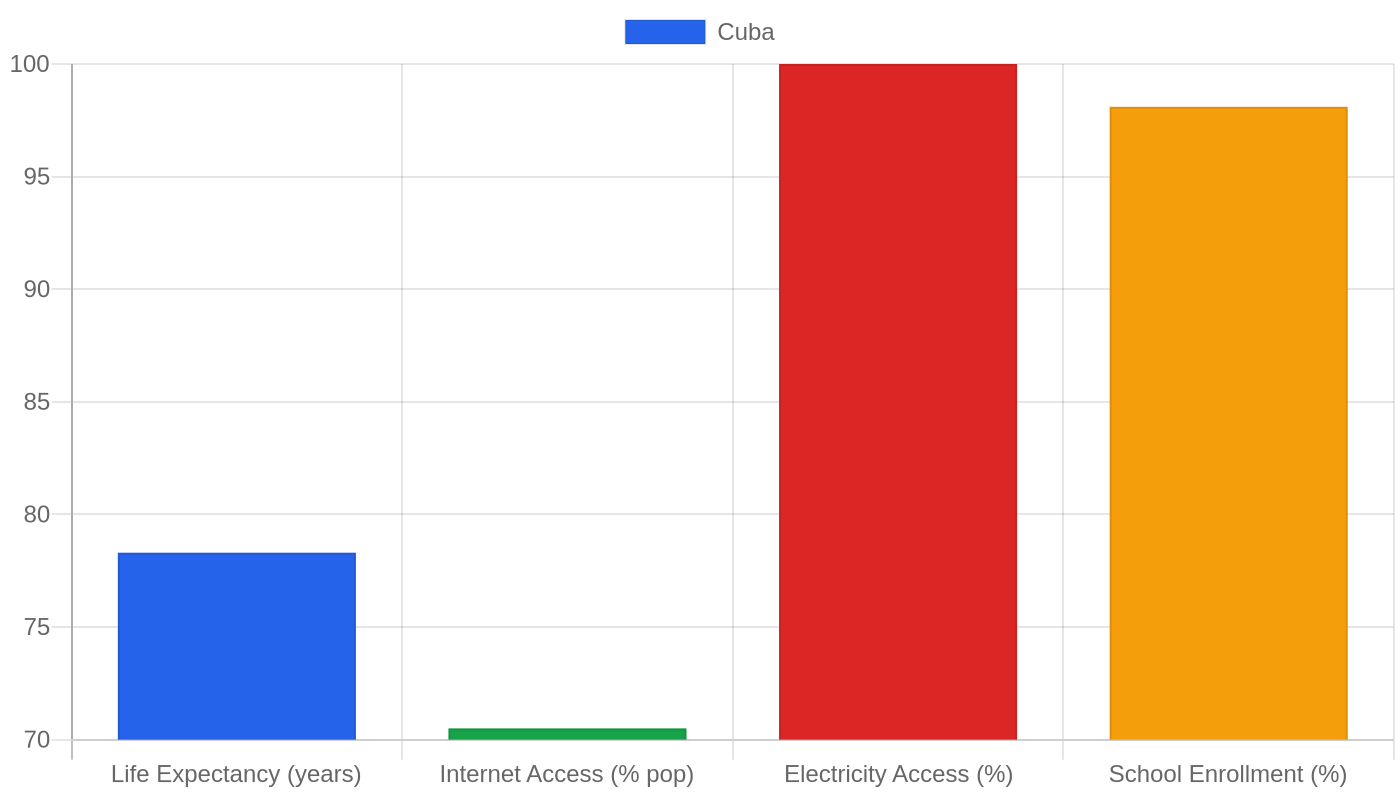
Quality of life is a mixed picture. Healthcare and education are free and universally accessible, a point of national pride. Literacy rates are high, and life expectancy compares favourably with other developing nations. Yet shortages of medicine, equipment, and basic supplies strain the system. The internet, controlled by ETECSA, is expensive and censored. Freedom of expression is limited, and independent journalism faces severe restrictions.
For many Cubans, the quality of life depends on access to remittances, connections, and the ability to navigate the informal economy.
The Present Tense — What Is Happening in Cuba Right Now
Cuba is currently navigating one of its most difficult economic periods in decades. The post-pandemic recovery in tourism has been slower than hoped, and the government has been forced to implement austerity measures, including price increases for fuel, electricity, and some consumer goods.
In 2024, the government announced a series of economic reforms aimed at expanding the private sector, including allowing small and medium-sized enterprises to operate with greater autonomy and permitting self-employed workers to hire employees more freely.
The Central Bank of Cuba has been attempting to unify the country’s dual currency system, a long-standing reform that has proven technically and politically challenging. The goal is to simplify transactions, reduce distortions, and attract foreign investment, but the transition has been bumpy. Shortages of basic goods, including bread, milk, and medicine, remain widespread, and the black-market exchange rate for the Cuban peso continues to diverge sharply from the official rate.
On the political front, the Communist Party remains firmly in control, but there are signs of generational change and cautious debate about economic direction. The government has allowed limited internet access and social media use, creating new spaces for public discourse, though still within boundaries. The question hanging over Cuba is whether the state can reform its economy just enough to improve living standards without triggering a political crisis that challenges the party’s monopoly on power.
The Bottom Line
Cuba is a country that demands patience and nuance from any observer. It is not a conventional emerging market, nor is it a failed state. It is a socialist experiment that has survived decades of external pressure and internal inefficiency, and that is now attempting to recalibrate without abandoning its core ideology. Investors with a very high risk tolerance and a long time horizon may find opportunities in tourism, renewable energy, and niche manufacturing.
For students of political economy, Cuba offers a rare laboratory of how a command economy adapts — or fails to adapt — to the 21st century. For everyone else, Cuba is a reminder that economic data tells only part of the story; the rest is written in the daily lives of its resilient, resourceful people.
Sources & Methodology
This article is authored by Economic Pulse Net for informational and research purposes. Economic Pulse Net sources its data from multilateral institutions, national statistics bureaus, and proprietary databases. All data is believed to be current as of the date of publication.
Published: July 24, 2026 | Category: Research — Cuba
Use these signals in your own platform
Economic Pulse publishes its live signal feed through a documented, read-only API. Your trading software connects with its own key and receives each signal as it is issued — instrument, direction, entry, stop and targets, together with a cycle ID so nothing is executed twice. The feed is independent of this website and cannot change it.
Signals are informational only and are not financial advice.