Economic Pulse Net | Sources: World Bank World Development Indicators, Government Sources | 2026
Key Takeaways
* Stagnant Growth Amidst Stability: Canada’s economy is showing signs of cooling with GDP growth projected at just 1.74% for 2025, yet inflation remains tightly controlled near the central bank’s target range.
Labor Market Softening: Recent data reveals a surprising contraction in employment, with 68,000 jobs lost in September alone, marking the second consecutive month of unexpected declines.
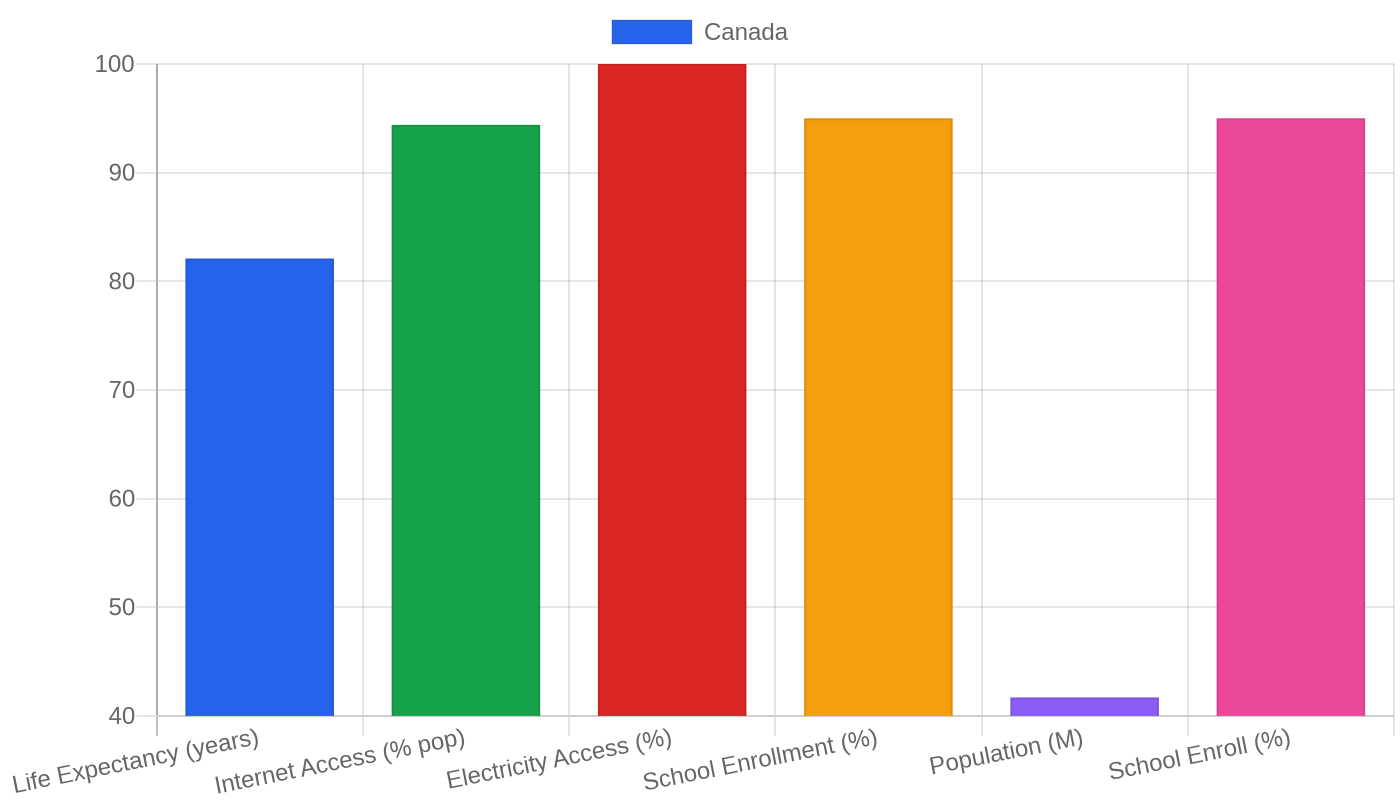
High Standard of Living: Despite economic headwinds, Canadians enjoy a robust standard of living, supported by a GDP per capita (PPP) exceeding $66,000 and a high GNI per capita of $56,420.
Political Continuity: The nation’s political landscape remains anchored in liberal democratic traditions, emphasizing social justice and egalitarian values that provide long-term stability for investors.
Diverse Corporate Base: From industrial giants like Norda Stelo to consumer services leaders such as A&W, the business ecosystem is varied, though recent news highlights significant M&A activity and sector shifts.
Economic Engine: Cooling but Resilient
Canada’s macroeconomic profile presents a picture of cautious stability rather than explosive expansion. According to World Bank data, the country’s Gross Domestic Product (GDP) is valued at approximately $2.32 trillion USD, reflecting its status as a major advanced economy. However, momentum appears to be slowing; GDP growth is projected at 1.74% for 2025, a figure that suggests the economy is operating well below its potential capacity.
This deceleration is corroborated by labor market indicators, which show an unemployment rate of 6.907%. While not critically high, this level indicates slack in the job market, a sentiment reinforced by recent reports from CBC News highlighting that the Canadian economy lost 68,000 jobs in September, continuing a trend of surprise declines.
Inflation, however, has been tamed, with the Consumer Price Index (CPI) holding steady at 2.07%, suggesting that monetary policy has successfully curbed price pressures without triggering a severe recession. For global observers, these numbers matter because they signal a transition phase where the era of rapid post-pandemic recovery has given way to a more mature, albeit slower, growth cycle.
The challenge for policymakers now is to stimulate demand without reigniting inflationary spirals, especially as the population continues to grow to over 41.6 million people.
Cost of Living: Affordability Under Pressure
For residents and expatriates alike, the cost of living in Canada is shaped by its unique geographic and demographic realities. With a GDP per capita (PPP) of $66,745, the average individual enjoys a high level of purchasing power relative to global standards, yet this aggregate wealth does not uniformly translate to easy affordability across all sectors. Housing remains a primary concern in major urban centers, driven by the influx of new residents into a population base of 41.65 million.
While specific rental indices are not provided in the current dataset, the tension between population growth and housing supply is a known structural issue. Daily expenses are moderated by the relatively low inflation rate of 2.07%, which helps preserve real wages for those who remain employed. However, the loss of nearly 70,000 jobs in a single month suggests that household budgets are becoming tighter, forcing many consumers to scrutinize discretionary spending.
Compared to other G7 nations, Canada’s cost structure is often viewed as moderate, but the disparity between high-income earners and those in precarious employment is widening. Consequently, while the baseline cost of living is manageable for the middle class, the recent labor market volatility adds a layer of uncertainty to long-term financial planning for families.
Investment & Business Climate: Innovation and Consolidation
The Canadian business environment is characterized by a mix of established industrial powerhouses and emerging service-oriented enterprises. Major players span diverse sectors, including Industrials, Manufacturing, Health Care, and Telecommunications. Companies such as Norda Stelo, 1-800-GOT-JUNK?, and 3Way International Logistics dominate the industrial logistics space, leveraging Canada’s vast geography for distribution networks.
In the consumer services sector, brands like A&W and Addition Elle have carved out significant market shares, indicating strong domestic brand loyalty. Meanwhile, the healthcare and technology sectors are represented by firms like Advanced Cyclotron Systems and Access Communications, pointing toward a growing emphasis on specialized medical tech and connectivity. The investment climate is currently undergoing consolidation, as evidenced by recent business developments reported by The Globe and Mail.
Emera’s bid for an energy powerhouse signals strategic moves in the utility sector, while the Weston family’s acquisition of U.K.’s Boots highlights cross-border capital flows. Furthermore, Stelco’s exit from galvanized steel production underscores the shifting dynamics within traditional manufacturing. Investors should watch these mergers and acquisitions closely, as they reflect a broader trend of industry rationalization and specialization.
The presence of a full democracy and a tradition of liberalism further reduces political risk for foreign direct investment, providing a predictable regulatory framework.
Safety, Politics & Quality of Life: The Foundation of Trust
Canada’s quality of life is deeply intertwined with its political stability and social cohesion. Described as a “full democracy,” the country operates under a political culture that emphasizes liberalism, egalitarianism, and social justice. These principles are not merely rhetorical; they form the bedrock of Canadian federalism, guided by founding ideals such as “peace, order, and good government” and an Implied Bill of Rights.
Since the 1960s, an emphasis on social justice has distinguished Canada’s political identity, fostering a society that prioritizes inclusivity and moderate governance. This political environment contributes significantly to the country’s overall safety and social fabric. Although specific crime and safety indices are listed as N/A in the current dataset, the historical reputation of Canada as one of the safest nations in the world remains a key asset for tourism and expatriate attraction.
The combination of high income levels—evidenced by a GNI per capita of $56,420—and strong social protections creates a high baseline for human development. For international stakeholders, this political and social stability acts as a buffer against external shocks, ensuring that business operations can proceed with minimal disruption from civil unrest or policy volatility.
The consistent application of rule of law and respect for individual rights makes Canada an attractive destination for long-term settlement and investment.
What’s Happening Now: Navigating Labor Shifts and Energy Moves
The most pressing narrative in Canada right now revolves around labor market adjustments and strategic corporate realignments. As reported by CBC News, the sudden loss of 68,000 jobs in September has sent shockwaves through the business community, marking the second straight month of unexpected declines. This softness in the labor market coincides with broader global energy shifts, highlighted by reports from The Globe and Mail regarding Russia supplying diesel to the U.S.
and global markets, which may indirectly affect North American energy pricing dynamics. Domestically, the business sector is responding to these changes through consolidation and strategic bidding. Emera’s aggressive bid for an energy powerhouse illustrates how utilities are positioning themselves for future grid demands and renewable transitions.
Simultaneously, the Weston family’s purchase of Boots and Stelco’s retreat from galvanized steel production indicate a reshuffling of assets in both consumer retail and heavy industry. These moves suggest that companies are prioritizing efficiency and core competencies amid uncertain growth conditions. Additionally, general business briefings from major outlets like The Globe and Mail and CBC continue to track these evolving trends, providing real-time insights into investor sentiment.
The interplay between job losses and corporate restructuring defines the current economic mood, creating a period of transition rather than stagnation. Stakeholders must remain agile, as the labor market’s sensitivity to policy changes becomes increasingly apparent.
The Bottom Line
Canada remains a critical player in the global economy, offering a blend of high living standards, political stability, and a diversified industrial base. However, the recent dip in GDP growth and unexpected job losses signal that short-term caution is warranted. Investors and businesses should focus on sectors showing resilience, such as specialized healthcare, telecommunications, and consolidated energy utilities.
Ultimately, Canada’s strength lies in its institutional trust and social cohesion, making it a reliable partner for long-term engagement despite cyclical economic headwinds.
Sources & Methodology
This article is authored by Economic Pulse Net for informational and research purposes. Economic Pulse Net sources its data from multilateral institutions, national statistics bureaus, and proprietary databases. All data is believed to be current as of the date of publication.
Published: October 11, 2026 | Category: Research — Canada
Use these signals in your own platform
Economic Pulse publishes its live signal feed through a documented, read-only API. Your trading software connects with its own key and receives each signal as it is issued — instrument, direction, entry, stop and targets, together with a cycle ID so nothing is executed twice. The feed is independent of this website and cannot change it.
Signals are informational only and are not financial advice.