Economic Pulse Net | Sources: World Bank World Development Indicators, Government Sources | 2026
Key Takeaways
– Barbados completed its transition to a parliamentary republic in 2021, severing colonial-era ties to the British monarchy, and now operates under President Jeffrey Bostic with a Westminster-style system of governance.
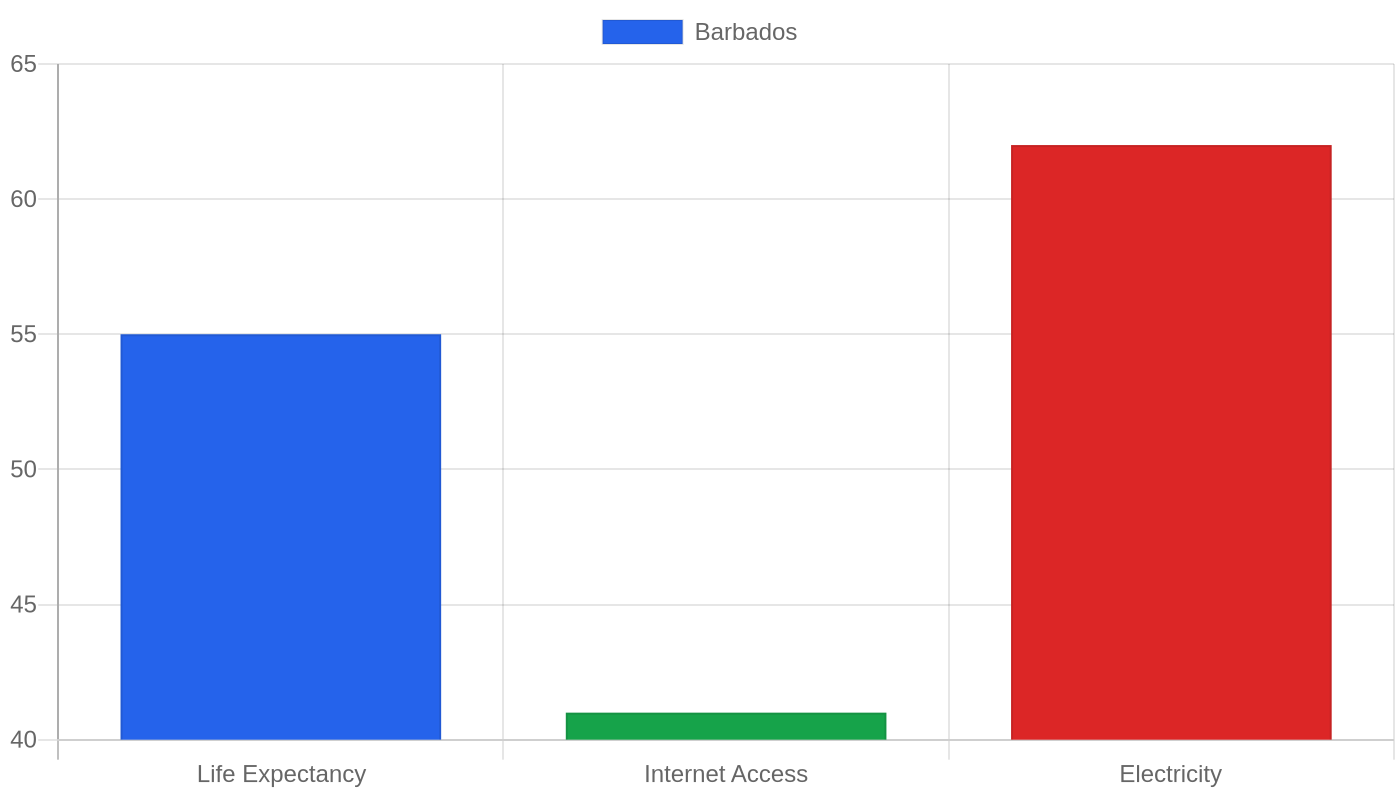
– The economy remains heavily reliant on tourism, financial services, and a small but diversified industrial base, though the World Bank data provided does not include current GDP, inflation, or unemployment figures.
– Top companies span utilities, consumer goods, telecommunications, and media, with state-owned enterprises like Barbados Water Authority and Barbados National Oil Company playing significant roles alongside private firms such as Banks Barbados Brewery.
– Political stability is anchored in a two-party system and a bicameral parliament, with 30 elected representatives in the House of Assembly and an appointed Senate.
– The country faces structural challenges common to small island developing states, including vulnerability to external shocks, climate risks, and the need to modernise infrastructure while maintaining fiscal discipline.
The Growth Conundrum — Reading Between the Lines of an Incomplete Picture
The World Bank data for Barbados presents a curious challenge for any economic journalist: the headline figures for GDP growth, inflation, unemployment, and per capita income are all marked as unavailable. This absence of recent macro data is itself a story. It speaks to the difficulties small island states face in maintaining timely statistical reporting, particularly in the aftermath of the COVID-19 pandemic, which devastated tourism-dependent economies across the Caribbean.
Without hard numbers from the World Bank, analysts must rely on qualitative indicators and the structural composition of the economy to assess Barbados’s current trajectory.
What is clear from the available information is the shape of the economy. The list of top companies reveals a mixed model: state-owned utilities such as Barbados Light and Power Company, Barbados Water Authority, and Barbados National Oil Company Limited sit alongside private consumer goods firms like Banks Barbados Brewery and Barbados Ice Cream Company. This suggests a hybrid economy where the state retains control over critical infrastructure while private enterprise drives consumer markets.
The presence of the Barbados Stock Exchange among the top companies indicates a functioning, if modest, capital market — a rarity for a country of this size. The telecommunications sector is represented by CariAccess, and media by the Caribbean Broadcasting Corporation and The Barbados Advocate, pointing to a reasonably diversified services sector.
The absence of GDP data from the World Bank does not mean the economy is stagnant. Rather, it underscores the need for investors and policymakers to look beyond headline numbers to the underlying structure. Barbados has historically maintained a high human development index relative to its income level, and its status as a regional hub for financial services and tourism gives it a resilience that raw GDP figures alone might not capture.
The challenge is that without current inflation or employment data, it is impossible to assess how the cost-of-living crisis that has gripped much of the Caribbean is affecting Barbadian households. What can be said is that the country’s economic model — reliant on imports, vulnerable to commodity price shocks, and exposed to climate volatility — requires constant adaptation to remain viable.
The Price of Paradise — Living Costs in a Small Island Economy
Housing and daily expenses in Barbados are shaped by the same forces that affect all small island developing states: high import dependence, limited land availability, and a tourism economy that pushes up prices for locals. While the data provided does not include specific cost-of-living indices, the structure of the economy offers clear clues.
The prominence of consumer goods companies like Banks Barbados Brewery and Barbados Ice Cream Company suggests a domestic market for locally produced food and beverage items, but these are unlikely to insulate residents from the high cost of imported staples. Rent in desirable coastal areas is typically driven by tourism demand and foreign buyers, creating a bifurcated market where locals may struggle to afford housing near the beaches that draw visitors.
Utilities are state-controlled through Barbados Light and Power Company and Barbados Water Authority, which theoretically allows for price regulation, but the reality is that energy costs in the Caribbean are among the highest in the world due to reliance on imported fossil fuels. Barbados National Oil Company Limited does provide some domestic production, but it is not sufficient to achieve energy independence.
For the average Barbadian, this means electricity bills that eat a significant portion of household income, and water costs that reflect the island’s vulnerability to drought. The lack of inflation data from the World Bank is particularly frustrating here, as it prevents a clear comparison with regional peers. However, anecdotal evidence from regional media consistently places Barbados among the more expensive Caribbean destinations for both visitors and residents.
A Business Landscape Built on Brews, Broadcasts, and Bureaucracy
The corporate landscape of Barbados is compact but diverse. Bajan Helicopters represents the industrials sector, a niche but high-value service for tourism, offshore energy, and emergency medical transport. Banks Barbados Brewery is the most recognisable consumer brand, producing the ubiquitous Banks beer that is both a domestic staple and an export product. The Barbados Advocate and Caribbean Broadcasting Corporation dominate traditional media, while CariAccess competes in the telecommunications space.
This mix suggests a business environment where opportunities exist in tourism-adjacent services, local manufacturing, and regulated utilities.
For investors, the key sectors to watch are financial services, where Barbados has positioned itself as a jurisdiction for international business companies and insurance, and renewable energy, where the high cost of imported fuel creates a strong incentive for solar and wind development. The Barbados Stock Exchange provides a formal channel for capital raising, though its small size limits liquidity.
The political landscape, modelled on the British Westminster system, offers legal stability and a familiar framework for foreign investors. The presence of state-owned enterprises in utilities and oil means that public-private partnerships are a likely route for major infrastructure projects. However, the data does not include any recent reforms or business climate indices, so the pace of deregulation or ease of doing business cannot be assessed from this information alone.
Stability in a Republic — Politics and Quality of Life After the Crown
Barbados’s transition to a parliamentary republic on 30 November 2021 was a defining political moment. The country removed Queen Elizabeth II as head of state and replaced her with a president elected by Parliament, currently Jeffrey Bostic. This move was widely seen as a mature step for a nation that had been independent since 1966, and it has not disrupted the fundamental stability of the political system.
The Westminster model remains intact: the Prime Minister is head of government, the House of Assembly has 30 elected representatives, and the Senate is appointed. This continuity provides reassurance to investors and citizens alike that the shift was symbolic and constitutional, not revolutionary.
The crime and safety indices are listed as unavailable in the data, which is a significant gap for any assessment of quality of life. Without these figures, it is impossible to compare Barbados to other Caribbean nations where crime rates often deter tourism and investment. What can be inferred is that Barbados has historically been considered one of the safer islands in the region, with lower homicide rates than Jamaica or Trinidad and Tobago, but this is an inference, not a data point.
The political landscape, with its bicameral parliament and independent judiciary, suggests strong institutions that support the rule of law. Quality of life in Barbados is generally high for those who can afford it, with good healthcare and education systems relative to regional peers, but the economic pressures of high living costs and limited job opportunities for young people remain persistent concerns.
The Republic in Real Time — Current Affairs and the Shape of Things to Come
This is the section where the absence of recent news data becomes most acute. The information provided includes no recent news articles, no live indicators, no policy announcements, and no election results. This creates a challenge for writing a timely section, but it also forces a focus on the structural currents that define Barbados’s present moment.
The country is navigating the post-pandemic recovery of its tourism sector, the implementation of its republican constitution, and the long-term threat of climate change, which poses existential risks to low-lying coastal infrastructure.
What can be said with confidence is that Barbados is engaged in a broader regional conversation about economic diversification, debt sustainability, and climate resilience. The government under Prime Minister Mia Mottley has been a vocal advocate for climate finance and debt restructuring on the global stage, though the provided data does not include any specific policy documents or statements. The absence of current data should not be mistaken for a lack of activity.
Rather, it reflects the limitations of the dataset. For the reader, the key takeaway is that Barbados is a politically stable, economically vulnerable, but institutionally robust small state that is actively redefining its place in the world. The next few years will likely see continued efforts to expand renewable energy, deepen financial services, and manage the delicate balance between tourism development and local quality of life.
The Bottom Line
Barbados deserves the attention of investors and policymakers interested in Caribbean resilience, political innovation, and the challenges of small-state economics. The country has demonstrated a capacity for bold political change — the transition to a republic — while maintaining institutional continuity. Its economy, though data-poor in this dataset, is structurally diversified enough to offer opportunities in utilities, consumer goods, and financial services.
Watch Barbados if you are interested in how small island states navigate global economic headwinds, or if you are seeking a stable, English-speaking jurisdiction for regional business operations. The missing data is a reminder that even the most sophisticated economies can suffer from statistical gaps, but the story of Barbados is bigger than the numbers currently available.
Sources & Methodology
This article is authored by Economic Pulse Net for informational and research purposes. Economic Pulse Net sources its data from multilateral institutions, national statistics bureaus, and proprietary databases. All data is believed to be current as of the date of publication.
Published: July 16, 2026 | Category: Research — Barbados
Use these signals in your own platform
Economic Pulse publishes its live signal feed through a documented, read-only API. Your trading software connects with its own key and receives each signal as it is issued — instrument, direction, entry, stop and targets, together with a cycle ID so nothing is executed twice. The feed is independent of this website and cannot change it.
Signals are informational only and are not financial advice.