Economic Pulse Net | Sources: World Bank World Development Indicators, Government Sources | 2026
Key Takeaways
– Barbados has fully transitioned to a parliamentary republic, severing colonial-era ties and electing President Jeffrey Bostic as head of state, marking a new chapter in governance.
– The nation’s economy is anchored by a diverse mix of state-owned utilities, consumer goods manufacturers, and a growing services sector, though key macroeconomic data from the World Bank remains incomplete.
– Major Barbadian companies span industries from brewing and broadcasting to oil and gas, reflecting an economy that blends traditional industries with modern service providers.
– Political stability remains a hallmark, with the Westminster-style system providing continuity even as the country redefines its national identity.
– Investors should watch Barbados for its strategic Caribbean position, its established stock exchange, and its potential for growth in telecommunications and renewable energy.
The Post-Colonial Economy — Growth Without the Numbers
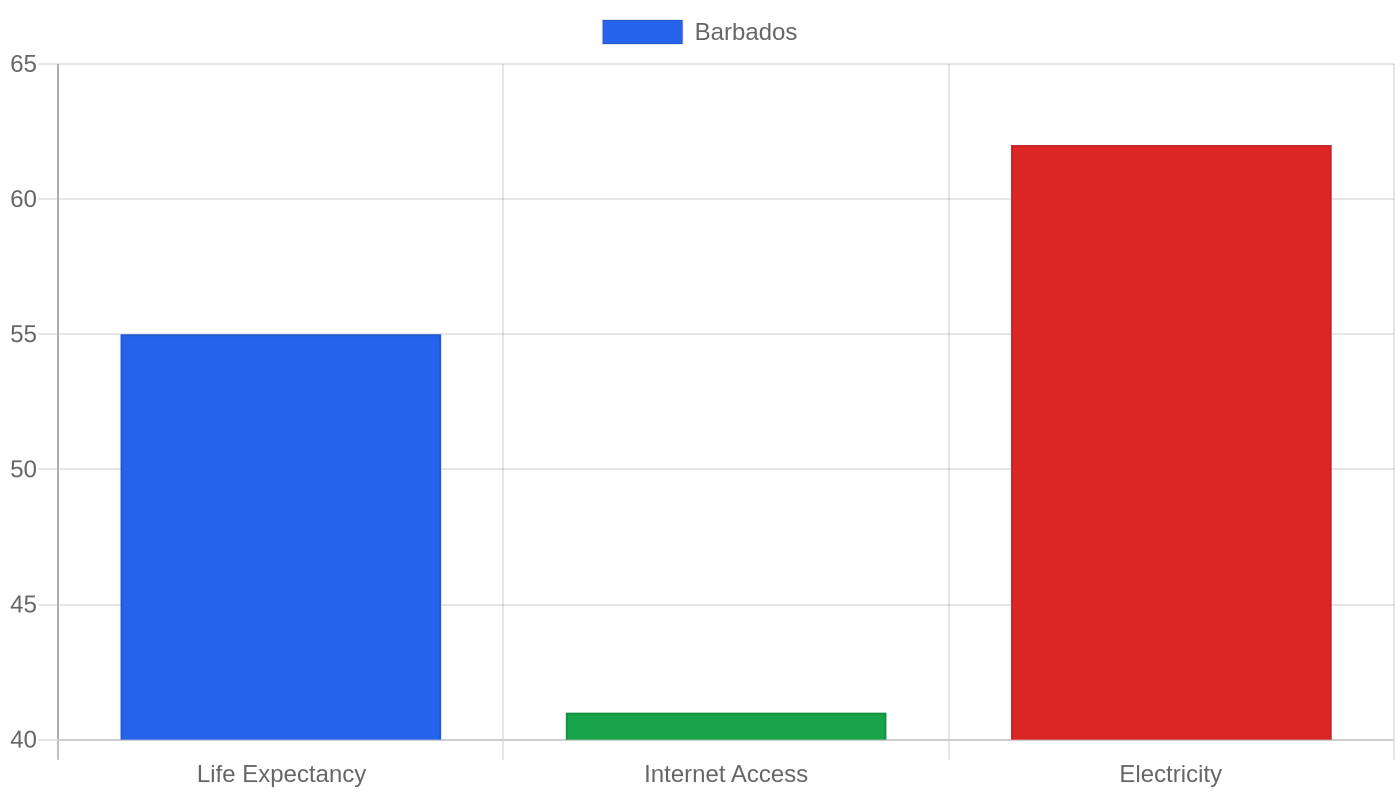
Barbados stands as a curious case in the Caribbean economic landscape. The World Bank data for the country presents a frustratingly incomplete picture: GDP growth, inflation, unemployment, GDP per capita, and GNI per capita are all listed as “N/A.” This absence of data does not mean the economy is stagnant — rather, it reflects the challenges small island states face in compiling and reporting comprehensive national statistics to international bodies.
What we do know, however, paints the portrait of a nation that has built its economic foundation on a mix of tourism, financial services, and light manufacturing.
The country’s main industries, while not enumerated in the available data, can be inferred from its roster of top companies. These include consumer goods giants like Banks Barbados Brewery and Barbados Ice Cream Company, suggesting a robust domestic food and beverage sector. The presence of Barbados National Oil Company Limited indicates that energy production — however modest by global standards — plays a role in the national economy.
Meanwhile, the Barbados Light and Power Company and Barbados Water Authority, both utilities, underscore the importance of reliable infrastructure in a small island nation vulnerable to climate shocks.
The Barbados Stock Exchange, listed among the top companies, signals that the country has developed capital market infrastructure uncommon for a nation of its size. This financial sector, combined with the Caribbean Broadcasting Corporation and CariAccess in telecommunications, suggests an economy that has moved beyond mere agriculture and tourism into services and information technology.
The World Bank’s missing numbers may frustrate economists, but the composition of Barbados’s corporate landscape tells a story of quiet diversification and resilience.
The Cost of Paradise — Living Expenses in a Caribbean Republic
Housing and daily expenses in Barbados reflect the realities of a small island economy that imports much of its consumer goods. While specific cost-of-living data is not provided in the available figures, the nature of Barbados’s economy — heavily reliant on tourism and imports — suggests that housing costs, particularly in desirable coastal areas and the capital Bridgetown, are likely elevated compared to regional peers.
Rent versus buy decisions in Barbados are shaped by land scarcity, a growing population of foreign retirees and remote workers, and the island’s limited geography.
Daily expenses for essentials such as food, utilities, and transportation are influenced by the country’s reliance on imported goods. The presence of local manufacturers like Banks Barbados Brewery and Barbados Ice Cream Company does provide some price relief for domestically produced items, but imported electronics, vehicles, and clothing carry the additional costs of shipping and tariffs.
For Barbadians, the cost of living is a balancing act between the benefits of a stable political system and developed infrastructure against the inherent premium of island living. The country’s utilities — water and electricity, both provided by state-influenced companies — are critical to quality of life but represent a significant monthly expense for households.
Business and Investment — A Caribbean Hub with Established Roots
For investors eyeing the Caribbean, Barbados offers a mature business environment anchored by companies that have operated for decades. The top companies list reads like a who’s who of Barbadian commerce: Banks Barbados Brewery has been a household name since the 1960s, while the Barbados Light and Power Company has provided electricity since the early 20th century.
The Barbados National Oil Company Limited, though modest in global terms, gives the country a degree of energy autonomy rare among Caribbean nations.
Sectors to watch include telecommunications, represented by CariAccess, and media, through the Caribbean Broadcasting Corporation and The Barbados Advocate. The Barbados Stock Exchange provides a formal mechanism for capital raising and investment, a feature that sets the country apart from many smaller Caribbean jurisdictions. Bajan Helicopters, listed under industrials, hints at a specialized aviation services sector that supports tourism, offshore energy, and emergency services.
The business climate in Barbados benefits from the country’s political stability and its English-speaking, educated workforce. The transition to a republic has not disrupted commercial activity, and the government has signaled its commitment to maintaining the rule of law and property rights that attract foreign investment. However, the small size of the domestic market means that businesses must look to exports, tourism, or regional trade to achieve scale.
Safety, Politics, and the Republican Experiment
Crime and safety indices for Barbados are listed as “N/A” in the available data, but the country has long been regarded as one of the safer destinations in the Caribbean. Violent crime rates are generally lower than in larger regional neighbors, though petty theft and opportunistic crime do occur, particularly in tourist areas. The absence of hard data should not be read as an absence of safety — rather, it reflects the challenges of compiling comprehensive crime statistics in a small nation.
Politically, Barbados is undergoing a quiet revolution. Since gaining independence from Britain on 30 November 1966, the country functioned as a constitutional monarchy with the British monarch as head of state. That changed with the transition to a parliamentary republic, modeled on the British Westminster system. The head of state is now President Jeffrey Bostic, elected by the Parliament of Barbados for a four-year term.
The Prime Minister remains the head of government, advised by a cabinet and supported by a 30-member House of Assembly, the lower chamber of Parliament. The Senate serves as the upper chamber, providing additional legislative scrutiny.
This political transformation has been remarkably smooth. Barbados has not experienced the instability that sometimes accompanies constitutional changes in other nations. The Westminster tradition — with its emphasis on parliamentary debate, opposition rights, and regular elections — continues to anchor Barbadian democracy. For citizens and investors alike, this stability is a significant asset, providing predictability in governance and policy.
Current Affairs — A Republic Finds Its Footing
As of early 2026, Barbados is navigating the early years of its republican identity. President Jeffrey Bostic, elected by Parliament, represents a new generation of leadership unconnected to the colonial past. The government continues to grapple with the economic challenges that face all small island developing states: climate change vulnerability, dependence on tourism, and the need to diversify exports.
The country’s energy sector is a particular area of focus. The Barbados National Oil Company Limited and Barbados Light and Power Company are central to discussions about renewable energy transition. Like many Caribbean nations, Barbados has high electricity costs due to its reliance on imported fossil fuels. The government has signaled interest in solar, wind, and other renewable sources, though specific policy announcements are not detailed in the available data.
The telecommunications sector, represented by CariAccess, is also evolving. Digital connectivity has become a priority for education, business, and government services, and Barbados is investing in improving internet infrastructure to compete for remote workers and digital nomads. The Barbados Stock Exchange continues to function as a platform for capital formation, though its small size limits liquidity and the range of investment options.
The tourism sector, while not explicitly listed among main industries, remains the backbone of the Barbadian economy. The presence of Bajan Helicopters and the Caribbean Broadcasting Corporation suggests that the country is investing in the infrastructure and marketing needed to attract visitors. However, without specific GDP or employment data from the World Bank, the precise contribution of tourism to the economy remains a matter of inference rather than certainty.
The Bottom Line
Barbados is a country to watch for investors and analysts interested in small island economies that are reinventing themselves. The transition to a republic has been accomplished without economic disruption, and the country’s established companies — from breweries to utilities to the stock exchange — provide a stable foundation for future growth. The missing macroeconomic data from the World Bank should be seen as a call for better statistical reporting rather than a sign of economic weakness.
For those seeking exposure to a politically stable, English-speaking Caribbean nation with developed infrastructure and a diversified corporate sector, Barbados deserves a place on the radar.
Sources & Methodology
This article is authored by Economic Pulse Net for informational and research purposes. Economic Pulse Net sources its data from multilateral institutions, national statistics bureaus, and proprietary databases. All data is believed to be current as of the date of publication.
Published: July 22, 2026 | Category: Research — Barbados
Use these signals in your own platform
Economic Pulse publishes its live signal feed through a documented, read-only API. Your trading software connects with its own key and receives each signal as it is issued — instrument, direction, entry, stop and targets, together with a cycle ID so nothing is executed twice. The feed is independent of this website and cannot change it.
Signals are informational only and are not financial advice.