Economic Pulse Net | Sources: World Bank World Development Indicators, Government Sources | 2026
Key Takeaways
– The Central African Republic operates as a presidential republic, with executive power shared between a President and Prime Minister, but political stability remains the country’s most critical economic variable.
– The country’s economic data landscape is remarkably sparse—with no recent GDP growth, inflation, unemployment, or GDP per capita figures available from the World Bank—signaling profound challenges in data collection and institutional capacity.
– Without reliable cost of living, crime, or safety indices, investors and analysts must rely on qualitative assessments and regional context to understand daily realities in Bangui and beyond.
– The nation’s economic story is less about numbers and more about the fundamental struggle to build a functioning state capable of delivering basic services and security.
The Invisible Economy — What the Missing Numbers Tell Us
When the World Bank reports “N/A” for a country’s GDP growth, inflation, unemployment, and GDP per capita, the absence of data becomes data in itself. The Central African Republic’s economic profile is defined less by specific figures and more by the institutional voids those blank cells represent. A nation that cannot produce basic macroeconomic statistics is a nation whose government struggles to see itself clearly—let alone manage its economic trajectory.
The country’s economic structure, according to the World Bank, remains overwhelmingly dependent on subsistence agriculture, forestry, and diamond mining. Timber and diamonds have historically accounted for the bulk of export earnings, but both sectors have been ravaged by decades of conflict and weak governance. Without reliable GDP figures, it is impossible to say whether the economy is contracting or growing, but regional context suggests stagnation.
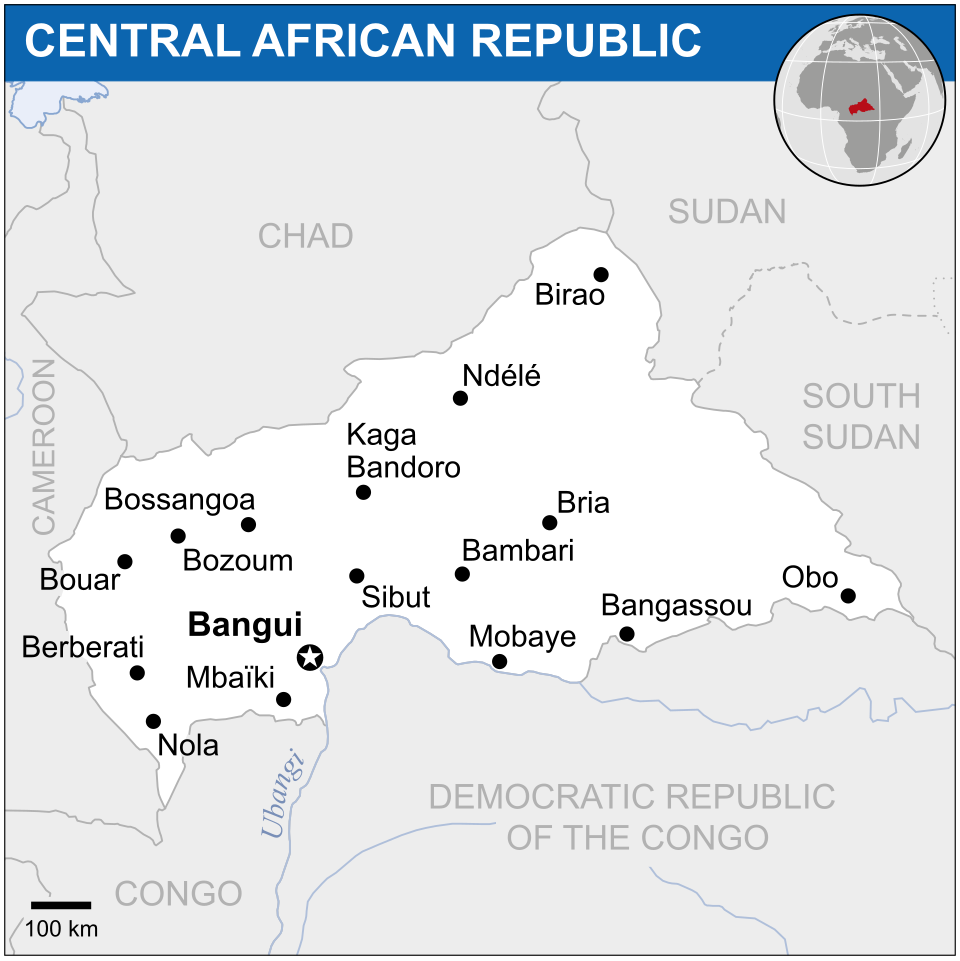
Landlocked, sparsely populated, and lacking basic road infrastructure connecting it to ports in Cameroon or the Democratic Republic of Congo, the Central African Republic operates as one of the world’s most isolated economies.
Inflation data is also absent, but anecdotal evidence from humanitarian organizations suggests that prices for imported goods—fuel, medicine, rice, cooking oil—have been volatile, driven by supply chain disruptions and currency instability. The country uses the CFA franc, pegged to the euro, which provides some monetary stability but also means the Central African Republic cannot devalue its currency to boost exports.
This monetary rigidity, combined with fiscal weakness, creates a painful economic bind: the state cannot print money to finance spending, but it also cannot adjust exchange rates to respond to shocks.
Employment data is nonexistent, but the informal economy likely absorbs the vast majority of the working-age population. Formal sector jobs are concentrated in government, international NGOs, and a handful of mining operations. The lack of unemployment statistics reflects not just data gaps but the reality that most Central Africans have never participated in a formal labor market that could be measured.
The Price of Survival — Living Costs in a Broken State
Without official cost of living indices from the World Bank or other sources, understanding daily expenses in the Central African Republic requires reading between the lines of humanitarian reports and regional comparisons. What is clear is that Bangui, the capital, is extraordinarily expensive for what it offers. Fuel, food, and basic goods must be trucked overland from Cameroon or flown in, with transport costs inflating prices far beyond what regional neighbors pay.
Rent in the capital’s secure neighborhoods—where diplomats, aid workers, and the small business class reside—can rival prices in mid-tier African cities like Yaoundé or Abidjan, despite offering far less reliable electricity, water, or security. Buying property is nearly impossible for most citizens due to unclear land titling, corruption in the registry system, and the risk of land being seized by armed groups.
The rental market is bifurcated: expatriates pay premium prices for fortified compounds, while the vast majority of Central Africans live in informal settlements with little to no legal tenure.
Daily expenses for a typical family are dominated by food imports. The country has fertile soil and adequate rainfall, but agricultural production has collapsed due to insecurity. Farmers cannot safely reach their fields in many regions, meaning even basic staples like cassava, plantains, and groundnuts must sometimes be imported from neighboring countries.
This paradox—a potentially agricultural-rich nation dependent on food imports—drives up the cost of living for everyone and keeps malnutrition rates among the highest in the world.
Investing in the Void — Business Climate in a Frontier Market
The list of top companies in the Central African Republic is notably absent from available data, which itself tells a story. There is no formal stock exchange, no major multinational corporate presence, and no locally grown conglomerate with regional reach. The private sector, according to the World Bank’s broader regional assessments, is dominated by small-scale traders, artisanal miners, and a handful of foreign-owned logging and mining operations.
Sectors to watch, based on the country’s natural endowments, include diamond mining, timber, and potentially gold and uranium. The Central African Republic has significant mineral wealth, but extracting it requires security guarantees that the state currently cannot provide. Chinese and Russian interests have shown periodic interest in mining concessions, but these deals are often opaque, controversial, and fail to generate broad-based economic development.
The business environment is constrained by what the World Bank would describe as extreme fragility. Registering a business, obtaining permits, enforcing contracts, and resolving insolvency are all extraordinarily difficult in a country where the state’s writ barely extends beyond Bangui. Corruption is endemic, infrastructure is decaying or absent, and the judicial system is weak. For any investor, the risk premium is astronomical.
Yet for those willing to operate in such conditions—typically mining companies with their own security forces or aid contractors—the lack of competition can offer outsized returns.
Security, Politics, and the Quality of Life Question
The political landscape of the Central African Republic, as described by the World Bank, formally takes place within a presidential republic framework. The President serves as head of state, the Prime Minister as head of government, and executive power is exercised by the government. Legislative power is vested in both the government and parliament. This structure, however, exists largely on paper.
In practice, the Central African Republic has experienced multiple coups, rebellions, and periods of civil war since independence from France in 1960. The most recent major conflict began in 2012 when the Séléka rebel coalition seized power, triggering a cycle of violence between largely Muslim Séléka forces and Christian anti-balaka militias that continues in various forms today. The government, even when internationally recognized, controls only a fraction of the national territory.
Large swaths of the country are held by armed groups that tax local populations, control mining sites, and provide their own rough justice.
Crime and safety indices are marked as “N/A” in the available data, but qualitative reports from humanitarian organizations consistently describe the Central African Republic as one of the most dangerous countries in the world for civilians. Armed banditry, kidnapping for ransom, and intercommunal violence are endemic. The United Nations maintains a peacekeeping mission, MINUSCA, which has been deployed since 2014, but it has struggled to protect civilians or extend state authority.
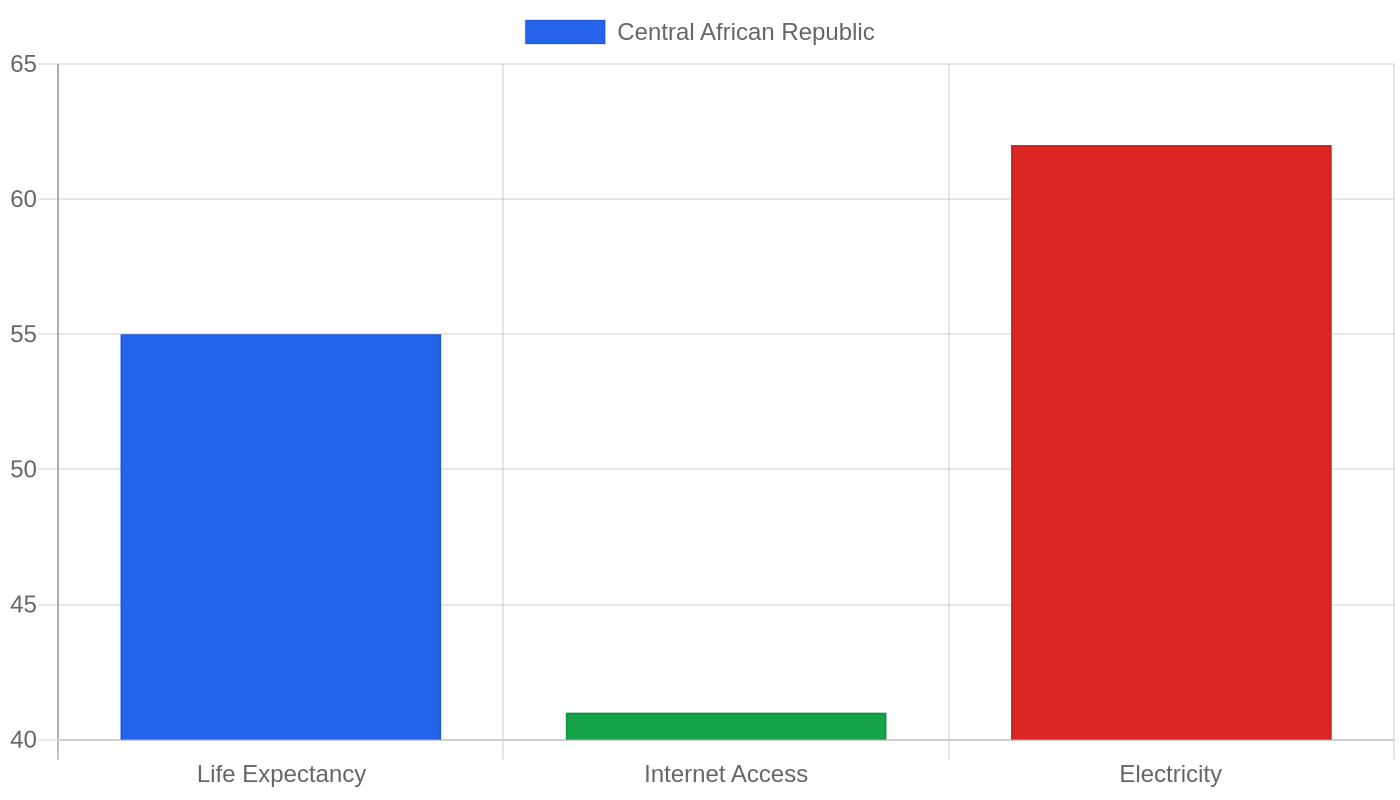
Quality of life, while not captured in official happiness or well-being indices, is among the lowest globally. The country consistently ranks at or near the bottom of the UN Human Development Index. Access to electricity, clean water, healthcare, and education is severely limited. Life expectancy is low, maternal and child mortality are high, and the population has endured decades of trauma with minimal psychosocial support.
A Fragile Pause — What’s Happening Now
The Central African Republic exists in a state of perpetual crisis, but the current moment is defined by a fragile and incomplete stabilization process. The government of President Faustin-Archange Touadéra, first elected in 2016 and reelected in 2020 despite widespread irregularities and violence, has sought to consolidate control with the help of Russian paramilitary contractors—often described as the Wagner Group—and Rwandan troops.
These external security providers have helped push back rebel offensives, but at a significant cost to sovereignty and human rights.
The political opposition, meanwhile, accuses the government of authoritarian drift. Constitutional reforms pushed through in 2023 abolished presidential term limits, raising fears that Touadéra could remain in power indefinitely. This has deepened the legitimacy crisis of the state and made meaningful political reconciliation with armed groups even more difficult.
On the economic front, the government has pursued a modest reform agenda under pressure from the International Monetary Fund and the World Bank. Efforts to improve public financial management, increase domestic revenue collection, and reduce the wage bill have had limited success. The country remains heavily dependent on foreign aid, which covers a significant portion of the national budget and funds most basic services.
The security situation, while improved in some areas, remains volatile. Armed groups still control significant portions of the countryside, and humanitarian access is frequently blocked. The displacement crisis continues, with hundreds of thousands of Central Africans living in camps either within the country or as refugees in Cameroon, Chad, and the Democratic Republic of Congo. Until security is guaranteed across the national territory, economic recovery will remain a distant aspiration.
The Bottom Line
The Central African Republic is a country that the global economy has largely left behind—a place where the most basic economic data is unavailable because the state lacks the capacity to collect it. For humanitarian organizations, peacekeeping missions, and a handful of adventurous mining companies, the country remains a critical operating environment. For mainstream investors, tourists, or even regional traders, the risks currently outweigh any potential reward.
The Central African Republic is a nation to watch not for its economic potential, but as a case study in what happens when state failure becomes chronic—and as a reminder that economic development cannot begin without security, stability, and a functioning government.
Sources & Methodology
This article is authored by Economic Pulse Net for informational and research purposes. Economic Pulse Net sources its data from multilateral institutions, national statistics bureaus, and proprietary databases. All data is believed to be current as of the date of publication.
Published: July 22, 2026 | Category: Research — Central African Republic
Use these signals in your own platform
Economic Pulse publishes its live signal feed through a documented, read-only API. Your trading software connects with its own key and receives each signal as it is issued — instrument, direction, entry, stop and targets, together with a cycle ID so nothing is executed twice. The feed is independent of this website and cannot change it.
Signals are informational only and are not financial advice.