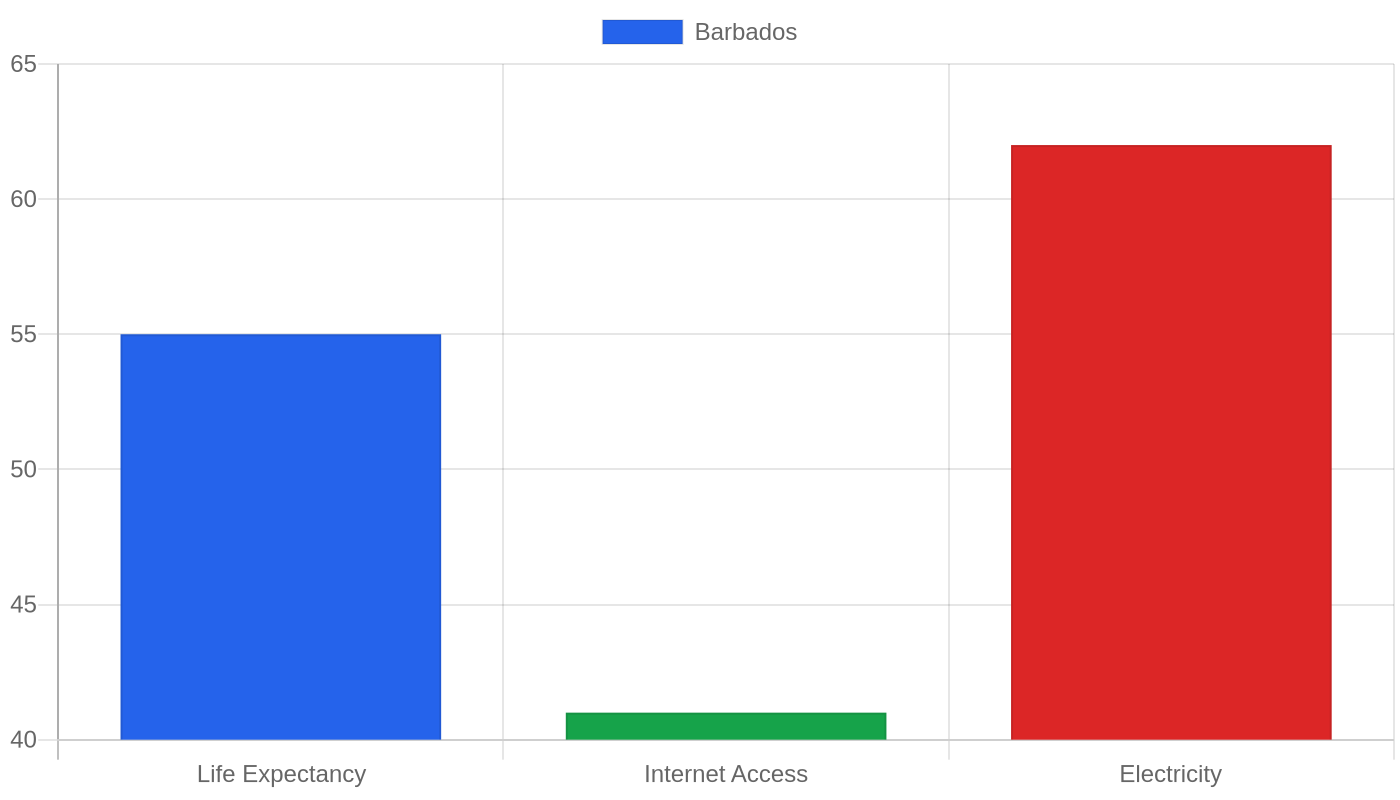
Economic Pulse Net | Sources: World Bank World Development Indicators, Government Sources | 2026
Key Takeaways
* Barbados operates as an independent parliamentary republic modeled on the British Westminster system, with Jeffrey Bostic serving as President and a Prime Minister leading the government.
The nation’s economic landscape is defined by a diverse mix of industries, including significant players in utilities, telecommunications, and consumer goods.
Major corporate entities such as the Barbados Stock Exchange and the Barbados National Oil Company Limited anchor key sectors of the local economy.
Political stability is maintained through a bicameral Parliament consisting of the House of Assembly and the Senate, ensuring a structured legislative process.
While specific macroeconomic metrics like GDP growth and inflation are currently unreported, the country maintains a robust institutional framework for business and governance.
Economic Foundations and Industrial Structure
Barbados presents a unique case study in small-island developing states where institutional stability often precedes rapid statistical expansion. Although recent World Bank data indicates that specific figures for GDP growth, inflation CPI, and unemployment are currently marked as N/A, the underlying structure of the economy remains visible through its industrial composition.
The presence of established entities like the Barbados Light and Power Company and the Barbados Water Authority suggests a state-involved or heavily regulated utility sector, which is critical for maintaining infrastructure reliability in island environments. Furthermore, the existence of the Barbados National Oil Company Limited points to strategic interests in energy security and potential diversification away from pure tourism dependence.
The Barbados Stock Exchange serves as a vital financial hub, facilitating capital formation for domestic enterprises and providing a platform for investment within the Caribbean region. This structural backbone implies that while headline numbers may be absent, the mechanisms for economic activity are firmly in place. The absence of reported GDP per capita PPP or GNI per capita figures does not negate the operational reality of these major corporations, which continue to drive employment and service delivery.
Understanding Barbados requires looking beyond volatile short-term indicators to the steady pulse of its foundational industries, from banking to brewing, as evidenced by companies like Banks Barbados Brewery.
Cost of Living and Daily Expenses
For residents and expatriates alike, understanding the cost of living in Barbados involves navigating a market shaped by import dependencies and local production capabilities. With detailed cost indices unavailable in the current dataset, the focus shifts to the tangible presence of consumer services and goods providers that dictate daily expenses.
The prominence of companies such as the Barbados Ice Cream Company and Banks Barbados Brewery indicates a vibrant local consumer market that supports both domestic consumption and potentially export-oriented manufacturing. These entities suggest that while imported goods may carry premium pricing due to logistics, there is a strong base of locally produced consumer goods that offer competitive alternatives.
Housing costs and rental markets are indirectly influenced by the stability of the utility sectors managed by the Barbados Light and Power Company and the Barbados Water Authority; reliable infrastructure is a key determinant of livability and property value. In the absence of specific inflation data, the consistency of these service providers offers a measure of predictability for household budgeting.
The availability of telecommunications services through CariAccess further integrates the population into the global digital economy, influencing both lifestyle costs and business operational expenses. Ultimately, the cost structure appears to be balanced between international price pressures and local industrial output, creating a distinct economic rhythm for those living on the island.
Investment Opportunities and Business Climate
The investment landscape in Barbados is characterized by a mature set of corporate actors spanning multiple essential sectors. For investors seeking exposure to the island’s economy, the Barbados Stock Exchange provides a regulated environment for equity trading, offering visibility into the performance of top listed companies.
The industrials sector is represented by Bajan Helicopters, suggesting niche opportunities in specialized transportation and logistics services that cater to both tourism and commercial needs. Meanwhile, the financials sector, anchored by the stock exchange itself, indicates a developed banking and investment infrastructure capable of supporting complex transactions.
The oil and gas sector, represented by the Barbados National Oil Company Limited, presents long-term strategic considerations regarding energy independence and regional supply chains. Consumer services also play a pivotal role, with media outlets like The Barbados Advocate and the Caribbean Broadcasting Corporation shaping public discourse and advertising markets. This diversity reduces over-reliance on any single industry, making the business climate relatively resilient to external shocks.
Companies like CariAccess highlight the importance of telecommunications infrastructure as a enabler for modern business operations, ensuring connectivity for both local enterprises and foreign investors. The presence of these varied entities suggests a dynamic environment where traditional industries coexist with modern service-based economies.
Safety, Politics, and Quality of Life
Barbados enjoys a stable political environment rooted in its history as an independent nation since November 30, 1966. The country functions as a parliamentary republic modeled on the British Westminster system, providing a familiar legal and administrative framework for many international observers. The head of state is the President of Barbados, presently Jeffrey Bostic, who is elected by the Parliament of Barbados for a four-year term.
This electoral process underscores the democratic nature of the state, with the President advised on matters of state by the Prime Minister, who serves as the head of government. Legislative power is vested in the Parliament of Barbados, which comprises the House of Assembly, featuring 30 representatives, and the Senate, adding another layer of scrutiny and representation.
While specific crime and safety indices are currently listed as N/A, the structured political system implies a rule-of-law environment conducive to social stability. The transparency of the governmental structure, with clear distinctions between ceremonial and executive roles, contributes to a predictable quality of life for citizens. This political maturity is a significant asset for long-term planning and personal security, offering a sense of continuity that is often lacking in more volatile regions.
The integration of these political institutions creates a cohesive national identity that supports both civic engagement and economic confidence.
Current Affairs and Policy Dynamics
In the absence of real-time news feeds or live indicators in the provided data, the current affairs landscape of Barbados is best understood through its enduring institutional frameworks. The ongoing operation of the House of Assembly and the Senate ensures that legislative processes continue uninterrupted, allowing for the gradual evolution of policy without abrupt disruptions.
The tenure of President Jeffrey Bostic, elected for a four-year term, marks a period of steady leadership within the presidential office, complemented by the executive guidance of the Prime Minister. This dual structure facilitates a balance between ceremonial duties and active governance, ensuring that state matters are addressed with consistent oversight.
The continued activity of major companies like the Barbados Water Authority and the Barbados National Oil Company Limited suggests that essential services remain a priority for the administration. Media organizations such as The Barbados Advocate and the Caribbean Broadcasting Corporation likely serve as vital channels for disseminating government announcements and public feedback.
The stability of these political and corporate entities indicates that current affairs are focused on maintenance and incremental improvement rather than radical overhaul. This approach fosters an environment where businesses can operate with a degree of certainty, knowing that the fundamental rules of engagement are unlikely to change drastically. The focus remains on sustaining the momentum of development within a secure and well-established constitutional order.
The Bottom Line
Barbados offers a compelling proposition for those valuing political stability and institutional maturity over high-velocity growth metrics. Investors and residents alike benefit from a transparent Westminster-style democracy and a diversified corporate base that spans utilities, finance, and consumer goods. While specific economic indicators like GDP and inflation are currently unreported, the presence of robust major companies suggests a functioning economy ready to capitalize on future opportunities.
It is a destination for those seeking a secure, well-governed environment in the Caribbean, where the foundations for long-term success are firmly laid.
Sources & Methodology
This article is authored by Economic Pulse Net for informational and research purposes. Economic Pulse Net sources its data from multilateral institutions, national statistics bureaus, and proprietary databases. All data is believed to be current as of the date of publication.
Published: October 01, 2026 | Category: Research — Barbados
Use these signals in your own platform
Economic Pulse publishes its live signal feed through a documented, read-only API. Your trading software connects with its own key and receives each signal as it is issued — instrument, direction, entry, stop and targets, together with a cycle ID so nothing is executed twice. The feed is independent of this website and cannot change it.
Signals are informational only and are not financial advice.