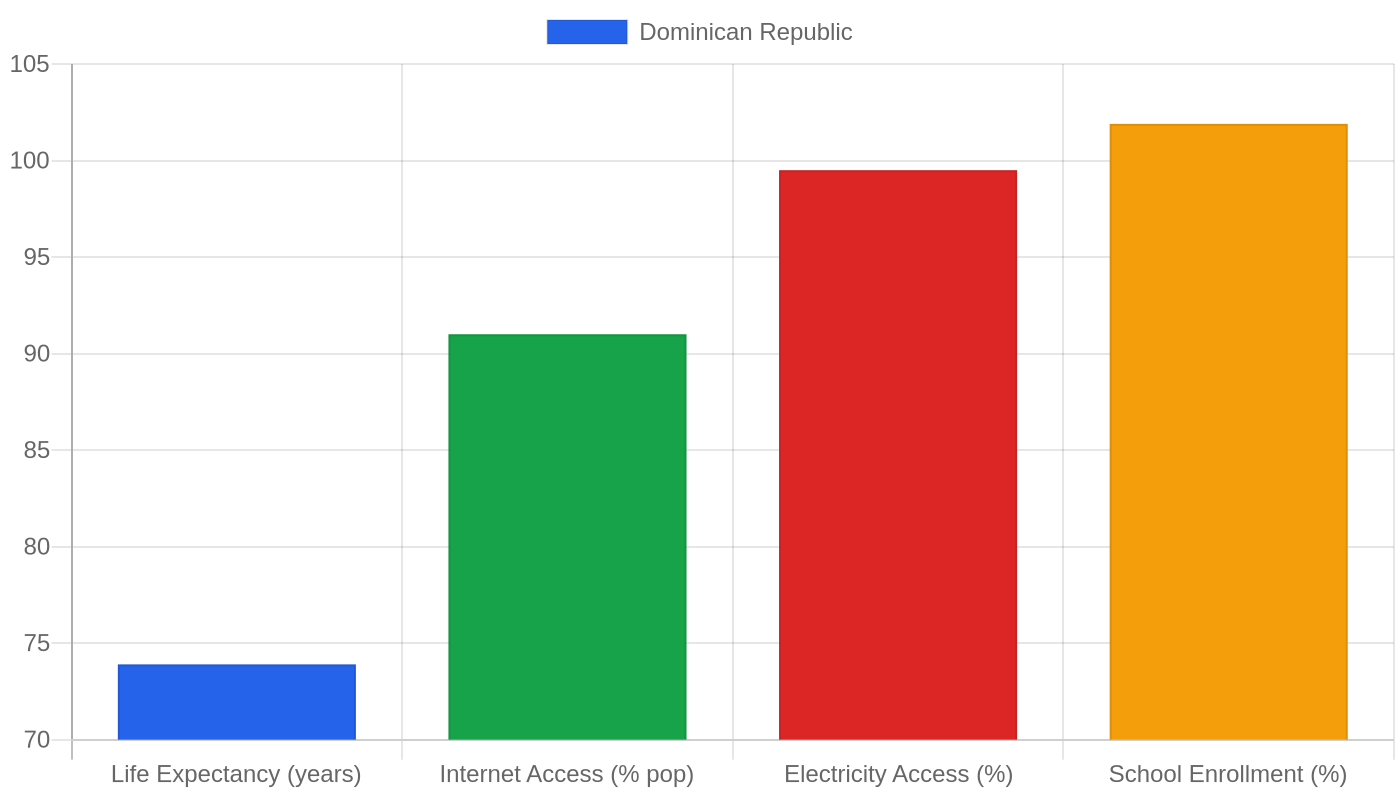
Economic Pulse Net | Sources: World Bank World Development Indicators, Government Sources | 2026
Key Takeaways
- Political Stability Amidst Democratic Structure: The Dominican Republic operates as a representative democracy with a clear separation of powers, featuring a directly elected president who serves as both head of state and commander in chief.
- Bicameral Legislative Framework: The national legislature is bicameral, composed of a senate and a lower house, ensuring a structured approach to lawmaking and executive oversight.
- Data Gaps Limit Current Economic Precision: Specific quantitative metrics for GDP growth, inflation, unemployment, and crime indices are currently unavailable in the provided dataset, necessitating a qualitative focus on structural and political foundations.
- Institutional Continuity: The political landscape is defined by established institutions, where the president and vice-president run on a joint ticket for four-year terms, promoting continuity in governance.
- Focus on Governance over Current Metrics: With real-time economic and safety data absent from the current record, the primary narrative centers on the country’s stable democratic framework and institutional design.
The Structural Backbone of Caribbean Governance
While current macroeconomic indicators such as GDP growth rates, inflation levels, and unemployment figures are not available in the latest World Bank data provided, the foundational stability of the Dominican Republic’s political system offers a distinct lens through which to view its long-term viability.
The country is firmly established as a representative democracy and a democratic republic, a status that has historically underpinned its social and economic resilience.
This political structure is characterized by three distinct branches of power: the executive, the legislative, and the judicial, each playing a critical role in maintaining the balance of governance.
The president of the Dominican Republic heads the executive branch, holding significant authority to execute laws passed by the congress, appoint the cabinet, and serve as the commander in chief of the armed forces.
This concentration of executive power is balanced by a bicameral national legislature, which is composed of a senate and a lower chamber, ensuring that legislative processes are thorough and representative.
The fact that the president and vice-president run for office on the same ticket and are elected by direct vote for four-year terms suggests a political system designed for stability and continuity, where the executive branch maintains a coherent policy direction over a multi-year period.
Although we lack the specific numbers to gauge the current economic pulse, the robustness of these democratic institutions provides a critical framework for understanding how the nation navigates both domestic challenges and external economic pressures.
Living Costs and Regional Positioning
In the absence of specific cost-of-living data, housing costs, or daily expense metrics from the provided sources, a precise analysis of the Dominican Republic’s domestic economic conditions remains elusive.
However, the stability of the political and legislative framework suggests that the environment for daily life is underpinned by consistent governance structures rather than volatile policy shifts.
Without data on rent versus buy dynamics or regional comparisons for daily expenses, it is not possible to quantify the exact financial burden on residents or expatriates.
The lack of specific inflation or GDP per capita figures means that the purchasing power of the average citizen cannot be accurately assessed against current market conditions.
Nevertheless, the established nature of the bicameral legislature and the direct election of the executive imply that policy decisions affecting living standards are made through formal, democratic channels.
This institutional stability may offer a degree of predictability for residents, even if the specific quantitative costs are not currently documented in the available data.
The focus on political structure over current economic metrics highlights a need for updated statistical reporting to fully understand the day-to-day economic reality for the population.
Business Climate and Industrial Landscape
The provided data does not list specific main industries, top companies, or detailed investment climate metrics, which limits the ability to provide a granular analysis of the Dominican Republic’s business environment.
Without information on key sectors or major corporate players, it is difficult to identify specific industries driving economic activity or areas of high investment potential.
The absence of GDP data further complicates the assessment of the overall size and growth trajectory of the private sector.
However, the stable political landscape, characterized by a four-year presidential term and a bicameral legislature, typically fosters an environment where long-term business planning is feasible.
The executive’s role in appointing the cabinet and executing laws suggests a centralized approach to economic policy, which can be advantageous for businesses seeking clear regulatory guidance.
While specific data on business friendliness or sectoral performance is missing, the democratic framework implies that business operations are subject to established legal and judicial processes.
The lack of detailed industry data underscores the need for comprehensive economic reporting to provide a complete picture of the business landscape.
Safety, Political Stability, and Quality of Life
Specific crime and safety indices for the Dominican Republic are not available in the current dataset, with both the Crime Index and Safety Index listed as N/A.
This data gap prevents a quantitative assessment of the country’s security environment or a direct comparison with regional averages.
However, the political landscape provides significant context for understanding the broader quality of life and social stability.
The Dominican Republic’s status as a representative democracy with a clear separation of powers suggests a society governed by rule of law rather than arbitrary executive action.
The bicameral legislature and the direct election of the president and vice-president on a joint ticket for four-year terms indicate a political system that values continuity and institutional integrity.
This political stability is often a key driver of social cohesion and can indirectly influence perceptions of safety and security.
While we cannot cite specific crime statistics, the established democratic processes and the role of the judiciary as a distinct branch of power suggest mechanisms for resolving disputes and maintaining order.
The absence of specific safety data does not negate the importance of the political framework in shaping the overall living conditions for citizens.
Current Affairs and Institutional Dynamics
With the latest GDP growth, inflation, and unemployment data unavailable, the current affairs narrative is dominated by the structural and political dynamics of the Dominican Republic.
The most recent information highlights the country’s functioning as a democratic republic, where the executive, legislative, and judicial branches operate in a defined relationship.
The president’s role as commander in chief of the armed forces and head of the executive branch remains central to the current political landscape, emphasizing the importance of military and executive alignment in governance.
The bicameral structure of the legislature, comprising a senate and a lower house, continues to serve as the primary forum for lawmaking and oversight, ensuring that executive actions are subject to legislative scrutiny.
The fact that the president and vice-president are elected on the same ticket for four-year terms suggests a current political cycle that prioritizes unified executive leadership.
Without specific recent news items or live economic indicators, the focus remains on the enduring nature of these institutional arrangements.
The current period appears to be one of institutional maintenance, where the established democratic processes are the primary driver of national policy and stability.
The Bottom Line
The Dominican Republic presents a case study in structural stability, where the robustness of its democratic institutions serves as the primary indicator of national resilience in the face of data scarcity.
For investors and analysts, the lack of current macroeconomic metrics necessitates a focus on the political and legal framework, which offers a predictable environment for long-term engagement.
The four-year presidential term and bicameral legislature provide a consistent rhythm to governance, reducing the risk of sudden policy shocks.
Ultimately, the country’s value lies in its established democratic processes and institutional continuity, which remain the most reliable anchors for understanding its future trajectory.
Sources & Methodology
This article is authored by Economic Pulse Net for informational and research purposes.
Economic Pulse Net sources its data from multilateral institutions, national statistics bureaus, and proprietary databases.
All data is believed to be current as of the date of publication. Published: September 02, 2026 |
Category: Research — Dominican Republic
Use these signals in your own platform
Economic Pulse publishes its live signal feed through a documented, read-only API. Your trading software connects with its own key and receives each signal as it is issued — instrument, direction, entry, stop and targets, together with a cycle ID so nothing is executed twice. The feed is independent of this website and cannot change it.
Signals are informational only and are not financial advice.