Economic Pulse Net | Sources: World Bank World Development Indicators, Government Sources | 2026
Key Takeaways
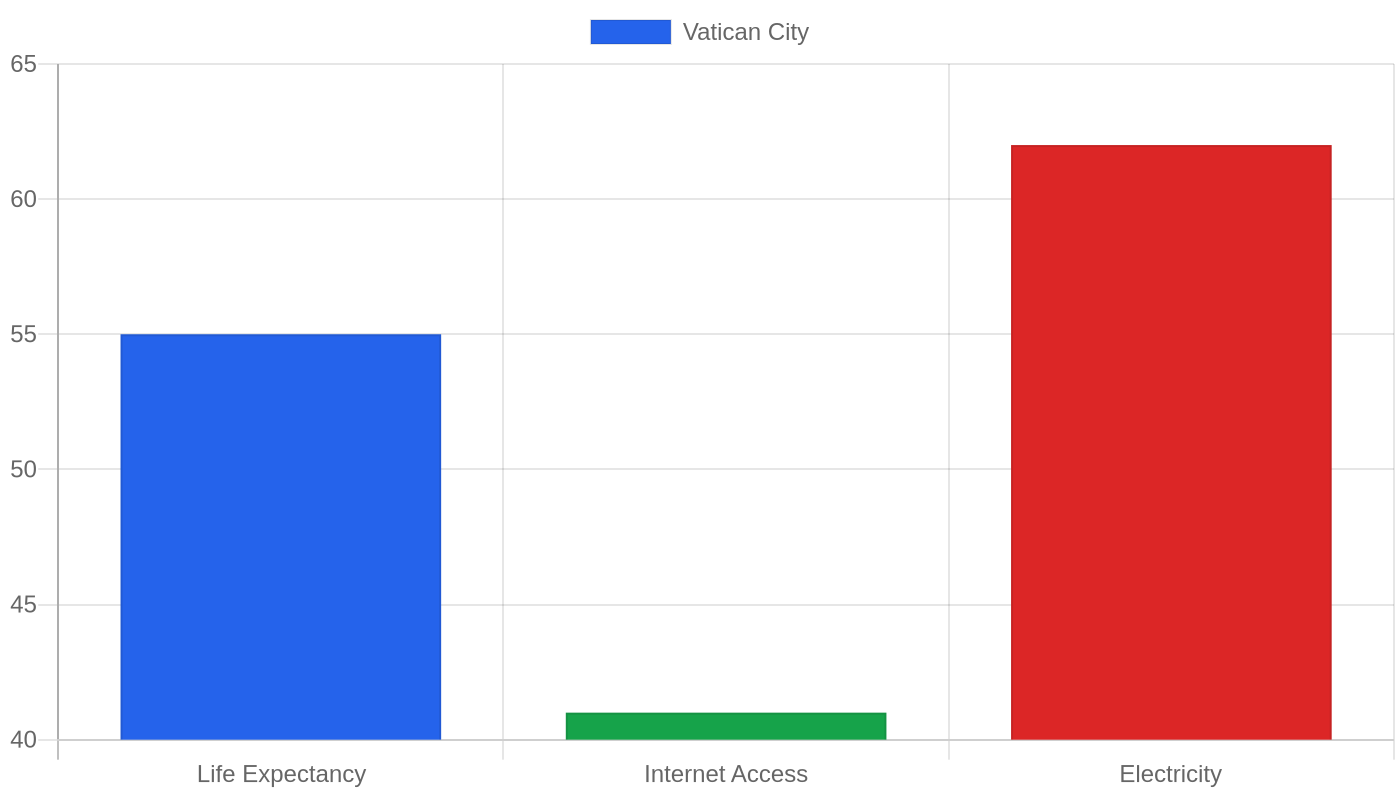
* Statistical Anomaly: As a unique sovereign entity, Vatican City does not report standard macroeconomic indicators such as GDP growth, inflation, or unemployment to the World Bank, rendering traditional economic analysis impossible through conventional metrics.
Non-Market Structure: The nation lacks a typical industrial base or corporate sector; there are no major companies listed in standard databases, and population figures are absent from primary international datasets.
Governance by Doctrine: Political and economic stability is derived entirely from the Holy See’s spiritual authority and diplomatic influence rather than market forces, fiscal policy, or legislative reform.
Safety and Order: With crime and safety indices marked as unavailable, the environment is defined by its status as a religious enclave where law enforcement is managed internally under canon law rather than civil criminal codes.
The Invisible Ledger: A Sovereign Exception
When economists look at global markets, they typically rely on a rigid framework of data points: Gross Domestic Product (GDP) growth rates, Consumer Price Index (CPI) inflation, and unemployment percentages. However, Vatican City stands as a profound exception to this rule. According to the World Bank, all primary economic indicators for the country are recorded as “N/A,” including GDP in USD, GDP per capita based on purchasing power parity (PPP), and GNI per capita.
This absence of data is not merely a reporting gap but a structural reality. The Vatican operates outside the standard capitalist framework that defines national economies. It does not produce goods for export, nor does it have a labor market subject to traditional supply and demand dynamics. Consequently, concepts like “unemployment” or “inflation” do not apply in any measurable sense.
The economy is sustained by donations, investments managed by the Holy See, and revenue from tourism and publications, but these flows are not aggregated into national accounts in the way they are for France, Germany, or even micro-states like Monaco. For investors and analysts, this means that Vatican City cannot be evaluated using standard valuation models. Its economic weight is measured in soft power and diplomatic leverage, not in percentage points of quarterly growth.
The lack of a reported GDP figure underscores its unique status as a city-state whose primary output is spiritual and diplomatic, rather than material.
Cost of Living: Beyond Market Pricing
In most nations, the cost of living is determined by housing rents, utility bills, and daily consumer expenses, often compared against regional averages to gauge affordability. In Vatican City, however, these metrics are entirely absent. Data sources provide no information on housing costs, rent-to-buy ratios, or general daily expenses. This is because the concept of a “cost of living” for residents is fundamentally different here.
The vast majority of the population consists of clergy and Swiss Guards who receive room and board as part of their service, effectively removing housing and basic sustenance from personal expense calculations. For the small number of lay employees and visitors, prices are likely set within an internal ecosystem that does not interact with the broader Italian or European retail markets in a transparent way.
There is no public data on whether a loaf of bread or a gallon of fuel costs more or less than in neighboring Rome, because the transactional volume is too low to generate statistical significance. Therefore, one cannot infer a regional comparison. The financial experience of being in Vatican City is not about navigating market prices but about participating in a closed loop of services provided by the institution.
For the outsider, the “cost” is primarily access—whether through ticket purchases for museums or donations—rather than the ongoing burden of maintaining a household in a free-market context.
Investment & Business Climate: No Corporate Landscape
Typically, an investment profile highlights top companies, key sectors, and the ease of doing business. For Vatican City, this section of the economic landscape is empty. The provided data lists no top companies, with entries simply showing placeholders or null values. There are no multinational corporations headquartered here, no startups seeking venture capital, and no manufacturing plants. The primary “industry” is governance and religious administration.
Any economic activity that occurs is incidental to the mission of the Holy See. There are no sectors “to watch” in the traditional sense of emerging technologies or renewable energy shifts. The business environment is not regulated by commercial law but by canon law and international treaties. Foreign entities do not establish subsidiaries here; instead, they engage with the Holy See as a diplomatic partner.
This makes Vatican City irrelevant to portfolio diversification strategies focused on equity markets or direct foreign investment. The only financial instruments associated with the state are those managed by the central banking activities of the Holy See, which operate discreetly and are not publicly traded. For businesses, the takeaway is clear: Vatican City is not a place for commerce, but a place for diplomacy.
Engagement is strictly limited to official relations, cultural exchanges, or charitable partnerships, none of which offer the scalability or profit margins found in other jurisdictions.
Safety, Politics & Quality of Life: Stability Through Sanctity
Evaluating safety and political risk usually involves analyzing crime indices, political stability scores, and happiness metrics. In the case of Vatican City, crime and safety indices are listed as N/A, and the political landscape is similarly undefined in standard economic terms. This silence speaks volumes. The absence of a crime index suggests that violent crime and theft are either non-existent or so rare that they do not warrant statistical tracking in international databases.
The political landscape is not characterized by parties, elections, or policy debates, but by the papacy and the Curia. Stability is absolute, derived from centuries of institutional continuity rather than democratic mandate. While we lack specific happiness data or quality-of-life scores comparable to Nordic countries, the environment is inherently secure and orderly. The Swiss Guard ensures physical safety, while the moral framework provides social cohesion.
For residents and visitors alike, the primary concern is not personal security or political unrest, but adherence to strict behavioral norms. The quality of life is high in terms of safety and infrastructure, but constrained by the unique rules of a religious enclave. It is a place of profound peace, yet one that requires total submission to the authority of the Church, making it a singular example of governance where spiritual obedience supersedes civic liberty.
Current Affairs: The Enduring Mission
While traditional news cycles focus on interest rate hikes or election results, current affairs in Vatican City revolve around spiritual leadership and global diplomatic initiatives. Recent developments are not captured in live economic indicators because the state does not react to market fluctuations. Instead, attention is fixed on the Pope’s encyclicals, synods, and diplomatic engagements with world leaders.
There are no recent reforms to tax codes or labor laws, as these concepts do not exist in the same form. The “news” is theological and geopolitical: how the Holy See addresses issues like climate change, poverty, and conflict resolution on the world stage. Business developments are minimal, limited to the maintenance of historic sites and the management of digital communications. The institution remains steadfast in its mission, unaffected by the volatility that shakes other economies.
For observers, the relevance of Vatican City today lies in its moral voice rather than its economic output. It continues to serve as a neutral ground for dialogue and a symbol of continuity in a rapidly changing world. The lack of economic turbulence is itself a statement—a demonstration that sovereignty can be maintained through faith and tradition alone, without the need for industrial production or financial speculation.
The Bottom Line
Vatican City should be watched not for investment opportunities, but as a unique case study in non-economic sovereignty. It proves that a state can function without GDP, inflation data, or corporate structures, relying instead on spiritual authority and diplomatic prestige. For economists, it is a fascinating outlier that challenges the universality of standard financial metrics.
For the general reader, it serves as a reminder that value can be derived from faith, history, and moral influence, independent of market forces.
Sources & Methodology
This article is authored by Economic Pulse Net for informational and research purposes. Economic Pulse Net sources its data from multilateral institutions, national statistics bureaus, and proprietary databases. All data is believed to be current as of the date of publication.
Published: October 29, 2026 | Category: Research — Vatican City
Use these signals in your own platform
Economic Pulse publishes its live signal feed through a documented, read-only API. Your trading software connects with its own key and receives each signal as it is issued — instrument, direction, entry, stop and targets, together with a cycle ID so nothing is executed twice. The feed is independent of this website and cannot change it.
Signals are informational only and are not financial advice.