Economic Pulse Net | Sources: World Bank World Development Indicators, Government Sources | 2026
Key Takeaways
* Robust Growth Amidst Price Pressures: Ghana’s economy is projected to expand by nearly 6% in 2025, a strong performance that contrasts sharply with a persistent inflation rate exceeding 14%.
Tight Labor Market: With an unemployment rate hovering around 3%, the country demonstrates a highly engaged workforce, though wage pressures may follow from tight labor conditions.
Dual-Party Political Stability: As a constitutional democracy dominated by the National Democratic Congress (NDC) and the New Patriotic Party (NPP), political continuity provides a stable backdrop for long-term economic planning.
Key Industrial Drivers: The business landscape is anchored by major players in basic materials, such as Ashanti Goldfields Corporation, and consumer services, including multiple airline entities like Aerogem Aviation and Africa World Airlines.
Economic Momentum Meets Monetary Headwinds
Ghana’s economic trajectory in 2025 presents a complex picture of robust expansion clashing with significant monetary challenges. According to data from the World Bank, the nation’s Gross Domestic Product (GDP) is forecasted to grow by 5.95% this year, reaching a total nominal value of approximately $114.2 billion USD. This growth rate suggests that despite global headwinds, domestic demand and industrial output are expanding at a healthy pace.
However, this optimism is tempered by a Consumer Price Index (CPI) inflation rate of 14.2%, which remains high enough to erode purchasing power and strain household budgets. While the broader GDP figure indicates a large and growing economic base, the per capita reality tells a different story; the GDP per capita based on Purchasing Power Parity (PPP) stands at roughly $8,610, while the Gross National Income (GNI) per capita is recorded at $2,630.
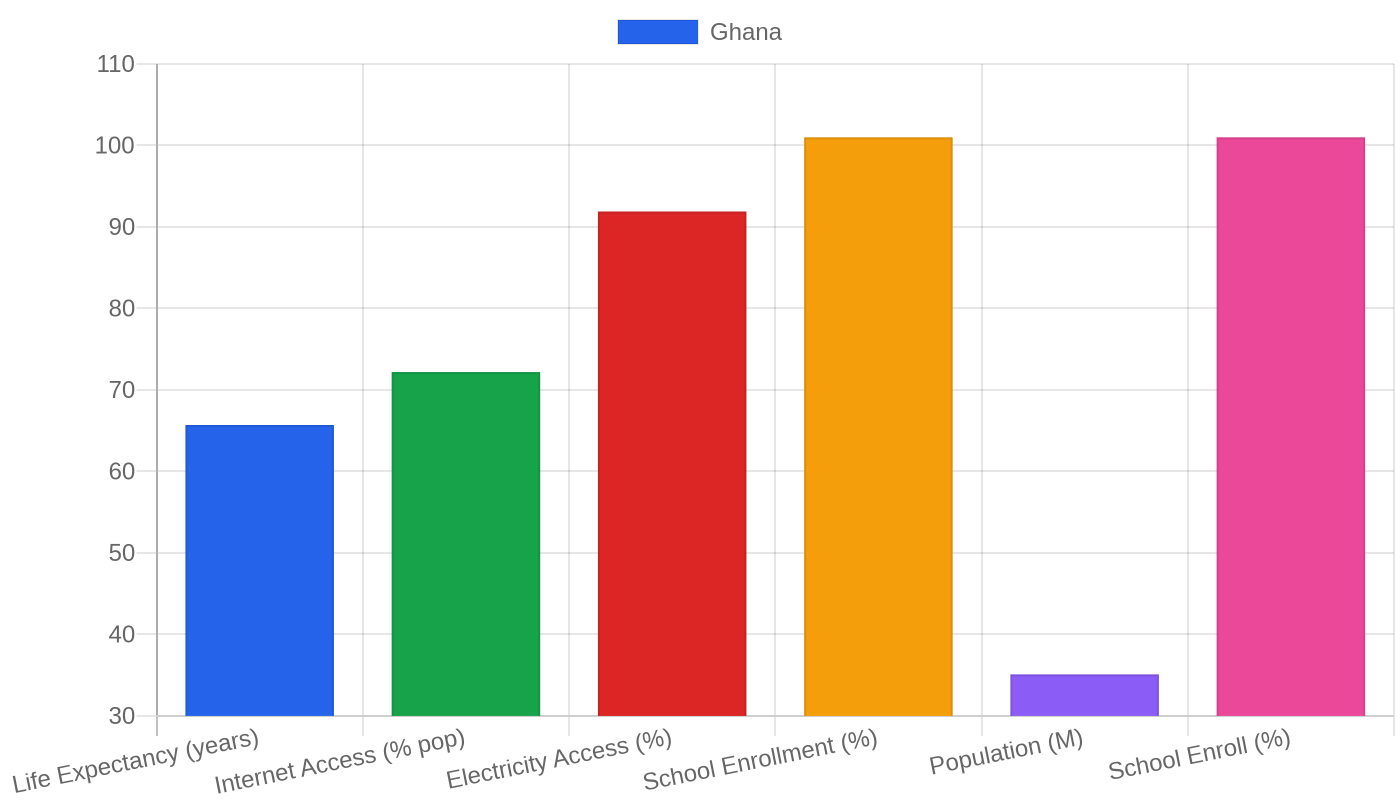
These figures highlight the disparity between aggregate national wealth and individual income levels across the population of 35 million. Furthermore, the unemployment rate is exceptionally low at just under 3%, suggesting that labor supply is tight and businesses are competing for workers, which could further fuel wage-driven inflation.
Understanding these dynamics is crucial: the high growth rate is not occurring in a vacuum but rather amidst a challenging environment where price stability remains elusive for consumers and investors alike.
Cost of Living and Housing Realities
For residents and expatriates alike, the cost of living in Ghana is heavily influenced by the prevailing inflationary environment. With CPI figures sitting above 14%, daily expenses for food, energy, and transportation are likely seeing substantial year-over-year increases. Although specific rental or housing purchase data is not provided in the current dataset, the high inflation rate implies that real estate costs, both for renting and buying, are likely tracking upward significantly.
In a market where GNI per capita is relatively modest at $2,630, households must allocate a larger portion of their income toward basic necessities compared to regions with lower inflation. This pressure extends beyond shelter; general consumer goods prices are rising, affecting everything from utility bills to grocery shopping.
Consequently, financial planning for individuals in Ghana requires careful attention to budgeting, as the gap between nominal wages and the actual cost of maintaining a standard of living widens. The absence of detailed housing indices means that prospective residents should anticipate higher entry costs and ongoing expense volatility, making savings and investment strategies more critical than ever.
Investment Landscape and Corporate Giants
The corporate sector in Ghana offers diverse opportunities, particularly in industries that serve both local consumption and international trade. The business environment is characterized by a mix of heavy industry and service-oriented enterprises. In the basic materials sector, companies like Ashanti Goldfields Corporation and African Champion Industries play pivotal roles, leveraging Ghana’s natural resources to drive export revenue and domestic supply chains.
Simultaneously, the consumer services sector is vibrant, represented by major aviation firms such as Aerogem Aviation, Afra Airlines, Africa World Airlines, and Antrak Air, which facilitate connectivity and tourism. The banking and financial services sector also features prominent institutions like AmalBank and the Agricultural Development Bank of Ghana, providing essential capital for various economic activities.
Additionally, consumer goods manufacturers such as Accra Brewery Company contribute to the industrial base, catering to the domestic market’s needs. For investors, these sectors offer a glimpse into an economy that is balancing resource extraction with service modernization.
The presence of established players in aviation and finance suggests a mature infrastructure supporting business operations, although the high inflationary context requires careful risk assessment regarding operational costs and profit margins.
Safety, Politics, and Social Fabric
Ghana maintains a reputation for political stability and social cohesion, which serves as a foundation for its economic resilience. Politically, the country operates as a unitary presidential constitutional democracy with a parliamentary multi-party system. Since the establishment of the Fourth Republic in January 1993, following the transition from military rule, Ghana has alternated power between two dominant parties: the National Democratic Congress (NDC) and the New Patriotic Party (NPP).
This structured democratic process, enshrined in the 1992 constitution, ensures a separation of powers among the executive, legislative, and judicial branches, with the President serving as commander-in-chief of the Ghana Armed Forces. Regarding safety, specific crime and safety indices are currently listed as N/A, meaning precise statistical comparisons cannot be made. However, the historical political continuity and lack of recent civil unrest suggest a generally stable security environment.
Quality of life indicators are implicitly tied to the economic data; while the low unemployment rate of 2.98% indicates broad job availability, the high inflation rate poses a challenge to overall well-being. Residents benefit from a predictable political calendar, even as they navigate the economic pressures associated with rising prices.
Current Affairs and Policy Directions
The immediate economic narrative in Ghana is defined by the tension between strong macroeconomic growth and persistent price instability. Policymakers are likely focused on curbing the 14.2% inflation rate without stifling the projected 5.95% GDP growth. The tight labor market, evidenced by the sub-3% unemployment rate, may necessitate wage adjustments that could further complicate inflation control efforts.
Businesses, from agricultural banks to aviation firms, are adapting to this environment by optimizing supply chains and managing currency risks. The dominance of the NDC and NPP suggests that any new economic reforms will likely be debated within a robust democratic framework, ensuring transparency but potentially slowing rapid policy shifts. Investors are watching closely to see how the government balances fiscal discipline with social welfare, especially given the GNI per capita of $2,630.
The focus now is on sustainable growth that translates into tangible improvements for the average citizen, rather than just aggregate GDP numbers. As the year progresses, the interplay between monetary policy and industrial output will determine whether Ghana can achieve a “soft landing” for its economy.
The Bottom Line
Ghana presents a compelling case for observers interested in emerging markets with strong democratic foundations and active industrial sectors. The combination of near-6% GDP growth and low unemployment highlights a dynamic economy, albeit one grappling with significant inflationary pressures. Investors and analysts should monitor the interplay between the dominant political parties and the central bank’s response to price stability.
Ultimately, Ghana’s ability to sustain its growth trajectory while improving living standards through controlled inflation will define its next economic chapter.
Sources & Methodology
This article is authored by Economic Pulse Net for informational and research purposes. Economic Pulse Net sources its data from multilateral institutions, national statistics bureaus, and proprietary databases. All data is believed to be current as of the date of publication.
Published: October 29, 2026 | Category: Research — Ghana
Use these signals in your own platform
Economic Pulse publishes its live signal feed through a documented, read-only API. Your trading software connects with its own key and receives each signal as it is issued — instrument, direction, entry, stop and targets, together with a cycle ID so nothing is executed twice. The feed is independent of this website and cannot change it.
Signals are informational only and are not financial advice.