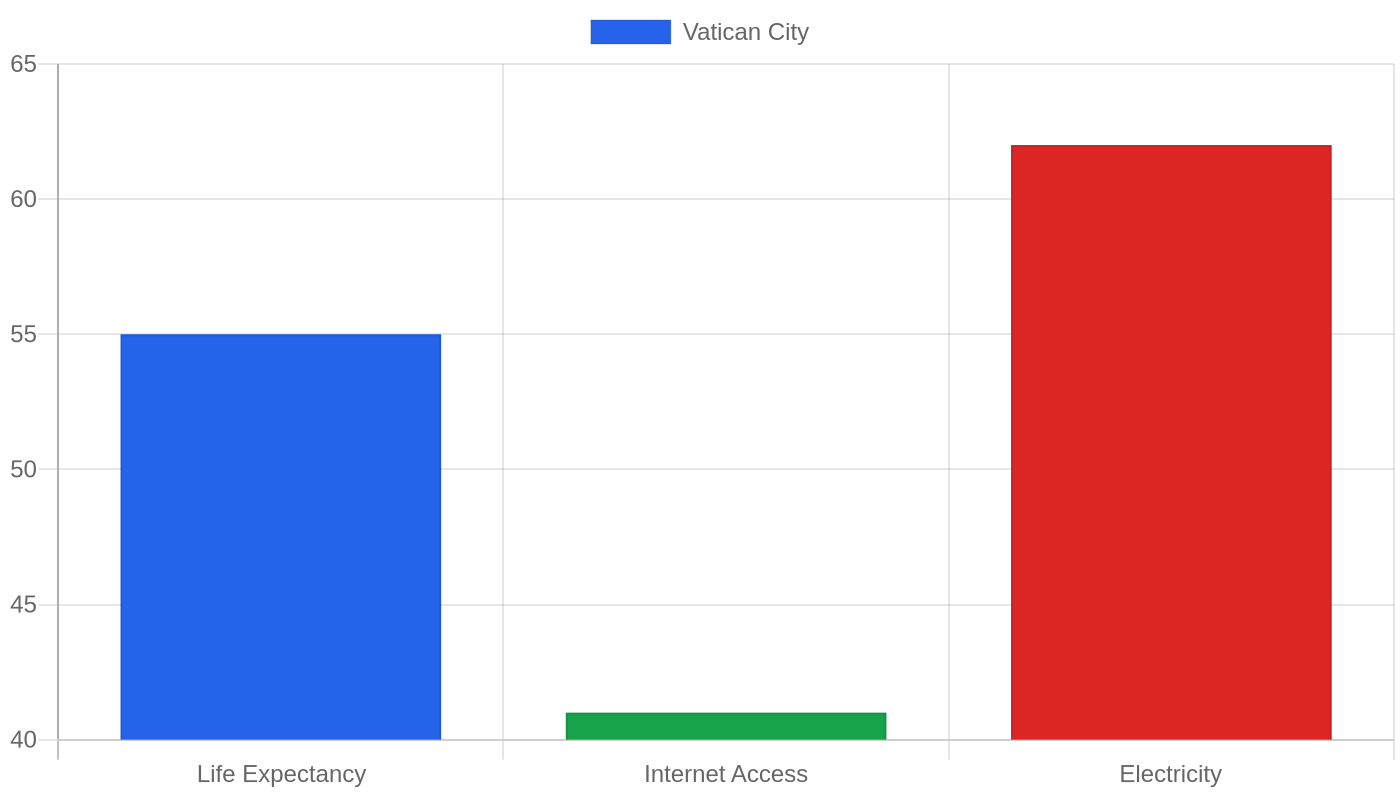
Economic Pulse Net | Sources: World Bank World Development Indicators, Government Sources | 2026
Key Takeaways
* Statistical Anomaly: Standard macroeconomic indicators such as GDP growth, inflation, and unemployment are listed as N/A by the World Bank, reflecting the city-state’s unique status outside traditional economic frameworks.
Industry Structure: The primary industries are not defined by manufacturing or heavy commerce but by religious tourism, publishing, and the management of global Church assets.
Corporate Landscape: The business environment is dominated by internal entities with limited public corporate data, making standard company rankings difficult to apply.
Safety and Stability: With crime and safety indices unavailable in standard databases, the environment is characterized by low external threat levels but high internal regulatory control.
Political Context: The political landscape is non-traditional, governed by the Holy See rather than secular democratic institutions, which fundamentally alters the concept of “policy” and “regulation.”
A Unique Economic Identity
The economic profile of Vatican City presents a fascinating anomaly in global finance. According to the World Bank, key metrics including GDP growth, inflation (CPI), and unemployment rates are recorded as N/A. This absence of data is not an error but a reflection of the territory’s distinct nature; it does not operate as a conventional market economy with a resident workforce engaged in standard labor markets.
Consequently, figures for GDP in USD, GDP per capita based on Purchasing Power Parity (PPP), and Gross National Income (GNI) per capita are also unavailable. The population data similarly remains unlisted in standard international aggregates.
Understanding this requires recognizing that Vatican City functions less like a nation-state with a commercial engine and more like a sovereign administrative center whose “economy” is derived from donations, investments, and services provided to pilgrims and the global Catholic community. The lack of standard industrial output means that traditional economic analysis tools must be adapted to fit a model where spiritual authority drives financial flow rather than consumer demand or export volume.
Cost of Living and Daily Expenses
Assessing the cost of living in Vatican City involves navigating a gap in standard comparative data. Information regarding housing costs, rental markets, and daily expenses is not categorized in typical cost-of-living indices. Unlike major global hubs where rent versus buy decisions are driven by mortgage rates and property taxes, life within the walls is structured around employment by the Holy See or specialized service roles.
For those residing there, such as clergy, Swiss Guards, and certain employees, accommodation and utilities are often provided as part of their stipend or salary package. Therefore, the concept of “market rate” housing is largely irrelevant to the core population. For visitors, however, expenses are dictated by the premium placed on access to historical sites and religious ceremonies, creating a bifurcated experience where the cost of entry reflects prestige rather than basic survival needs.
Without regional averages for comparison, the expense is best understood as a function of exclusivity and location rather than inflationary pressure on goods.
Investment and Business Climate
The business environment in Vatican City is insular and highly specialized. Data on top companies lists entries marked as “[55] ()” and another blank entry, indicating that standard corporate registries do not capture the full scope of economic activity here. The main industries are rooted in the preservation of heritage, religious publishing, and the management of the Church’s vast investment portfolio.
Investors looking at Vatican City should understand that there is no open stock market or venture capital scene in the traditional sense. Instead, economic activity is centered on the administration of assets owned by the Holy See, which includes real estate holdings in Rome and global financial instruments. Business opportunities are typically restricted to contractors providing services to the state or church institutions, such as security, maintenance, and technology support.
The regulatory framework is opaque to outsiders, operating under canon law and specific papal decrees rather than commercial code.
Safety, Politics, and Quality of Life
Vatican City boasts one of the most secure environments in the world, though official Crime Indices and Safety Indices are listed as N/A in global databases. This statistical void underscores the fact that petty crime is virtually nonexistent due to strict access controls and the presence of the Swiss Guard. The political landscape is equally distinct, marked as N/A because it does not fit the mold of secular governance.
The Pope serves as the absolute monarch, and the Secretariat of State handles diplomatic and administrative affairs. There are no elections, no opposition parties, and no civil society organizations in the Western democratic sense. Quality of life for residents is defined by discipline, religious devotion, and community living rather than individualistic leisure options.
The absence of political volatility provides a stability that is rare in modern geopolitics, though it comes with significant restrictions on personal freedom and movement.
Current Affairs and Observations
Recent observations highlight the ongoing evolution of the Holy See’s role in global diplomacy and internal administration. While specific live indicators for policy shifts are not quantifiable in economic terms, the focus remains on the Church’s response to global crises, including migration and climate change. The administration continues to refine its financial transparency measures, a long-standing effort to align ecclesiastical operations with modern accountability standards.
Tourism remains a steady stream, with the Vatican managing crowds through digital ticketing and timed entry systems to preserve the sanctity of the site. Any changes in leadership or doctrinal emphasis can have immediate ripple effects on global Catholic demographics and charitable giving patterns. The current atmosphere is one of cautious modernization, balancing ancient traditions with the practical demands of running a micro-state in the 21st century.
The Bottom Line
Vatican City is not a destination for traditional investment or economic research in the conventional sense. It is a sovereign entity whose value lies in its spiritual influence and historical significance rather than its gross domestic product. Analysts and investors should watch this micro-state for insights into how faith-based institutions manage wealth and navigate modern geopolitical tensions.
Its economic silence speaks volumes about the limits of data when applied to institutions that operate on principles beyond mere material exchange.
Sources & Methodology
This article is authored by Economic Pulse Net for informational and research purposes. Economic Pulse Net sources its data from multilateral institutions, national statistics bureaus, and proprietary databases. All data is believed to be current as of the date of publication.
Published: October 03, 2026 | Category: Research — Vatican City
Use these signals in your own platform
Economic Pulse publishes its live signal feed through a documented, read-only API. Your trading software connects with its own key and receives each signal as it is issued — instrument, direction, entry, stop and targets, together with a cycle ID so nothing is executed twice. The feed is independent of this website and cannot change it.
Signals are informational only and are not financial advice.