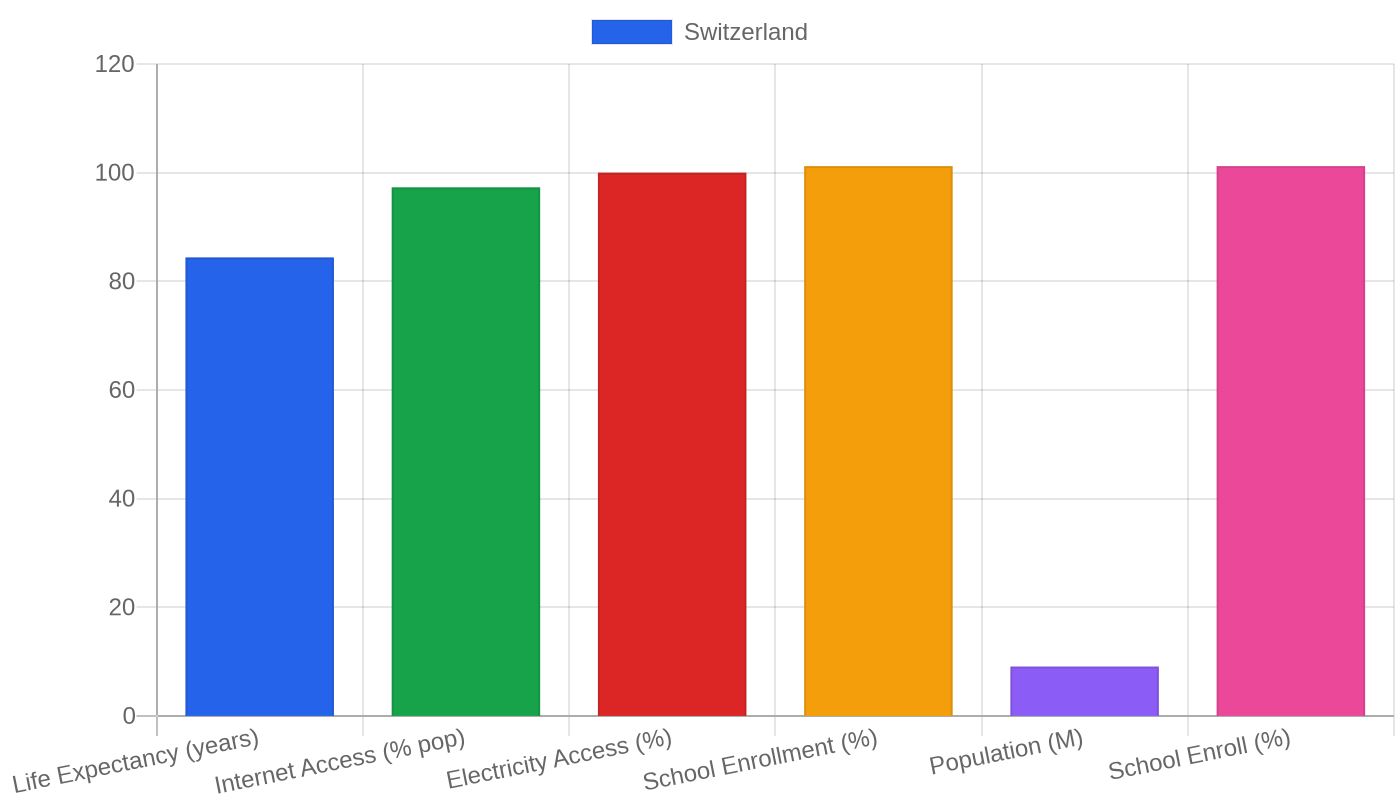
Economic Pulse Net | Sources: World Bank World Development Indicators, Government Sources | 2026
Key Takeaways
– Switzerland’s economy grew at a modest 1.3% in 2025, reflecting steady but unspectacular expansion in a mature, high-income economy.
– Inflation stands at an astonishingly low 0.15%, one of the lowest rates in the developed world, giving policymakers rare breathing room.
– Unemployment remains low at 4.87%, signaling a tight labor market that supports household spending and social stability.
– The country’s GDP per capita exceeds $102,500 on a PPP basis, placing it among the world’s wealthiest nations by purchasing power.
– Despite strong democratic institutions, electoral participation remains a noted weakness, according to the International IDEA’s Global State of Democracy indices.
The Swiss Economic Engine — Slow, Steady, and Exceptionally Rich
Switzerland’s economic narrative is not one of breakneck growth but of remarkable resilience and wealth preservation. According to the World Bank, the country posted GDP growth of 1.30% in 2025 — a figure that would disappoint in emerging markets but represents a healthy, sustainable pace for a mature economy already operating near full capacity.
The absolute size of the economy, over $1.04 trillion in nominal GDP, underscores Switzerland’s outsized global footprint relative to its population of just 9.09 million people.
What truly sets Switzerland apart is its inflation picture. The World Bank reports consumer price inflation at just 0.15% in 2025. This is not deflation, which can signal economic distress, but rather a state of near-perfect price stability. For Swiss households and businesses, this means predictable costs, preserved purchasing power, and minimal erosion of savings. The Swiss National Bank, which has long prioritized price stability, appears to have achieved something close to its ideal scenario.
This low-inflation environment also gives the central bank flexibility to support growth without the fear of overheating.
Unemployment stands at 4.87%, according to the World Bank — a figure that would be considered full employment in most economies. This low jobless rate, combined with high wages and strong social safety nets, creates a virtuous cycle of consumer confidence and domestic demand. The labor market’s tightness does pose challenges for employers seeking skilled workers, but it also forces productivity-enhancing investments in automation and training.
Switzerland’s main industries — which span precision manufacturing, pharmaceuticals, financial services, and high-end consumer goods — benefit from this skilled, stable workforce. The country has effectively built an economic model that prioritizes quality over quantity, value over volume.
The Cost of Living Premium — What $102,000 Per Person Actually Buys
Switzerland’s GDP per capita of $102,513 on a PPP basis, as reported by the World Bank, is among the highest globally. But this headline figure masks a complex reality: high incomes are necessary because the cost of living is extraordinarily high. Housing, in particular, represents a significant burden. In major cities like Zurich, Geneva, and Basel, rental prices are among the steepest in Europe, driven by limited land availability, strict zoning regulations, and a preference for renting over owning.
The homeownership rate in Switzerland is one of the lowest in the developed world, hovering around 40%, as high property prices and substantial down payment requirements make purchasing prohibitive for many.
Daily expenses — from groceries to transportation to healthcare — carry a premium that reflects the country’s high wage structure and strong currency. A meal at a mid-range restaurant, a monthly public transport pass, or even a simple coffee can cost double what it would in neighboring countries. However, the high incomes and low inflation mean that for those employed, these costs are manageable.
The Swiss have built a society where the high cost of living is offset by high quality of life, excellent public services, and a currency that holds its value. For expatriates and newcomers, the sticker shock is real, but the trade-off is access to one of the world’s most stable, clean, and efficient environments.
Business and Investment — The Home of Giants and Niche Champions
Switzerland’s corporate landscape is a study in contrasts. The country hosts global industrial titans like ABB, a leader in robotics and electrification, and Alcon, a major force in eye care. The health care sector is particularly strong, with companies like Actelion — known for its pulmonary arterial hypertension treatments — and Alcon demonstrating Swiss prowess in life sciences. The consumer goods sector features names like A.
Favre & Fils and Alchimie Forever, reflecting a tradition of luxury and precision. ALSO Holding represents the technology sector, while Alpiq anchors the utilities space. Even the financial sector has an alternative player: Alternative Bank Switzerland, which focuses on ethical and sustainable banking.
For investors, Switzerland offers a stable, predictable business environment with strong rule of law, low corporate tax rates in many cantons, and a highly educated workforce. The country’s political neutrality and longstanding tradition of direct democracy provide a level of policy stability that is rare in a volatile world.
Key sectors to watch include pharmaceuticals, where Swiss companies continue to innovate; precision manufacturing, which benefits from the country’s reputation for quality; and sustainable finance, where Switzerland is positioning itself as a global hub. The presence of companies like Allseas in oil and gas also indicates that Switzerland remains relevant in traditional energy, even as the world transitions.
The business climate is characterized by discretion, long-term thinking, and a resistance to short-termism — values that align well with the Swiss economic model.
Safety, Democracy, and the Quality of Life Paradox
Switzerland consistently ranks among the world’s safest and most democratic countries. According to the International IDEA’s Global State of Democracy (GSoD) Indices and Democracy Tracker, Switzerland performs in the high range on overall democratic measures. The country’s system of direct democracy — where citizens can vote on specific policies and laws — is a model of participatory governance. However, the same report identifies a particular weakness in electoral participation.
This is a curious paradox: a nation with extraordinary democratic tools at its disposal, yet a citizenry that sometimes chooses not to use them. Voter turnout in national elections has historically been lower than in many other European democracies, suggesting a degree of political contentment or apathy.
In terms of safety, Switzerland is exceptionally secure. Violent crime is rare, and the country’s police forces are efficient and trusted. The quality of life extends beyond safety: clean air, efficient public transport, excellent healthcare, and a strong education system all contribute to high levels of well-being. The Swiss also benefit from a culture of civic responsibility and social trust. Neighbors know each other, community associations are active, and the social fabric is strong.
This combination of material wealth, personal safety, and social cohesion makes Switzerland a benchmark for quality of life — even if the cost of entry is high.
Current Affairs — The Challenges of Perfection
For all its strengths, Switzerland in 2026 faces several pressing issues. The low inflation rate of 0.15%, while enviable, raises questions about whether the economy is too cautious. Some economists worry that near-zero inflation could tip into deflation if global demand weakens, potentially discouraging spending and investment. The Swiss National Bank must navigate this delicate balance without the cushion of higher inflation that other central banks enjoy.
Meanwhile, the tight labor market at 4.87% unemployment creates pressure on businesses to raise wages, which could eventually feed into services inflation — though there is little sign of that yet.
Politically, the weakness in electoral participation flagged by International IDEA is prompting soul-searching among policymakers. Efforts to increase voter engagement, particularly among younger citizens and expatriates, are ongoing. The country’s direct democracy system, while robust, can also lead to decision-making paralysis on complex issues, as frequent referendums slow the pace of reform.
On the economic front, Switzerland must also contend with the strength of the Swiss franc, which makes exports more expensive and challenges the competitiveness of its manufacturing and tourism sectors. The country’s main industries — from precision instruments to pharmaceuticals — are high-value enough to absorb some currency pressure, but the margin for error is thin.
As the global economy shifts toward digitalization, green energy, and new trade blocs, Switzerland’s model of slow, consensus-driven change faces its biggest test in decades.
The Bottom Line
Switzerland remains a beacon of stability, wealth, and democratic governance in an increasingly turbulent world. For investors seeking a safe harbor, businesses requiring a predictable regulatory environment, or individuals prioritizing quality of life, it is hard to beat. However, the very factors that make Switzerland successful — caution, consensus, and conservatism — also make it vulnerable to disruption.
The country’s low inflation and low unemployment are strengths today, but they could become constraints tomorrow. Anyone watching Switzerland should do so not for dramatic headlines, but for the quiet, incremental decisions that will determine whether this Alpine powerhouse can adapt its model of perfection to a rapidly changing world.
Sources & Methodology
This article is authored by Economic Pulse Net for informational and research purposes. Economic Pulse Net sources its data from multilateral institutions, national statistics bureaus, and proprietary databases. All data is believed to be current as of the date of publication.
Published: July 20, 2026 | Category: Research — Switzerland
Use these signals in your own platform
Economic Pulse publishes its live signal feed through a documented, read-only API. Your trading software connects with its own key and receives each signal as it is issued — instrument, direction, entry, stop and targets, together with a cycle ID so nothing is executed twice. The feed is independent of this website and cannot change it.
Signals are informational only and are not financial advice.