Economic Pulse Net | Sources: World Bank World Development Indicators, Government Sources | 2026
🇨🇭 Switzerland 2026 — The Alpine Fortress of Stability in a Fracturing World
Switzerland has long occupied a peculiar place in the global imagination: a small, landlocked nation that punches far above its weight in banking, pharmaceuticals, and precision engineering. But in an era of geopolitical turbulence, rising debt burdens, and inflationary shocks across Europe, the Swiss model is being tested in ways it hasn’t been for decades.
The latest data paints a picture of an economy that is remarkably steady — almost stubbornly so — but questions linger about whether that stability is a strength or a sign of complacency.
Key Takeaways
– Switzerland’s inflation rate sits at a barely perceptible 0.15%, the lowest among major European economies and a stark contrast to the cost-of-living crises gripping much of the continent.
– Unemployment stands at 4.87%, a figure that remains historically low by European standards and reflects the country’s resilient labor market.
– With a GDP of roughly $1.04 trillion and a GDP per capita (PPP) of over $102,500, Switzerland remains one of the wealthiest nations on Earth by virtually any measure.
– The country’s democratic credentials are strong, though international observers flag weaknesses in electoral participation — a paradox for a nation famous for its direct democracy.
– A diverse corporate base spanning industrials, healthcare, technology, and financials continues to anchor Switzerland’s global competitiveness.
An Economy That Refuses to Blow Off Steam
Switzerland’s latest economic data reads like a calm day on Lake Geneva. Inflation, as measured by the consumer price index, stands at just 0.154%, according to World Bank figures — a rate so low it would trigger deflation alarms in most central banking corridors. For Swiss households, this means purchasing power has remained remarkably intact at a time when consumers in neighboring Germany, France, and Italy have watched grocery bills and energy costs spiral.
The country’s unemployment rate of 4.873% is similarly reassuring, sitting well below the eurozone average and suggesting that employers remain confident enough to retain and hire workers. With a total GDP of approximately $1.04 trillion, Switzerland’s economy is larger than many observers intuitively assume — it is not merely a boutique financial center but a full-fledged industrial and technological powerhouse.
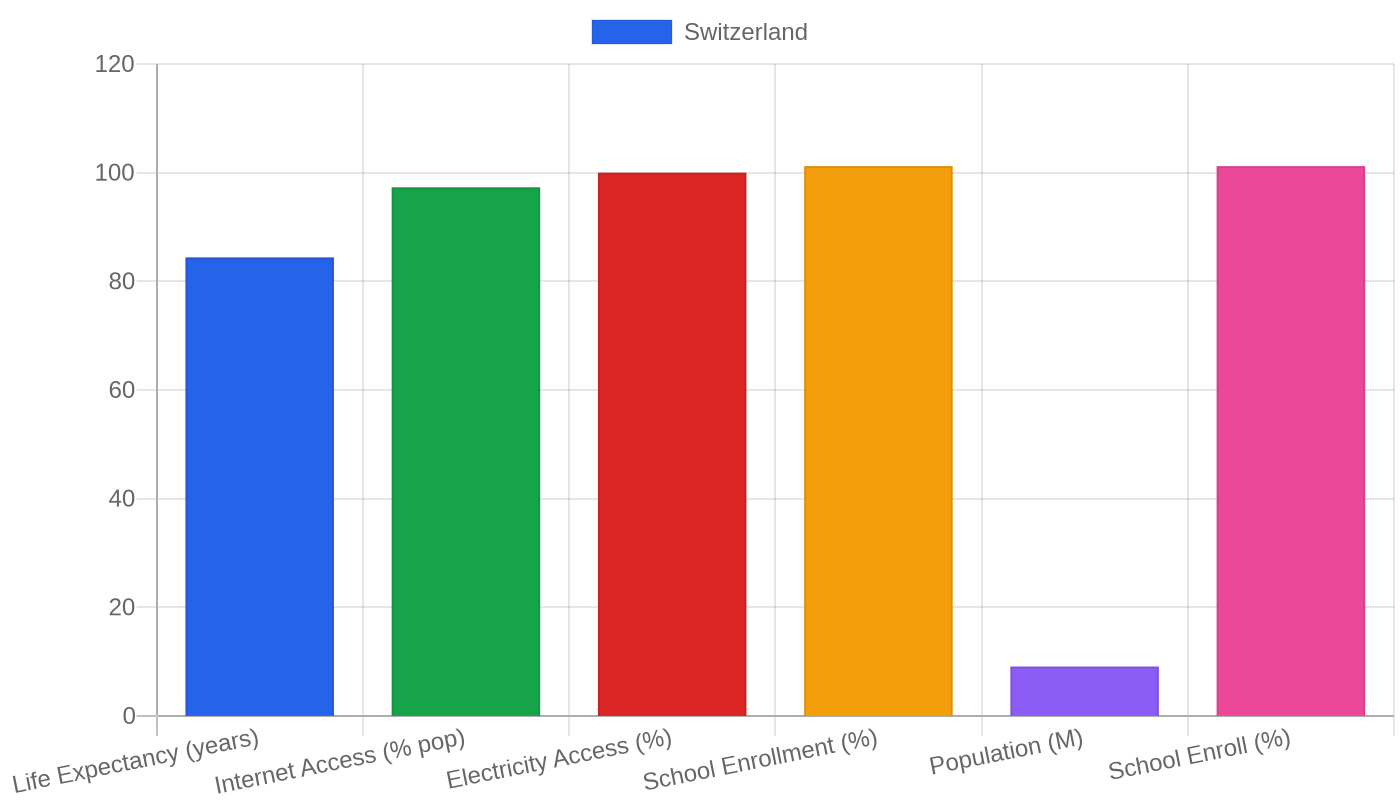
GDP per capita on a purchasing-power-parity basis exceeds $102,500, while gross national income per capita reaches $110,330, placing Switzerland in an exclusive club of nations where broad-based prosperity is the norm rather than the exception. The country’s population of just over 9 million means this wealth is concentrated among a relatively small citizenry, amplifying the per-capita effect.
What the headline numbers cannot capture, however, is the structural challenge beneath the surface: an economy this stable can also be an economy that struggles to generate the kind of dynamic growth that emerging competitors in Asia and the Middle East are now delivering. The World Bank’s data does not provide a current GDP growth figure, leaving analysts to infer that Switzerland’s expansion is likely modest — consistent with a mature, high-income economy navigating a slow-growth global environment.
The Cost of Living: Premium Prices, Premium Stability
Switzerland is famously expensive, and nothing in the available data contradicts that reputation. While the World Bank dataset provided does not include granular cost-of-living indices, the country’s extraordinary GNI per capita of $110,330 tells its own story: Swiss consumers earn enough to sustain some of the highest price levels in Europe, from Zurich’s famously pricey rental market to the cost of a simple coffee in Geneva.
The near-zero inflation rate of 0.154% is a critical mitigating factor — unlike households in the United Kingdom or parts of Eastern Europe, Swiss residents are not watching their real incomes erode month by month. Rental markets in major cities like Zurich, Geneva, and Basel remain tight, driven by limited housing supply, strict zoning regulations, and sustained demand from international workers drawn to the country’s financial and pharmaceutical sectors.
Compared to regional averages across Western Europe, Swiss housing costs are significantly higher in absolute terms, though the gap narrows considerably when adjusted for local wages. The practical result is a two-tier experience: long-term residents with rent-controlled leases enjoy remarkable stability, while newcomers and young professionals face steep entry costs.
Daily expenses — groceries, transport, dining — remain among the highest in the world, but so too does the quality of public infrastructure, healthcare, and education that those taxes and prices help fund.
A Corporate Landscape Built for Resilience
Switzerland’s corporate roster is a study in diversification. ABB, the industrial automation and electrification giant, represents the country’s deep engineering heritage and its pivot toward energy transition technologies. Alcon, the eye-care specialist, and Actelion, the biopharmaceutical firm, underscore Switzerland’s status as a global hub for life sciences — a sector anchored by the broader presence of pharma giants in Basel.
Alpiq and Alternative Bank Switzerland reflect the country’s evolving energy and financial landscapes, with the latter signaling growing demand for ethical and sustainable banking. ALSO Holding, a technology distribution and services company, highlights Switzerland’s quiet but significant role in European IT infrastructure. Consumer goods players like A. Favre & Fils and Alpa point to a manufacturing base that extends beyond heavy industry into niche, high-value products.
Allseas, active in offshore oil and gas installation, demonstrates that Swiss companies operate globally even when their home market is landlocked. For investors, the message is clear: Switzerland offers exposure to stable, well-regulated sectors with strong intellectual property protection and a business environment consistently ranked among the world’s most competitive.
The absence of detailed industry-level data in the current dataset is a limitation, but the corporate names alone reveal a economy that has successfully moved up the value chain.
Democracy, Safety, and the Swiss Paradox
International IDEA’s Global State of Democracy indices place Switzerland in the high range on overall democratic measures — a finding that will surprise no one familiar with the country’s legendary referenda and citizen assemblies. Yet the same assessment flags particular weaknesses in electoral participation, a paradox for a nation whose political identity is built on direct democracy.
The explanation likely lies in the frequency of votes — Swiss citizens are called to the ballot box several times a year on everything from tax rates to immigration policy — which can breed fatigue even among the most civically minded populations.
On crime and safety, the World Bank dataset does not provide a crime index or safety index for Switzerland, but the country’s broader reputation for low crime rates, well-funded policing, and social cohesion is consistent with its high quality-of-life indicators. The political landscape remains stable, dominated by a consensus-oriented multi-party system that avoids the polarization seen in many neighboring countries.
For businesses and families alike, Switzerland’s combination of political predictability, personal safety, and world-class public services remains a powerful draw — even if the price of admission is high.
What’s Happening Now: Stability Under the Microscope
Switzerland’s current moment is defined less by crisis than by scrutiny. With inflation at 0.154%, the Swiss National Bank faces a different challenge than its counterparts in Frankfurt or London: the risk of undershooting its price stability mandate rather than overshooting it. The country’s unemployment rate of 4.873% remains healthy, but economists are watching for signs of softening in export-dependent sectors as global demand cools.
The corporate landscape is shifting: ABB continues to reposition itself around electrification and automation, while Alcon and Actelion navigate the complex dynamics of global healthcare markets. Alternative Bank Switzerland’s prominence in the top-company list reflects a broader trend of Swiss capital flowing toward sustainable and ethical investments — a shift that could reshape Zurich’s financial identity over the coming decade.
International IDEA’s findings on electoral participation have sparked domestic debate about whether Switzerland’s direct democracy model needs modernization to engage younger voters. Meanwhile, the country’s energy sector, represented by Alpiq, is grappling with the same questions facing all of Europe: how to secure supply, meet climate targets, and keep prices affordable.
The absence of a current GDP growth figure in the World Bank data leaves a gap in the near-term picture, but the surrounding indicators suggest an economy that is holding steady rather than surging.
The Bottom Line
Switzerland in 2026 is not a story of dramatic transformation — it is a story of remarkable resilience. For investors, the country offers a rare combination of low inflation, low unemployment, and high per-capita wealth, wrapped in a political system that prizes stability above all.
For policymakers elsewhere, Switzerland is both an aspiration and a cautionary tale: its model works precisely because it is difficult to replicate, built on centuries of institutional trust, a highly educated workforce, and a cultural willingness to compromise. Watch Switzerland not for fireworks, but for signals — how it manages its energy transition, whether it can reinvigorate democratic participation, and whether its corporate champions can keep pace with a rapidly changing global economy.
In a world of noise, the Alpine fortress remains a quiet but consequential player.
Sources & Methodology
This article is authored by Economic Pulse Net for informational and research purposes. Economic Pulse Net sources its data from multilateral institutions, national statistics bureaus, and proprietary databases. All data is believed to be current as of the date of publication.
Published: September 23, 2026 | Category: Research — Switzerland
Use these signals in your own platform
Economic Pulse publishes its live signal feed through a documented, read-only API. Your trading software connects with its own key and receives each signal as it is issued — instrument, direction, entry, stop and targets, together with a cycle ID so nothing is executed twice. The feed is independent of this website and cannot change it.
Signals are informational only and are not financial advice.