Economic Pulse Net | Sources: World Bank World Development Indicators, Government Sources | 2026
Key Takeaways
* Moderate Growth with High Prosperity: Sweden is projected to see a GDP growth of approximately 1.54% in 2025, maintaining a robust GDP per capita (PPP) of over $72,500 despite global headwinds.
Labor Market Pressures: With an unemployment rate hovering near 8.7%, the nation faces challenges in integrating labor into its high-value industrial and service sectors.
Price Stability: Inflation remains exceptionally low at roughly 0.68%, offering consumers stability but potentially signaling weak domestic demand.
Unique Civic Culture: The country’s political landscape is defined by deep-rooted “popular movements” that continue to shape social policy and civic engagement.
Diverse Industrial Base: From biotech giants like 3H Biomedical to consumer brands such as Acne Studios, Sweden’s corporate ecosystem spans healthcare, technology, and lifestyle goods.
Economic Pulse: Navigating Moderate Expansion
Sweden’s economy in 2025 presents a picture of cautious stability rather than explosive growth. According to World Bank data, the nation’s GDP growth is projected at 1.54316373266217% for the year, a figure that reflects a mature economy adjusting to post-pandemic realities and shifting global trade dynamics. While this growth rate may appear modest compared to emerging markets, it underscores the resilience of a highly developed industrial base.
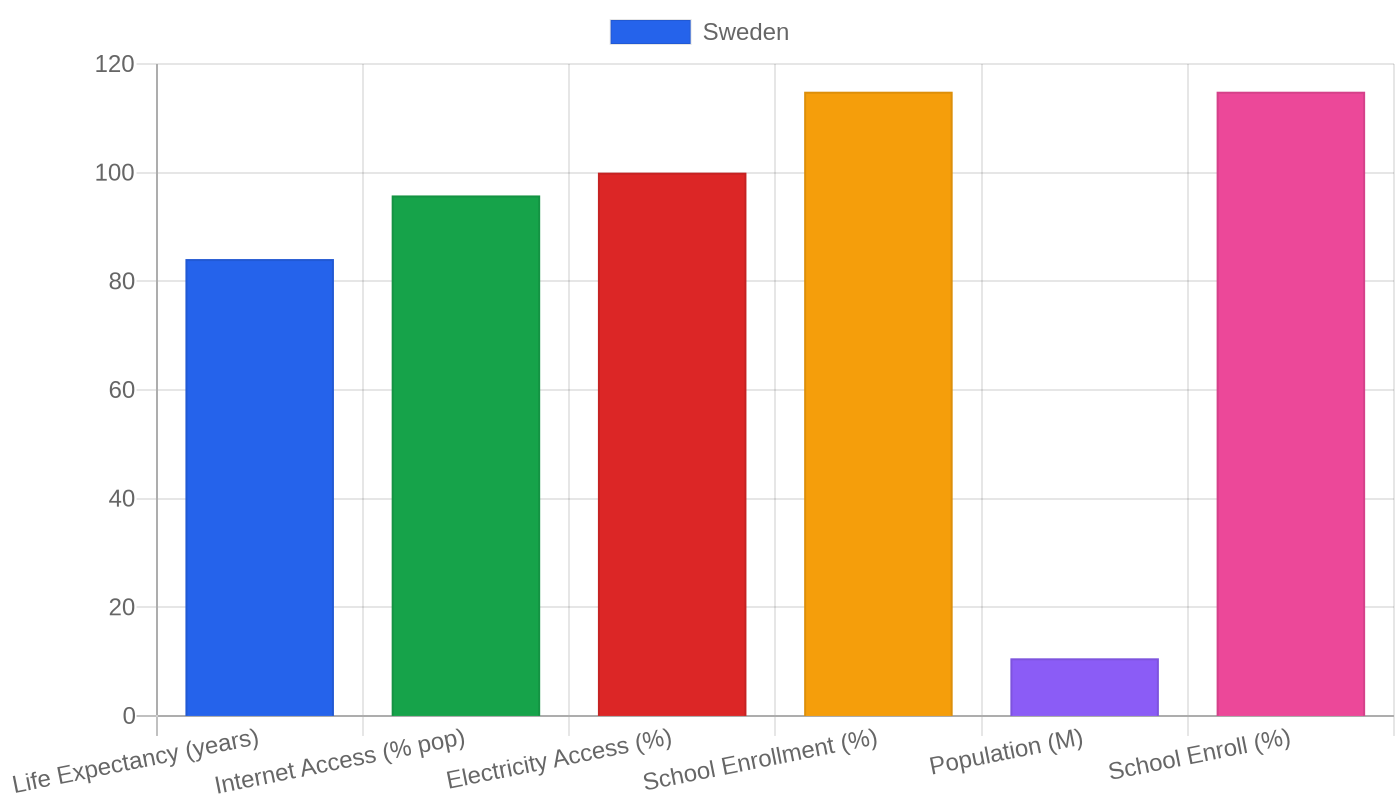
The total GDP stands at approximately $669 billion USD, supporting a population of just over 10.5 million people. This demographic size allows for significant wealth distribution, evidenced by a GNI per capita of $63,010 and a staggering GDP per capita (PPP) of $72,528.89. These figures indicate that while the aggregate economy is growing steadily, individual purchasing power remains among the highest globally.
However, the labor market tells a more complex story; an unemployment rate of 8.694% suggests that structural mismatches between worker skills and industry needs are persisting. For policymakers, the challenge lies not in stimulating massive expansion, but in ensuring that this moderate growth translates into broader employment opportunities.
The low inflation rate of 0.679869285243995% further complicates the narrative; while price stability is beneficial for consumers, it can also indicate subdued consumption, requiring careful monetary calibration to prevent economic stagnation.
Cost of Living: Affordability in a High-Income Society
For residents and expatriates alike, Sweden offers a unique cost-of-living dynamic driven by its high income levels and regulated market structures. With a GDP per capita (PPP) exceeding $72,500, the average Swedish household possesses substantial financial capacity to absorb daily expenses.
However, the extremely low inflation rate of less than 0.68% suggests that essential goods and services have seen minimal price increases recently, providing a buffer against the cost-of-living crises affecting many other Western nations. Housing costs, while historically high in major urban centers like Stockholm, are tempered by strong tenant protections and government subsidies that keep rent burdens manageable relative to income.
Daily expenses, from groceries to public transportation, remain predictable due to the stable CPI, allowing for long-term financial planning without the volatility seen in higher-inflation economies. Compared to regional averages in Northern Europe, Sweden maintains a balance where high wages offset the premium prices often associated with Nordic living.
This equilibrium ensures that while the initial setup costs for establishing a life in Sweden can be steep, the ongoing maintenance of that lifestyle is financially sustainable for the majority of the workforce. The result is a society where quality of life is not strictly gated by extreme wealth, but supported by a systemic approach to affordability that prioritizes social welfare and market stability.
Investment & Business Climate: A Hub for Innovation and Industry
The Swedish business environment is characterized by a diverse array of top-tier companies driving innovation across multiple sectors. In the healthcare space, firms like 3H Biomedical are pushing boundaries in medical technology, reflecting Sweden’s strength in scientific research and development. Meanwhile, the consumer goods sector remains vibrant, with established names such as AarhusKarlshamn, Abba Seafood, and ABU Garcia leveraging global supply chains to maintain international presence.
The fashion and lifestyle industry continues to exert soft power through brands like Acne Studios, which command premium positions in global markets. Technology is another critical pillar, with companies like Acando and Adtraction facilitating digital transformation for both local and international clients. Industrials play a foundational role, represented by AFRY, which provides engineering and consultancy services essential for infrastructure projects.
Energy security and utility management are handled by entities like AGA, ensuring that industrial operations remain uninterrupted. Additionally, the retail and consumer services landscape is served by major players such as Åhléns, catering to domestic consumption patterns. This mix of traditional industries and modern tech firms creates a resilient investment climate.
Foreign investors find Sweden attractive not only for its skilled workforce but also for its transparent regulatory framework and strong intellectual property protections, which foster an environment where innovation can thrive without excessive bureaucratic friction.
Safety, Politics & Quality of Life: The Foundation of Social Trust
Sweden’s reputation for safety and political stability is deeply rooted in its unique historical and cultural fabric. While specific crime and safety indices are listed as N/A in current datasets, the country’s social cohesion is bolstered by a tradition of “popular movements” (Folkrörelser).
These movements, including powerful trade unions, independent Christian organizations, temperance groups, and women’s rights advocates, have historically empowered ordinary citizens to participate actively in democratic processes. This culture of civic engagement extends to modern issues, including the notable influence of intellectual property pirate movements, which reflect a society that values digital rights and open information.
Politically, Sweden has long been a pioneer in social legislation, famously becoming the first country to outlaw corporal punishment of children in 1966, a law that was later explicitly codified to prohibit parents from spanking their own children. This legislative history underscores a societal commitment to individual rights and child welfare, contributing to high levels of public trust in institutions.
The combination of low crime perception, strong social safety nets, and active civic participation creates a high quality of life that attracts talent and investment. Residents benefit from a system where legal frameworks protect personal freedoms while encouraging collective responsibility, resulting in a stable and harmonious social environment.
What’s Happening Now: Current Affairs and Policy Shifts
In 2025, Sweden is navigating a period of economic recalibration marked by steady but slow growth and persistent labor market adjustments. The focus for policymakers and business leaders is on managing the implications of an 8.694% unemployment rate while capitalizing on the country’s strong GDP per capita metrics. Recent trends show that inflation has cooled significantly to 0.68%, suggesting that monetary policies are effectively curbing price spikes without triggering recessionary pressures.
This deflationary trend requires businesses to adapt their pricing strategies and investment timelines, as consumer spending power is preserved but volume may remain constrained. Simultaneously, the continued prominence of popular movements indicates that social issues will remain central to political discourse, influencing everything from labor laws to digital regulation.
Companies like 3H Biomedical and Acando are likely expanding their operations in response to global health and tech demands, even as domestic growth moderates. The government’s emphasis on maintaining high standards in education and infrastructure supports these long-term industrial goals. As the year progresses, the interplay between low inflation and moderate GDP growth will determine whether Sweden can achieve a more balanced recovery that reduces unemployment without sacrificing price stability.
The Bottom Line
Sweden remains a compelling destination for investors and professionals seeking stability within a high-income, innovative economy. Its strengths lie in a diversified industrial base, strong social cohesion, and exceptional per-capita wealth, which together create a resilient foundation for long-term growth. While challenges such as unemployment and modest GDP expansion require attention, the country’s proactive approach to social policy and technological innovation positions it well for future success.
Stakeholders should watch Sweden closely as a model of how mature economies can navigate global uncertainties through structural reform and civic engagement.
Sources & Methodology
This article is authored by Economic Pulse Net for informational and research purposes. Economic Pulse Net sources its data from multilateral institutions, national statistics bureaus, and proprietary databases. All data is believed to be current as of the date of publication.
Published: October 05, 2026 | Category: Research — Sweden
Use these signals in your own platform
Economic Pulse publishes its live signal feed through a documented, read-only API. Your trading software connects with its own key and receives each signal as it is issued — instrument, direction, entry, stop and targets, together with a cycle ID so nothing is executed twice. The feed is independent of this website and cannot change it.
Signals are informational only and are not financial advice.