Economic Pulse Net | Sources: World Bank World Development Indicators, Government Sources | 2026
Key Takeaways
– Romania’s GDP growth has slowed to a near-standstill of just 0.68% in 2025, according to the World Bank, raising questions about the economy’s momentum after years of expansion.
– Inflation remains stubbornly high at 7.19%, far above the European Union average, squeezing household budgets and complicating the central bank’s policy path.
– The country boasts a GDP per capita (PPP) of over $50,800, placing it firmly in the upper-middle-income bracket, but the gap with Western Europe remains significant.
– Romania’s political system is a unitary semi-presidential republic, with a president elected by popular vote and a prime minister confirmed by parliament, providing institutional stability amid economic headwinds.
– Major homegrown companies like Banca Transilvania, Bitdefender, and Automobile Dacia anchor the economy, but the industrial landscape is narrow, leaving it exposed to sector-specific shocks.
The Great Deceleration — Why 0.68% Growth Matters
The World Bank’s latest data paints a picture of an economy that has hit a speed bump. Romania’s GDP growth for 2025 stands at a mere 0.68%, a figure that would have been unthinkable just a few years ago when the economy was regularly clocking 4% to 5% annual expansion. This sharp deceleration matters because it comes at a time when inflation is still running hot at 7.19%, according to the same World Bank figures.
That combination — sluggish growth plus high inflation — is a classic stagflationary mix that puts policymakers in a bind. The central bank cannot cut interest rates aggressively to stimulate growth without risking an even more entrenched inflation spiral. Yet keeping rates high chokes off the very investment and consumption the economy needs to regain momentum.
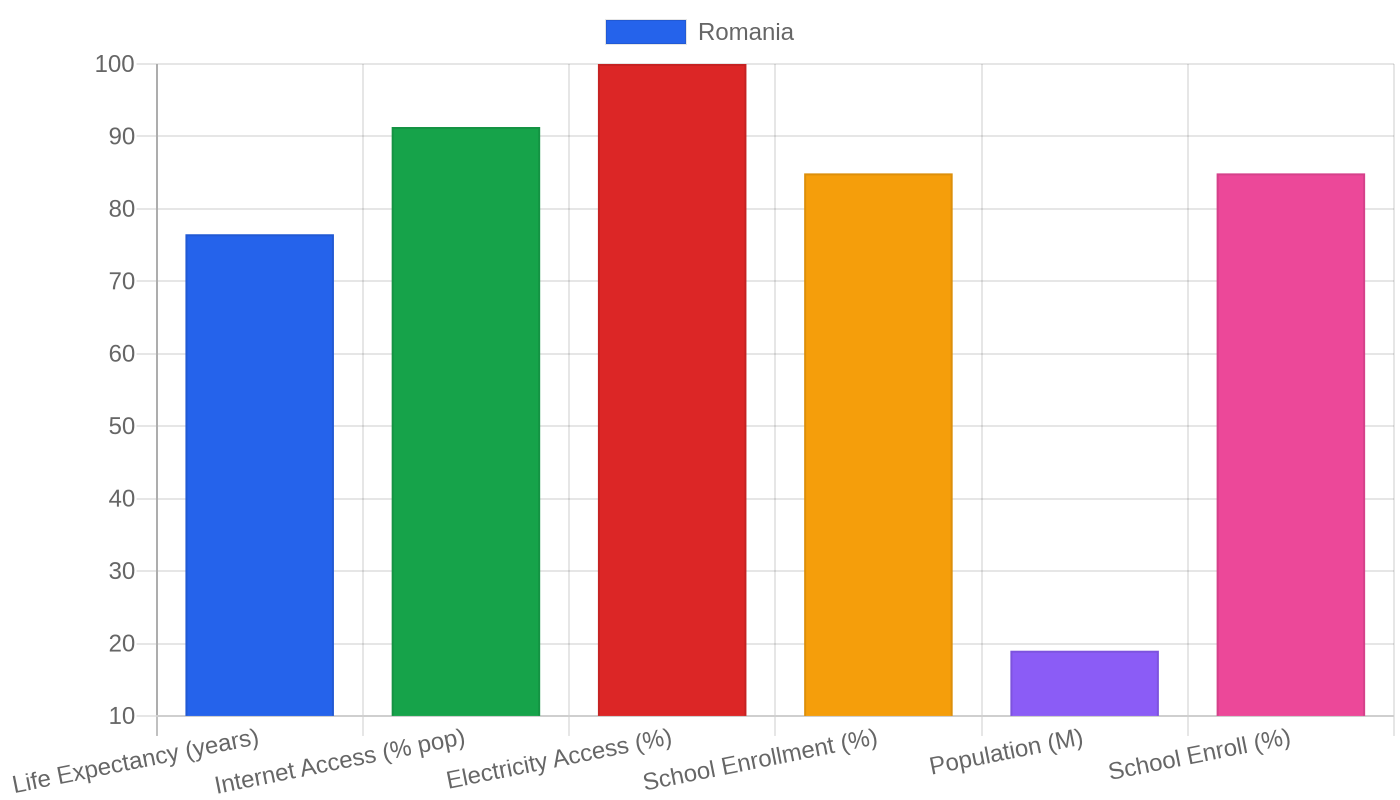
Romania’s total GDP stands at roughly $428.7 billion, making it a mid-sized European economy. But the per capita story is more revealing. On a purchasing power parity basis, the average Romanian generates over $50,800 in economic output annually. That is a respectable figure that places the country ahead of several EU peers, but it masks deep regional disparities.
Bucharest and a handful of western cities like Cluj-Napoca and Timișoara drive the bulk of this output, while rural areas and the country’s east lag far behind. The unemployment data is not available from the World Bank, but the broader picture suggests that the labor market remains tight — a paradox when growth is so weak. Employers cannot find enough skilled workers, yet the economy is not creating enough new jobs to absorb those on the margins.
The main industries driving this economy are not explicitly listed in the data, but the top companies provide strong clues. Automobile Dacia, the Romanian carmaker owned by Renault, is a massive exporter and a bellwether for the manufacturing sector. Banca Comercială Română and Banca Transilvania dominate the financial landscape, while Bitdefender represents a rare success story in homegrown technology.
This industrial mix is heavily weighted toward consumer goods, financial services, and automotive production — sectors that are all highly sensitive to the European business cycle. When Germany sneezes, Romania catches a cold, and right now, the eurozone is barely breathing.
The Cost of Living Squeeze — When Inflation Outpaces Wages
With inflation running at 7.19%, the cost of living in Romania has become a daily source of anxiety for millions of households. The World Bank data does not break down housing costs or grocery prices, but the headline inflation figure alone tells a grim story.
Food and energy prices have been the primary drivers, as they have been across much of Europe, but Romania’s higher inflation rate suggests that domestic factors — such as a weak currency, supply chain bottlenecks, and strong wage growth in certain sectors — are compounding the problem. Rent in Bucharest has risen sharply over the past two years, though exact figures are not available from the provided data. What is clear is that the gap between wages and prices is widening for most workers.
The homeownership rate in Romania is among the highest in Europe, a legacy of post-communist property privatization. That means fewer households are directly exposed to rising rents, but it also means that many families have tied up their wealth in illiquid assets. For those looking to buy, the combination of high inflation and elevated interest rates has made mortgages prohibitively expensive for first-time buyers.
The rental market in major cities is increasingly competitive, with young professionals and students competing for a limited supply of modern apartments. Compared to regional averages, Romania’s cost of living remains lower than in Hungary or Poland, but the gap is closing fast — and wages have not kept pace.
Daily expenses like groceries, utilities, and transportation have all risen noticeably. The 7.19% inflation figure is not an abstract number; it translates into higher prices at the supermarket checkout, larger electricity bills, and more expensive petrol at the pump. For a country where a significant portion of the population still relies on cash-in-hand work and informal economic activity, the official inflation data may even understate the real pain felt by lower-income households.
The middle class, which expanded rapidly during the boom years of EU accession, is now feeling squeezed from both sides — stagnant real incomes and rising costs.
Investment Landscape — Where the Giants Play
Romania’s corporate landscape is dominated by a mix of financial institutions, consumer goods manufacturers, and a few standout technology firms. The top companies listed in the data include Banca Transilvania and Banca Comercială Română in the financial sector, Automobile Dacia and Arctic S.A. in consumer goods, and Bitdefender in technology.
The presence of Antibiotice Iași in the health care sector is notable, as it signals a domestic pharmaceutical industry that has survived and adapted since the fall of communism. These companies are not just economic actors; they are national champions that shape the business climate and set the tone for corporate governance.
For investors, the most interesting story may be Bitdefender. The cybersecurity firm has grown from a small Romanian startup into a global player with a significant presence in North America and Western Europe. Its success demonstrates that Romania has the talent and the entrepreneurial culture to produce world-class technology companies, even if the broader ecosystem remains underdeveloped.
The financial sector, meanwhile, is well-capitalized and profitable, with Banca Transilvania in particular pursuing an aggressive expansion strategy that has made it the largest bank in the country by assets. Foreign investors have taken note, with Austrian and Greek banking groups maintaining significant stakes in the sector.
The business environment in Romania has improved markedly since EU accession in 2007, but challenges remain. Corruption, though reduced, has not been eliminated. The judicial system can be slow and unpredictable. And the tax regime, while competitive on paper, is subject to frequent changes that make long-term planning difficult.
Still, the country offers advantages that are hard to ignore: a strategic location at the intersection of Central and Eastern Europe, a well-educated workforce, and a domestic market of 19 million people with rising purchasing power. For companies in automotive, IT services, and consumer goods, Romania remains a compelling destination — provided the macroeconomic headwinds do not blow them off course.
Safety, Politics, and the Quality of Life Question
Romania is a unitary semi-presidential representative democratic republic, a system that distributes power between a president elected by popular vote and a prime minister confirmed by parliament. The president serves as head of state, representing the country in international affairs and acting as supreme commander of the armed forces, while the prime minister oversees the executive branch. This structure has provided a degree of political stability, even as governments have come and gone with some frequency.
The active civil society mentioned in the data reflects a population that is increasingly engaged and unwilling to tolerate the kind of authoritarian backsliding seen in neighboring Hungary or Poland.
Crime and safety indices are not available from the provided data, which makes it difficult to offer a precise assessment. However, Romania is generally considered a safe country by European standards. Violent crime is rare in most urban areas, and petty crime like pickpocketing is the primary concern for visitors and residents alike in busy tourist zones.
The bigger quality-of-life issues are more structural: inadequate healthcare infrastructure in rural areas, aging public transport systems outside the capital, and persistent air quality problems in cities like Bucharest and Brașov. These are the kinds of challenges that do not show up in crime statistics but profoundly affect daily life.
Happiness data is also absent from the provided information, but one can infer from the economic figures that the mood is mixed. A GDP per capita above $50,000 suggests that material living standards have improved dramatically since the 1990s. But the 7.19% inflation rate and the near-zero growth rate suggest that the good times have paused, if not reversed. Romanians are resilient — they have to be, given the country’s history — but the current economic climate is testing that resilience.
The political system, for all its flaws, has at least provided a framework for debate and accountability, which is more than many countries in the region can claim.
What’s Happening Now — The 2025 Stagflation Puzzle
The most pressing issue in Romania right now is the disconnect between growth and inflation. The World Bank data shows GDP growth at just 0.68% for 2025, while inflation remains above 7%. This is not a temporary blip; it reflects structural problems that have been building for years. The economy grew rapidly in the decade after EU accession, fueled by EU structural funds, foreign investment, and a construction boom. But that model is running out of steam.
The funds are still flowing, but they are increasingly tied to reforms that the political class has been slow to implement. Foreign investment has cooled as global interest rates have risen and as investors have become more selective about where they deploy capital.
The inflation story is particularly acute. At 7.19%, Romania has one of the highest inflation rates in the European Union. The central bank has raised interest rates aggressively to combat it, but the impact on growth has been exactly what one would expect — demand has cooled, and the economy has stalled. The government faces a difficult choice: continue the tight monetary policy and accept the growth pain, or ease off and risk an inflation spiral that would hurt the poorest households the most.
There is no easy answer, and the political consequences of either choice are significant.
On the business front, the major companies are adapting. Bitdefender continues to expand globally, leveraging Romania’s reputation as a hub for cybersecurity talent. Banca Transilvania is deepening its digital offerings, trying to capture a younger, tech-savvy customer base. Automobile Dacia, meanwhile, is navigating the transition to electric vehicles, a challenge that will define its future.
The government has signaled support for EV manufacturing, but the infrastructure — charging stations, grid upgrades, battery supply chains — is still in its infancy. These are the stories that will determine whether Romania can break out of its current stagnation or whether it will settle into a prolonged period of low growth and high inflation.
The Bottom Line
Romania in 2025 is a country caught between its impressive potential and its stubborn structural challenges. The GDP per capita of over $50,800 (PPP) and the presence of globally competitive companies like Bitdefender and Banca Transilvania show what is possible. But the 0.68% growth rate and the 7.19% inflation rate show what is real. Investors should watch Romania for its long-term promise in technology, automotive, and financial services, but they should be prepared for a bumpy ride in the short term.
Policymakers elsewhere in Europe should study Romania’s experience as a cautionary tale: rapid convergence with the EU is not guaranteed, and the path from upper-middle-income to high-income status is the hardest stretch of all.
Sources & Methodology
This article is authored by Economic Pulse Net for informational and research purposes. Economic Pulse Net sources its data from multilateral institutions, national statistics bureaus, and proprietary databases. All data is believed to be current as of the date of publication.
Published: July 30, 2026 | Category: Research — Romania
Use these signals in your own platform
Economic Pulse publishes its live signal feed through a documented, read-only API. Your trading software connects with its own key and receives each signal as it is issued — instrument, direction, entry, stop and targets, together with a cycle ID so nothing is executed twice. The feed is independent of this website and cannot change it.
Signals are informational only and are not financial advice.