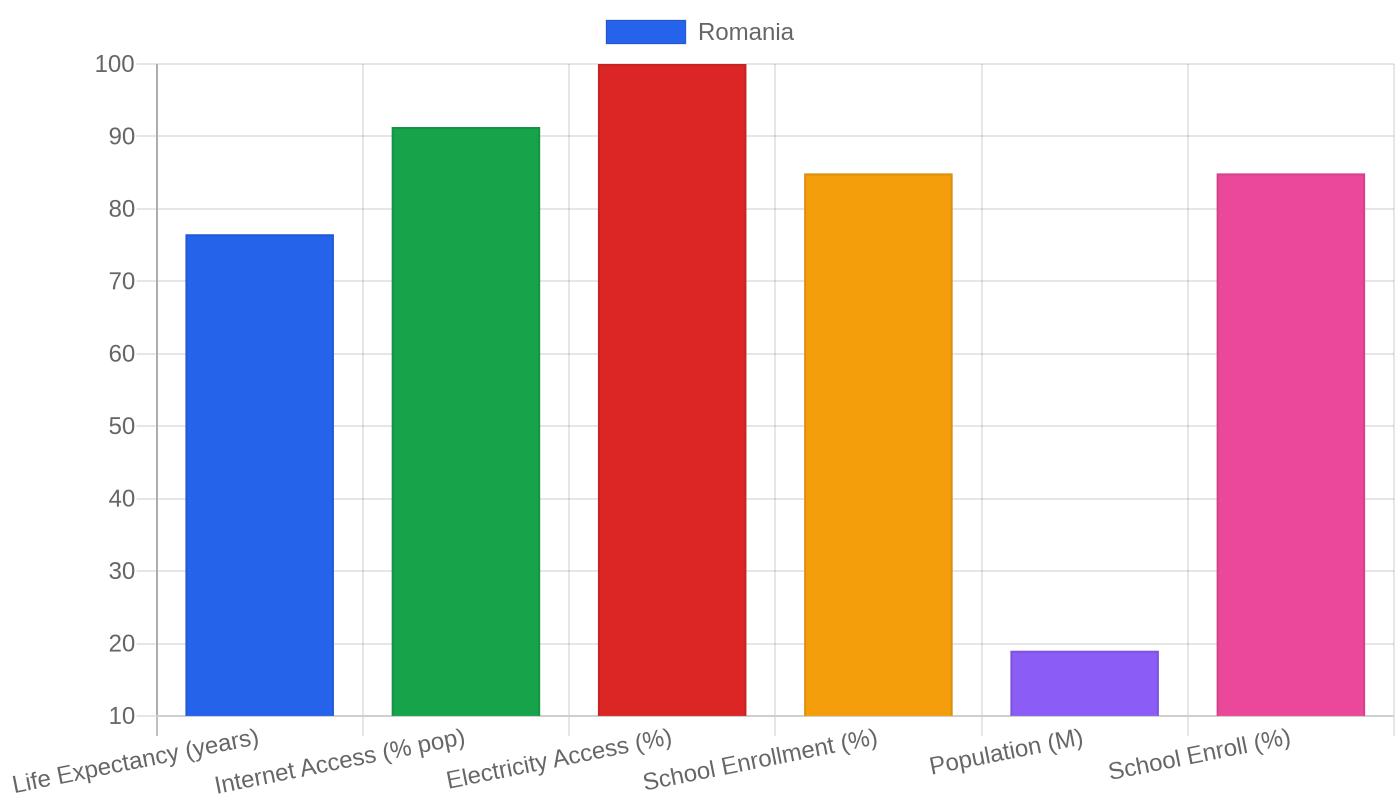
Economic Pulse Net | Sources: World Bank World Development Indicators, Government Sources | 2026
Key Takeaways
– Romania’s GDP growth in 2025 is a mere 0.68%, according to the World Bank, placing it among the slower-growing economies in Central and Eastern Europe this year.
– Inflation remains stubbornly high at 7.19%, more than double the European Central Bank’s target, eroding household purchasing power and complicating monetary policy.
– The economy is heavily anchored in consumer goods and financial services, with household names like Automobile Dacia and Banca Transilvania dominating the corporate landscape.
– Political stability under a semi-presidential system provides a predictable governance framework, but the slow growth and high inflation combination poses a test for policymakers.
– Despite the macroeconomic headwinds, Romania’s GDP per capita PPP stands at nearly $51,000, signalling a middle-income economy with significant domestic consumption potential.
The Great Deceleration — Why 0.68% Growth Matters
Romania’s economy is moving, but barely. According to the World Bank, GDP growth in 2025 registered just 0.68%, a figure that raises eyebrows for a country that has historically posted stronger expansion rates. To put that number in context: an economy growing at less than one percent is an economy that is effectively treading water. Population growth is negligible—the country’s population stands at just over 19 million—so per capita income gains are minimal.
The total GDP of roughly $429 billion places Romania as a mid-tier European economy, but the growth trajectory is worrying.
The inflation picture makes matters worse. With CPI inflation running at 7.19%, as reported by the World Bank, the gap between nominal wage growth and real purchasing power is widening. For ordinary Romanians, this means that even if salaries rise, the cost of everyday goods—food, energy, transport—is rising faster. The central bank is caught in a familiar bind: raise interest rates to tame inflation and risk choking off what little growth exists, or hold steady and watch prices climb.
The 0.68% GDP figure suggests the economy is already fragile. Any aggressive tightening could tip it into contraction.
The structure of Romania’s economy offers clues to the slowdown. The country’s main industries, while not exhaustively listed in the data, are heavily weighted toward consumer goods and services. Automobile Dacia, the iconic carmaker, is a bellwether for manufacturing. When European demand softens—as it has amid Germany’s industrial slowdown—Dacia feels the pinch. Similarly, consumer-facing companies like Angst and Apulum depend on domestic spending, which is being squeezed by inflation.
The financial sector, anchored by Banca Comercială Română and Banca Transilvania, is profitable but cautious, lending less aggressively in an uncertain environment.
The Cost of Living Squeeze — Rents, Bread, and the 7% Tax on Everything
For the average Romanian household, 2025 is a year of recalibration. With inflation at 7.19%, according to the World Bank, the cost of living is rising at a pace that outstrips wage growth in many sectors. Housing costs are a particular pressure point. While specific rental data is not available in the provided figures, regional context is instructive. Across Central and Eastern Europe, housing affordability has deteriorated sharply since the post-pandemic recovery, and Romania is no exception.
In Bucharest, rents for a one-bedroom apartment in a decent neighbourhood have climbed steadily, pushing younger workers into shared accommodation or longer commutes.
The decision between renting and buying has become more fraught. Mortgage rates, while not explicitly stated in the data, are likely elevated given the high inflation environment. Banks like Banca Transilvania and Banca Comercială Română are offering loans, but at terms that reflect the central bank’s fight against inflation. For those who already own property, the situation is less dire—existing homeowners benefit from rising asset values—but first-time buyers face a daunting barrier to entry.
Daily expenses, from groceries to utilities, are absorbing a larger share of disposable income. The consumer goods companies that dominate Romania’s corporate sector—Arctic S.A. in home appliances, Apulum in food products—are passing on higher costs to customers, creating a feedback loop of rising prices and cautious spending.
Where the Money Is — Romania’s Corporate Powerhouses and Investment Climate
Romania’s corporate landscape is a study in contrasts. On one hand, you have global-facing technology firms like Bitdefender, the cybersecurity giant that has carved out a reputation far beyond the country’s borders. Bitdefender represents the kind of high-value, export-oriented business that policymakers dream of replicating. On the other hand, the economy remains anchored by consumer staples and financial services.
Automobile Dacia, a subsidiary of Renault, is the manufacturing flagship, producing affordable cars for European markets. Its performance is a proxy for Romania’s industrial health.
The financial sector is dominated by two major players: Banca Comercială Română and Banca Transilvania. Both are deeply integrated into the daily life of Romanian businesses and households. Their lending decisions, deposit rates, and risk appetites shape the broader investment climate. For foreign investors looking at Romania, these banks are the gatekeepers.
The presence of Antibiotice Iași in the health care sector points to a pharmaceutical industry with domestic production capacity, a strategic asset in a world increasingly focused on supply chain resilience.
The business environment, while not quantified in the data, benefits from Romania’s political stability. The country is a unitary semi-presidential representative democratic republic, with a clear separation of powers. The President handles international affairs and constitutional oversight, while the Prime Minister runs the executive branch. This structure provides predictability, which investors value. However, the slow growth and high inflation combination is a deterrent.
Companies considering expansion in Romania are weighing the country’s competitive labour costs and EU market access against the reality of a stagnating domestic economy.
Safety, Politics, and the Quality of Life Question
Romania’s political landscape is stable but not without its tensions. As a unitary semi-presidential representative democratic republic, the country has a structured system of governance and an active civil society, according to the data. The President, elected by popular vote, serves as head of state and supreme commander of the armed forces. The Prime Minister, appointed by the President and confirmed by Parliament, runs the government day-to-day.
This dual-executive system has served Romania well through multiple transitions, but it requires a degree of cooperation between the presidency and parliament that is not always guaranteed.
On safety, specific crime and safety indices are not provided in the data, which limits a quantitative assessment. However, Romania is generally considered one of the safer countries in Eastern Europe for both residents and visitors. Petty crime exists in urban centres, as it does everywhere, but violent crime rates are low.
The quality of life, measured by metrics like GDP per capita PPP at nearly $51,000 from the World Bank, suggests that Romanians enjoy a standard of living that is respectable by regional standards. That figure, however, masks significant disparities between Bucharest and rural areas, between the young and the elderly, and between those with property and those renting in an inflationary environment.
The 2025 Reality Check — Stagflation Lite
This is the moment that defines Romania’s near-term trajectory. The World Bank data for 2025 paints a picture that economists call “stagflation lite”: growth so slow it is barely perceptible, combined with inflation that is punishing consumers. The 0.68% GDP growth figure is not a recession, but it is dangerously close to stagnation. The 7.19% inflation rate is not hyperinflation, but it is high enough to force difficult choices on households and policymakers alike.
What is happening right now is a test of Romania’s economic resilience. The consumer goods sector, led by companies like Arctic S.A. and Angst, is facing margin pressure as input costs rise and consumers tighten belts. Automobile Dacia is navigating a European auto market that is itself in transition, with electric vehicle adoption creating both opportunities and existential questions for legacy manufacturers.
The financial sector, through Banca Transilvania and Banca Comercială Română, is managing credit risk carefully, aware that a prolonged period of high inflation could lead to a wave of non-performing loans.
Politically, the government is under pressure to act. The semi-presidential system allows for decisive policy, but any measures to stimulate growth—tax cuts, subsidies, public investment—risk adding fuel to the inflation fire. The active civil society mentioned in the data is watching closely. Protests over the cost of living have already occurred in other European capitals; Romania is not immune.
The coming months will reveal whether the government can navigate this narrow corridor between stagnation and inflation without crashing into either ditch.
The Bottom Line
Romania in 2025 is an economy caught between forces it cannot easily reconcile. The 0.68% growth rate and 7.19% inflation, both from the World Bank, create a challenging environment for businesses, households, and policymakers. Investors with a long-term horizon should watch Romania for its strategic position within the EU and its competitive corporate sector, particularly in technology and manufacturing. But the short-term picture is one of caution.
Anyone considering exposure to Romania—whether through equity, real estate, or business expansion—needs to price in the inflation risk and the very real possibility that growth remains anemic for the foreseeable future.
Sources & Methodology
This article is authored by Economic Pulse Net for informational and research purposes. Economic Pulse Net sources its data from multilateral institutions, national statistics bureaus, and proprietary databases. All data is believed to be current as of the date of publication.
Published: July 30, 2026 | Category: Research — Romania
Use these signals in your own platform
Economic Pulse publishes its live signal feed through a documented, read-only API. Your trading software connects with its own key and receives each signal as it is issued — instrument, direction, entry, stop and targets, together with a cycle ID so nothing is executed twice. The feed is independent of this website and cannot change it.
Signals are informational only and are not financial advice.